Hello! Welcome to your next lesson on risk assessment.
In our previous lesson, we established the overall process for identifying and assessing the Risk of Material Misstatement (RoMM) as laid out in SA 315. We saw that this involves understanding the entity and its internal controls, and that risks can manifest at either the pervasive financial statement level or the specific assertion level.
Today, we'll sharpen that understanding by focusing on a crucial distinction that underpins the entire risk-based audit approach. Our learning outcome is to distinguish between business risks and risks of material misstatement at the financial statement and assertion levels.
Mastering this distinction is key to moving beyond a "checklist" mentality. It helps you understand the why behind your audit procedures, a perspective that is essential for your CA Final exams and for developing strong professional judgment.
1. The Big Picture: From Business Risk to Audit Risk
An audit doesn't happen in a vacuum. A company operates in a dynamic environment, facing threats and opportunities. These create Business Risks. As auditors, our primary concern is how these business risks might filter down and create a Risk of Material Misstatement (RoMM) in the financial statements.
This flowchart provides an excellent high-level view of this relationship.
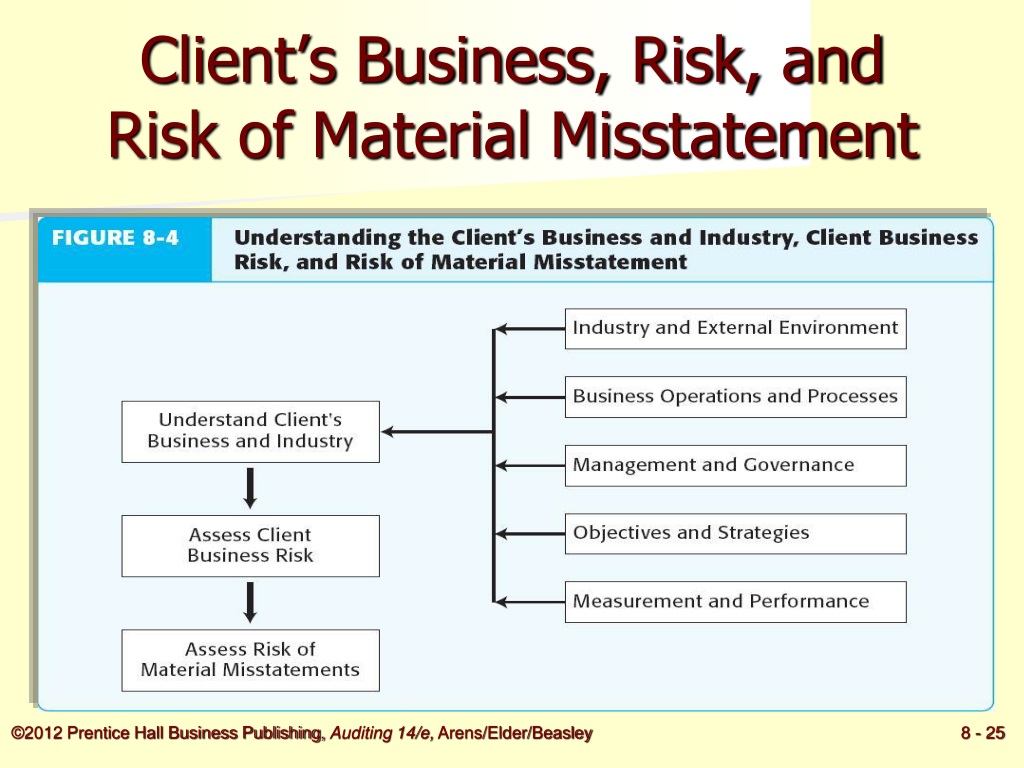
As you can see, the auditor's process starts broad (understanding the business) and progressively narrows its focus to the specific risks that could affect the financial statements.
Let's define these two types of risk more precisely.
What is Business Risk?
Business Risk is a broad concept. It refers to any risk that could prevent a company from achieving its objectives, such as profitability, market leadership, or operational efficiency. These risks are the concern of management every single day.
To get the formal definition and see common examples, please review the following excerpt.
IDENTIFYING AND RESPONDING TO THE RISK OF MATERIAL MISSTATEMENT
This resource provides the formal definition of 'Business risk' as per auditing standards and a helpful list of common sources from which such risks arise.
Please read the section titled 'The entity’s risk assessment process' on page 48. Focus on the formal definition of 'Business risk' and the list of examples that follows, such as 'Changes in operating environment', 'New technology', and 'New accounting pronouncements'.
In essence, business risk is the company's problem. For example:
- A new technology could make its main product obsolete.
- A major new competitor could enter the market.
- Changes in environmental regulations could significantly increase its operating costs.
The Connection to Risk of Material Misstatement (RoMM)
Risk of Material Misstatement (RoMM) is the auditor's concern. It's the risk that the financial statements are materially misstated before the audit begins.
The crucial link is this: RoMM is often a consequence of business risk, but not all business risks lead to RoMM.
-
Scenario 1: Business Risk leads to RoMM.
- Business Risk: A company is in a declining industry and faces intense pressure to meet revenue targets set by analysts.
- Potential RoMM: This pressure might tempt management to record fictitious sales at year-end to meet those targets. This creates a high risk of material misstatement for the occurrence assertion of revenue.
-
Scenario 2: Business Risk does NOT lead to RoMM.
- Business Risk: A company's key raw material supplier unexpectedly goes bankrupt, disrupting its production line.
- Potential Outcome: Management quickly finds an alternative supplier. While this was a serious operational issue (a business risk), if the financial impact (e.g., slightly higher costs) is properly accounted for and disclosed, there may be no material misstatement in the financial statements.
Your job as an auditor is to identify the business risks that have financial statement implications.
2. The Two Levels of Misstatement Risk
As we discussed in our last lesson, once you identify a potential RoMM, SA 315 requires you to assess it at two levels. This is a critical step because the level of risk dictates the type of audit response needed.
Let's quickly refresh this concept.
4 | CA FINAL AUDIT REVISION SERIES|Risk assessment, internal control &materiality| CA Mahamood Shaik
This short video segment provides clear, practical examples that perfectly illustrate the difference between risks at the financial statement level and those at the assertion level.
Please watch from 19:45 to 23:33. Pay close attention to the two examples provided: An incompetent accountant (a financial statement level risk because it's pervasive and can cause errors anywhere). Lack of security in a warehouse (an assertion level risk because it specifically affects the existence and valuation of inventory).
-
Financial Statement Level Risks: These are pervasive. They relate to the financial statements as a whole and can affect many assertions. Think of them as issues with the overall "control consciousness" or integrity of the entity.
- Example: Management has a reputation for being overly aggressive and overriding controls to achieve bonus targets. This risk isn't confined to one account; it threatens the integrity of the entire set of financial statements.
-
Assertion Level Risks: These are specific. They relate to individual classes of transactions, account balances, or disclosures.
- Example: The company uses a complex formula to calculate the warranty provision. There is a high risk of misstatement related to the valuation assertion for the warranty liability account.
Understanding this distinction is not just academic. A financial statement level risk (like a weak control environment) requires a broad, overall response from the auditor. An assertion level risk (like inventory valuation) requires specific, targeted procedures.
3. Application: Tying It All Together
Let's apply these concepts to a practical, exam-style scenario. This will help you see how to connect business circumstances to specific audit risks, a skill vital for the CA Final exam.
Scenario:
You have been appointed as the auditor of an NGO working in the field of "upholding democracy."
- Last year's accounts were unaudited, and activities were small-scale.
- This year, the NGO received substantial donations, including foreign funds via the FCRA route. It also uses crowdfunding.
- The government has new powers to cancel FCRA certificates.
- Given its work in a sensitive political and social field, there are many public accusations against the NGO.
Before reading the solution, take a moment to think:
- What are the major business risks for this NGO? (Think about its objectives, funding, and regulatory environment).
- How might these business risks translate into Risks of Material Misstatement (RoMM)?
- Are these RoMMs at the financial statement level or assertion level?
Now, let's see how the ICAI material approaches this. The following reading contains both the question and a detailed model answer.
MATERIALITY, RISK ASSESSMENT AND INTERNAL CONTROL - CA
This exercise from the ICAI study material is an excellent example of how to break down a complex scenario into specific audit risks. It will help you structure your answers with the technical precision required for the exam.
First, find 'Test Your Understanding 2' on page 4.18 and read the scenario about the NGO. Next, go to page 4.63 and read the solution for question 2. Notice how it deconstructs the problem by discussing: Inherent Risk: Citing the political field, foreign funds (FCRA), and unaudited opening balances. Control Risk: Noting that rapid growth in donations means formal controls may be lacking. Detection Risk: Mentioning that as a first-time audit, the auditor's own understanding may be incomplete. This structure is a great template for your exam answers.
This example perfectly demonstrates the thought process: the NGO's business risk of non-compliance with FCRA or misuse of funds (due to weak controls after rapid growth) directly creates a high inherent and control risk (the two components of RoMM) for the auditor.
Conclusion
Today, we've drilled down into the anatomy of audit risk. You now have a clear framework for distinguishing between the risks a business faces in its daily operations and the specific risks of misstatement that are the auditor's primary focus.
Key Takeaways:
- Business Risk relates to the entity's ability to achieve its objectives. It's a broad concept managed by the entity.
- Risk of Material Misstatement (RoMM) is the risk that financial statements are incorrect. It is the auditor's focus and is often a consequence of unmitigated business risks.
- The auditor's process is to understand the entity's business risks to identify potential RoMM.
- RoMM must be assessed at two levels: the pervasive Financial Statement Level (requiring an overall audit response) and the specific Assertion Level (requiring targeted audit procedures).
Preview of the Next Lesson
We have now established how to identify and categorize risks. A huge part of this assessment, as we've seen, hinges on the quality of the company's internal controls. In our next lesson, we will do a deep dive into the significance of understanding the entity's internal control components. We will break down each of the five components prescribed by SA 315 in greater detail to understand how they function and how an auditor evaluates them.