Hello! Welcome to your lesson on risk assessment.
In our last session, we discussed SA 320 and established how auditors determine what is "material" or important enough to influence a user's decisions. Now that we know how to define what's important, the next logical question is: where are the most likely places for material errors or fraud to occur?
This brings us directly to SA 315, "Identifying and Assessing the Risks of Material Misstatement." Today's learning outcome is to describe the process of identifying and assessing the risks of material misstatement by understanding the entity and its environment, including its internal controls.
This standard forms the very foundation of a modern, risk-based audit. It moves us away from a check-everything approach to a smarter, more focused one. For your CA Final exams, a strong conceptual grasp of SA 315 is critical, as it dictates the entire audit strategy. We'll connect the formal requirements of the standard to the practical steps you've likely seen during your articleship.
1. The Risk-Based Audit Approach
Before diving into the details, let's frame our discussion. Modern auditing is not about giving equal attention to every single account. It's about focusing your efforts on the areas where the risk of material misstatement (RoMM) is highest. This is the essence of a risk-based audit.
Think about two ways to audit a company:
- Approach 1 (Traditional): You have 100 hours. You spend 25 hours on assets, 25 on liabilities, 25 on income, and 25 on expenses, regardless of the company's specifics.
- Approach 2 (Risk-Based): You first study the company and find that inventory valuation is complex and the sales process has weak controls, while expenses are straightforward. You might then decide to spend 40 hours on inventory and sales, and only 10 on expenses.
Clearly, the second approach is more effective and efficient. SA 315 provides the framework for implementing this intelligent approach. The first step in this process is to perform Risk Assessment Procedures (RAPs).
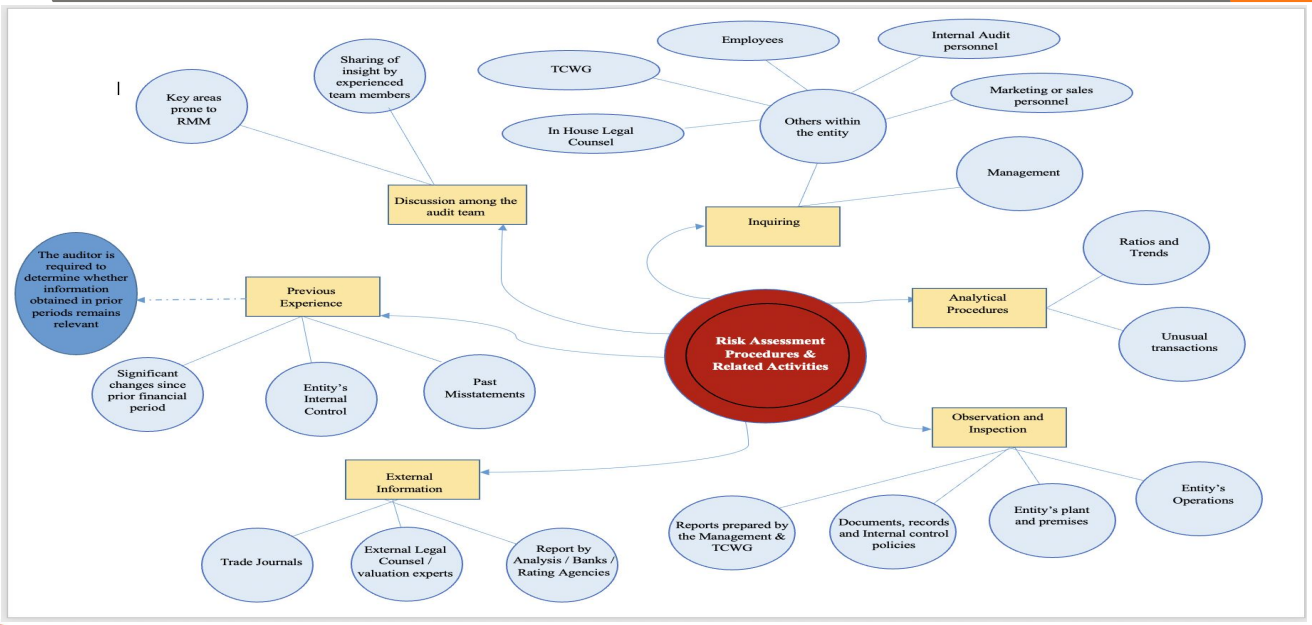
These are the activities you perform to gain an understanding of the entity. You've done these throughout your articleship. They primarily include:
- Inquiry: Asking questions of management, finance staff, and other employees.
- Analytical Procedures: Analyzing trends and relationships in financial and non-financial data to spot unusual fluctuations.
- Observation: Watching processes or procedures being performed by others (e.g., observing an inventory count).
- Inspection: Examining documents, records, and tangible assets.
This mind map provides a great overview of the various procedures and sources of information an auditor uses.
2. The Core of the Process: Understanding the Entity
To assess risk, you must first understand the business. SA 315 requires the auditor to obtain an understanding of the entity and its environment, its applicable financial reporting framework, and—crucially—its system of internal control.
What is Audit Risk?
Let's clarify what we mean by "risk." Audit Risk is the risk that the auditor expresses an inappropriate opinion (e.g., giving a clean report when there's a material misstatement). It has two main components:
- Risk of Material Misstatement (RoMM): The risk that the financial statements are materially misstated before the audit begins. This risk exists within the company itself and is made up of:
- Inherent Risk: The susceptibility of an assertion to misstatement, assuming there are no controls. For example, the valuation of complex financial instruments is inherently riskier than the valuation of cash.
- Control Risk: The risk that the company's own internal controls will fail to prevent or detect and correct a misstatement.
- Detection Risk: The risk that the auditor's own procedures will fail to detect a material misstatement that exists.
The auditor cannot change inherent or control risk—those belong to the client. The auditor's job is to assess RoMM and then manage detection risk by performing more or better audit procedures in high-risk areas.
The following video provides a clear explanation of audit risk and its components.
4 | CA FINAL AUDIT REVISION SERIES|Risk assessment, internal control &materiality| CA Mahamood Shaik
To start, let's get our definitions straight. This segment from CA Mahamood Shaik clearly defines Audit Risk and breaks it down into its components: Risk of Material Misstatement (Inherent and Control Risk) and Detection Risk.
Watch from 01:44 to 19:06. Focus on the definition of each risk component and the inverse relationship between the assessed Risk of Material Misstatement and Detection Risk.
3. Understanding the System of Internal Control
A significant part of understanding the entity is understanding its system of internal control. This is a topic you've encountered extensively, but SA 315 provides a specific structure for the auditor's understanding.
Internal Control is the process designed, implemented, and maintained by management to provide reasonable assurance about achieving the entity's objectives related to:
- Reliability of financial reporting.
- Effectiveness and efficiency of operations.
- Safeguarding of assets.
- Compliance with laws and regulations.
Inherent Limitations of Internal Control
It's important to remember that internal controls can only provide reasonable, not absolute, assurance. Why? Because of inherent limitations, such as:
- The possibility of human error.
- Controls being circumvented by collusion between employees.
- Management overriding a control.
- The cost of a control outweighing its benefit.
- Controls being designed for routine transactions, not unusual ones.
The Five Components of Internal Control
SA 315 requires the auditor to understand five specific components of the entity's internal control system. Understanding this framework is essential for your exams.
4 | CA FINAL AUDIT REVISION SERIES|Risk assessment, internal control &materiality| CA Mahamood Shaik
This video by CA Mahamood Shaik provides a comprehensive walkthrough of the five components of internal control. It will give you the detailed, structured knowledge required to answer exam questions on this topic.
Please watch the segment from 1:01:06 to 1:15:53. Pay close attention to the explanation of each of the five components: Control Environment: The 'tone at the top'—management's attitude and commitment to integrity and ethical values. Entity's Risk Assessment Process: How the entity itself identifies and responds to its own business risks. Control Activities: The actual policies and procedures (e.g., segregation of duties, authorizations, reconciliations). Information System and Communication: The systems used to capture and report information, and how control-related responsibilities are communicated. Monitoring of Controls: Management's process for assessing whether controls are operating effectively over time.
This structured approach ensures the auditor considers the entire ecosystem of control within the entity, not just isolated policies.
4. Identifying and Assessing the Risks
After gaining an understanding of the entity and its controls, the auditor is ready for the main event: identifying and assessing the risks of material misstatement.
Two Levels of Risk
Risks can manifest at two levels:
- Financial Statement Level: These are risks that are pervasive and could affect many assertions across the financial statements. For example, a weak control environment or an incompetent CFO could lead to errors everywhere. This is often called a 'pervasive' risk.
- Assertion Level: These are risks that relate to specific classes of transactions, account balances, or disclosures. For example, a lack of security at a warehouse creates a risk for the existence and valuation assertions for inventory, but it likely doesn't affect accounts payable.
The video below gives clear examples that will help you distinguish between these two levels.
4 | CA FINAL AUDIT REVISION SERIES|Risk assessment, internal control &materiality| CA Mahamood Shaik
Let's return to CA Mahamood Shaik's video for a concise explanation of the two levels at which risk is assessed.
Watch from 19:06 to 23:22. Focus on the examples he provides to differentiate between a risk at the financial statement level (pervasive) and a risk at the assertion level (specific).
The Assessment Process: A Practical Walkthrough
So, how does an auditor actually do this? It's an iterative process of connecting risks to controls and assertions.
SA 315 Revision | CA Final Audit | CA Shubham Keswani (AIR 8)
CA Shubham Keswani provides an excellent, practical example of the auditor's thought process when assessing risk. This will help you see how all the pieces we've discussed fit together.
Watch the segment from 19:23 to 23:36. He uses a simple example of buying an iPad to illustrate the four key activities in risk assessment: Identify risks (e.g., risk of paying a higher price). Relate the risk to what can go wrong and consider the relevant controls (e.g., getting multiple quotations). Assess the risk at the assertion level. Consider the likelihood and magnitude of a potential misstatement.
Significant Risks
Some risks are so important that they require special audit consideration. SA 315 calls these significant risks. These are typically risks that are high on the spectrum of inherent risk. Examples include:
- Risk of fraud.
- Risks related to significant economic or accounting developments.
- Complex transactions.
- Significant transactions with related parties.
- Transactions involving a high degree of subjectivity or estimation uncertainty.
Identifying a risk as 'significant' has direct implications for the audit response, which we will cover in our next lesson on SA 330.
Conclusion
In this lesson, we have unpacked the process of identifying and assessing risks as prescribed by SA 315. We've seen that it's a systematic process that forms the backbone of a risk-based audit, directing the auditor's attention to where it matters most.
Key Takeaways:
- SA 315 provides the framework for a risk-based audit, focusing efforts on high-risk areas.
- The process begins with performing Risk Assessment Procedures (inquiry, inspection, observation, analytical procedures) to understand the entity.
- A core part of this understanding involves evaluating the entity's five components of internal control: Control Environment, Risk Assessment, Control Activities, Information & Communication, and Monitoring.
- Internal controls have inherent limitations, meaning they only provide reasonable, not absolute, assurance.
- Based on this understanding, the auditor identifies and assesses risks of material misstatement (RoMM) at two levels: the pervasive financial statement level and the specific assertion level.
- Risks that require special audit consideration are identified as significant risks.
Preview of the Next Lesson
We have now planned the audit (SA 300), determined what is material (SA 320), and identified and assessed the risks of material misstatement (SA 315). The next logical step is to decide what to do about those risks. In our next lesson, we will explore SA 330, "The Auditor's Responses to Assessed Risks," to learn how we design overall responses and further audit procedures to address the risks we've just identified.