In our last lesson, we established a solid foundation by reviewing the movement of every piece on the board. Now, we will build upon that knowledge to learn one of the most important and unique moves in chess. Your ambition to master the game requires a deep understanding not just of rules, but of strategic concepts, and today's topic brilliantly combines both.
This lesson focuses on a special move that accomplishes two critical goals simultaneously: securing your king and bringing a powerful piece into the game. We will learn how to execute castling correctly (kingside and queenside) and identify when it is legal. Mastering this move is a fundamental step away from novice play and toward structured, strategic thinking.
The What and Why of Castling
Castling is a special move involving the king and one of its rooks. It is the only time in the game you can move two of your own pieces in a single turn, and the only time the king can move more than one square.
Strategically, castling achieves two vital objectives:
- King Safety: It moves the king away from the center of the board, where it is often most vulnerable in the opening, and tucks it into a corner, usually behind a shield of pawns.
- Rook Activation: It moves a rook out from its starting corner and toward the center files, allowing it to participate in the battle more quickly. This is often described as "connecting the rooks."
This dual-purpose makes castling a cornerstone of opening strategy, a topic we will explore in depth in a later module. For now, let's focus on the mechanics.
How to Castle: Kingside and Queenside
There are two forms of castling, determined by which rook you choose.
-
Kingside Castling: This involves the king and the rook on the h-file (the rook closer to the king). The king moves two squares towards the rook (from e1 to g1 for White, or e8 to g8 for Black), and the rook jumps over the king to the adjacent square (from h1 to f1 for White, or h8 to f8 for Black). This is also called "castling short" and is notated as 0-0.
-
Queenside Castling: This involves the king and the rook on the a-file (the rook on the queen's side). The king still moves two squares towards the rook (from e1 to c1 for White, or e8 to c8 for Black), and the rook jumps over to the adjacent square (from a1 to d1 for White, or a8 to d8 for Black). This is also called "castling long" and is notated as 0-0-0.
The following cheat sheet provides an excellent visual summary of both moves.
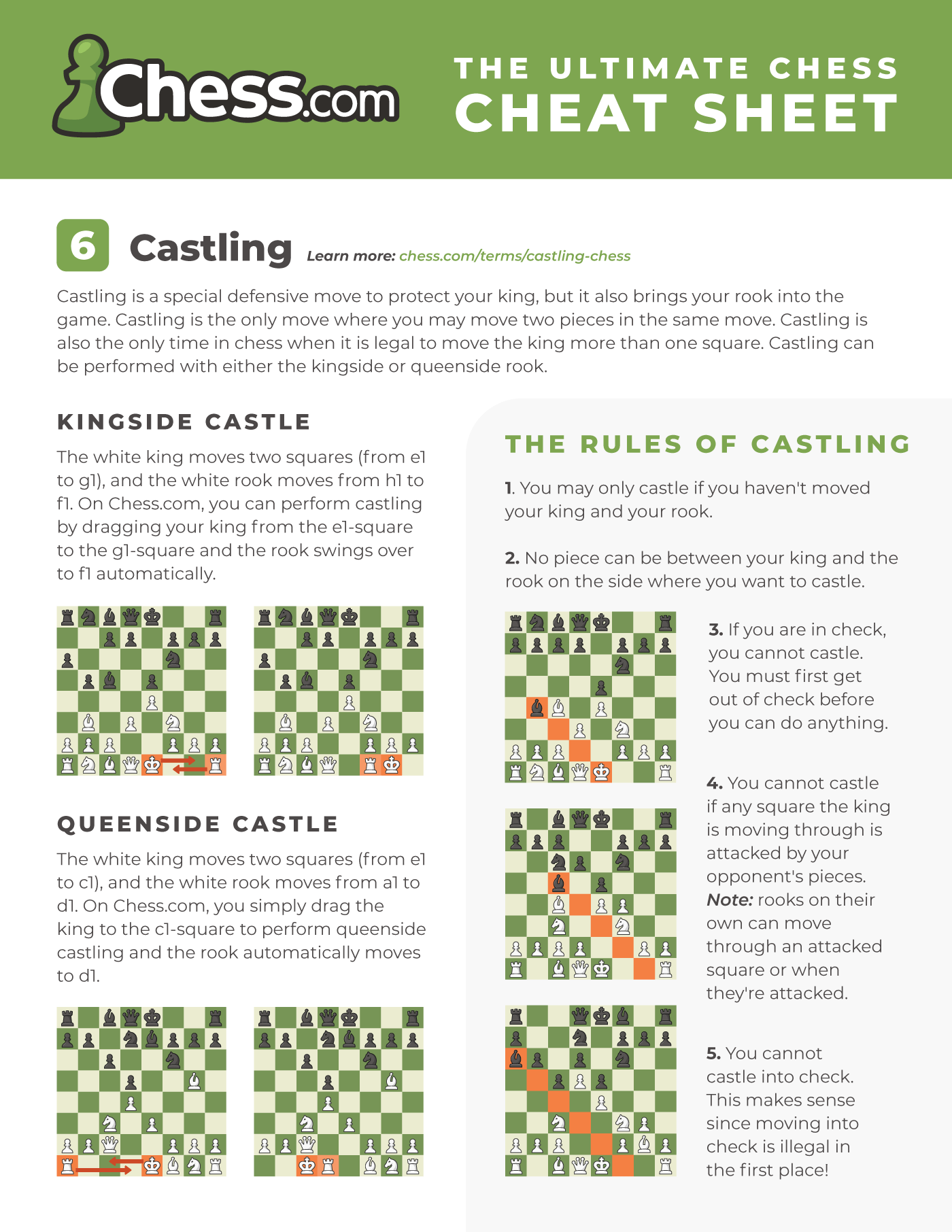
To see the move in action, watch the first part of this instructional video from ChessKid. FunMaster Mike gives a very clear, step-by-step demonstration.
How Do I Castle in Chess? | Castling | ChessKid
This video clearly explains the mechanics of the castling move.
Watch from the beginning up to the explanation of how the king and rook move for both kingside and queenside castling. Note his emphasis that the king always moves two squares, regardless of which side it castles on.
The Five Rules of Castling
Knowing how to move the pieces is only half the battle. A grandmaster's precision comes from knowing exactly when a move is legal. Castling has a specific set of five conditions that must all be met. If even one of these rules is broken, you cannot castle.
- The king must not have moved. If you have moved your king, even one square, and then moved it back, you permanently lose the right to castle for the rest of the game.
- The chosen rook must not have moved. Similarly, if you move your h1-rook, you lose the right to castle kingside. You might still be able to castle queenside if the a1-rook hasn't moved.
- There must be no pieces between the king and the rook. The path must be clear. To castle kingside, the f1 and g1 squares must be empty. For queenside, the d1, c1, and b1 squares must be empty.
- The king may not be in check. If an opponent's piece is attacking your king, you cannot castle to escape. You must deal with the check first using another move.
- The king cannot pass through or land on a square that is attacked by an enemy piece. This is the trickiest rule for many players.
- You can't castle through check: For kingside castling, the king moves from e1 to g1, passing through f1. If an enemy piece attacks f1, you cannot castle kingside.
- You can't castle into check: The destination square (g1 for kingside, c1 for queenside) cannot be under attack.
A simple way to remember the check-related rules is: You cannot castle out of, through, or into check.
This image clearly shows a violation of rule #5.

Let's return to the ChessKid video, which provides excellent visual examples for each of these five rules.
How Do I Castle in Chess? | Castling | ChessKid
This part of the video systematically breaks down the five conditions that make castling illegal.
Watch the segment from "five times in chess where castling may not be allowed". Pay close attention to the examples he provides for each rule, especially the distinction between castling through check and castling into check.
Practice: Test Your Knowledge
True understanding comes from application. The following exercises from the US Chess Federation will test your ability to apply these five rules in various positions. This is precisely the kind of pattern recognition that separates strong players from beginners.
[PDF] CASTLING - US Chess Federation
This worksheet presents several chess puzzles designed to test your understanding of castling legality.
Find "Worksheet 2.1.2 Can I Castle?". Go through each of the eight diagrams. For each one, determine if the indicated player (White or Black) can castle. If they cannot, write down which of the five rules is being broken. For example, is there a piece in the way? Has the king moved? Is the king in check? Or is it attempting to castle through or into check? Try to solve them without moving pieces on a board first, to train your visualization.
Conclusion
In this lesson, we have dissected one of chess's most strategically rich moves. You now understand not only how to perform castling but also the crucial rules governing its legality.
Key Takeaways:
- Castling is a special move involving the king and a rook, performed either kingside (0-0) or queenside (0-0-0).
- Its primary purposes are king safety and rook activation.
- There are five absolute rules for castling:
- The king has not moved.
- The rook has not moved.
- The squares between them are clear.
- The king is not currently in check.
- The king does not pass through or land on an attacked square.
Internalizing these rules until they are second nature is essential. In your games, you should always be looking for the opportunity to castle early to secure your king.
In our next session, we will continue exploring the unique rules of chess by examining another special move, this time involving the pawn: en passant. It is a rare but important capture that every aspiring master must know.