Welcome to your first lesson on the path to chess mastery. Your ambition to reach the highest levels of the game is a fantastic starting point, and every grandmaster began exactly where you are now: by mastering the fundamentals. You mentioned you already know the basics of how the pieces move, so we will use this lesson to conduct a thorough and formal review. Our goal is to ensure your understanding is not just casual, but precise and deeply ingrained. Flawless knowledge of the rules is the bedrock upon which all advanced tactics and strategies are built.
Today, we will achieve the first learning outcome of our course: to identify the movement and capturing rules for each chess piece (king, queen, rook, bishop, knight, and pawn). We will examine each piece's unique characteristics, how it moves, how it captures, and its general role in your army.
The Chess Army and Piece Value
A game of chess is a battle between two armies of 16 pieces each. Each piece has a unique way of moving and a relative value that helps guide decisions during the game. Understanding this value system is an early step in learning how to make "profitable" exchanges, a concept central to winning.
To get a quick but powerful introduction to this idea, let's turn to International Master Levy Rozman, also known as GothamChess.
How To Play Chess: The Ultimate Beginner Guide
Watch this segment from "How To Play Chess: The Ultimate Beginner Guide". Levy provides a concise overview of piece values and the core concept of piece interaction—how they attack, defend, and capture each other.
Focus on two parts. First, the introduction to piece values, where he assigns points to each piece. Then, skip ahead to the section on piece interaction, where he explains how to think about captures in terms of trading these points. This framework is crucial for your goal of making money, or in chess terms, gaining a material advantage.
Here is a summary of the standard point system. The king's value is infinite because losing it means losing the game.
- Pawn: 1 point
- Knight: 3 points
- Bishop: 3 points
- Rook: 5 points
- Queen: 9 points
- King: Priceless / Infinite
With this framework in mind, let's dissect the movement of each piece. This cheat sheet provides an excellent visual summary that you can refer to throughout the lesson.
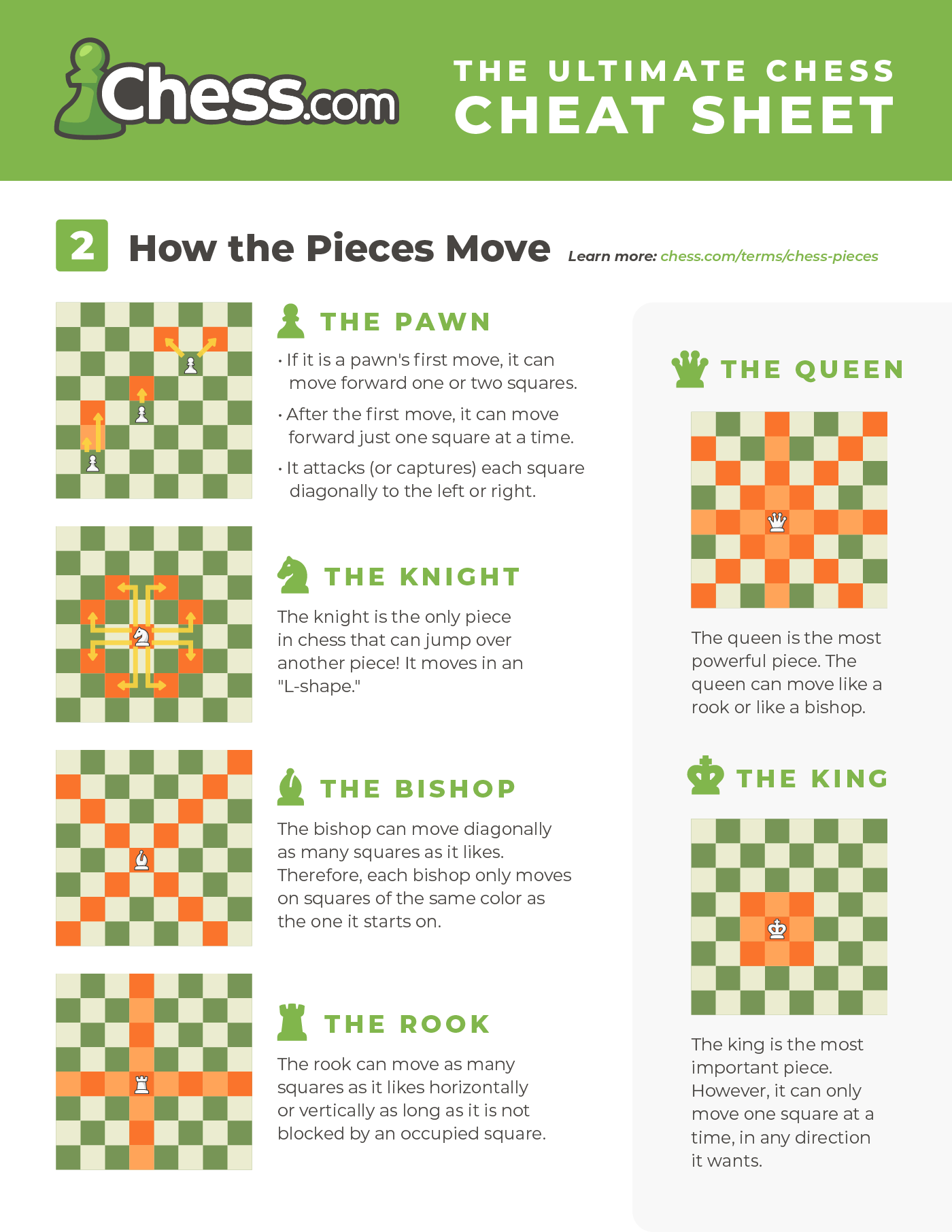
The Long-Range Pieces: Rook and Bishop
The rook and bishop are often called "long-range" pieces because they can move across the entire board in a single turn, provided their path is clear.
The Rook
The rook moves in straight lines—horizontally along the ranks and vertically along the files. It can move any number of squares but cannot jump over other pieces. It captures an enemy piece by moving onto its square.
The Bishop
The bishop moves any number of squares diagonally. A key characteristic of the bishop is that it is restricted to squares of the color it starts on. Each player begins with two bishops: one for the light squares and one for the dark squares. Like the rook, it cannot jump over other pieces.
For a detailed breakdown of these rules, please read the following sections from the "Chess Rules" guide.
Chess Rules: Simple Guide With Illustrations And Videos
This guide provides clear, text-based rules for each piece. We'll use it to formally define the movement of the rook and bishop.
First, find the section "How the Rook (Castle) Moves." Read from the beginning of this section down to the sentence ending here. Pay attention to the examples of how other pieces can block the rook's path. Next, read the section "How the Bishop Moves." Focus on the description of its movement and color restriction.
The Royalty: Queen and King
These are the two most important pieces in your army, for very different reasons.
The Queen
The queen is the most powerful piece in chess. Her movement combines the powers of both the rook and the bishop. This means she can move any number of unobstructed squares horizontally, vertically, or diagonally. Her immense range and flexibility make her a formidable attacking piece.
The King
The king is the most important piece. The entire objective of chess is to trap the opponent's king. The king is also the slowest piece, able to move only one square in any direction (horizontally, vertically, or diagonally). A king can capture an enemy piece on an adjacent square, but it has a critical restriction: it can never move into a square that is attacked by an opponent's piece.
Let's return to the "Chess Rules" guide to formalize these definitions.
Chess Rules: Simple Guide With Illustrations And Videos
This reading covers the queen's powerful abilities and the king's crucial, life-preserving movement rules.
First, find and read the section titled "How the Queen Moves in Chess". Then, skip back to the section "How the King Moves" and read the three conditions for a legal king move.
The Specialists: Knight and Pawn
The knight and pawn have the most unique and peculiar rules in chess. Mastering their movement is a sign of a developing player.
The Knight
The knight's movement is unique: it moves in an 'L' shape. This can be visualized as moving two squares in one direction (horizontal or vertical) and then one square perpendicularly. The knight is the only piece that can jump over other pieces, friend or foe. This makes it extremely tricky and valuable in crowded positions. A simple way to check a knight's move is that it always lands on a square of the opposite color from which it started.
The Pawn
The pawn may seem weak, but it possesses the "soul of chess." Its rules are the most complex:
- Movement: Pawns only move forward. From its starting square, a pawn has the option to move one or two squares forward. After it has moved, it can only advance one square at a time.
- Capturing: Pawns capture differently than they move. A pawn captures one square diagonally forward. It cannot capture a piece directly in front of it.
- Special Rules: Pawns have two special rules—promotion and en passant—which are so important that we will dedicate future lessons to them. For now, just know that a pawn that reaches the far side of the board is promoted to a more powerful piece (usually a queen).
To see these pieces in action, we'll watch two short video clips.
01 - Piece Movement (How to move the Chess Pieces?) | Chess
The "Coach Dat" video offers a very clear and methodical explanation of the knight's jump and the pawn's distinct movement versus capture.
First, watch the explanation of the knight's L-shaped move. Pay close attention to how it counts "one, two, slide to the side." Then, watch the demonstration of the knight jumping over pieces and capturing. Next, watch the segment on the pawn. Focus on the difference between its forward move and its diagonal capture, and the concept of a pawn being "blocked."
Practice Your Moves
Theory is essential, but mastery comes from practice. The following interactive exercises will allow you to move each piece on the board, helping to solidify your understanding.
This Lichess tutorial provides simple, interactive puzzles to practice moving each piece.
Go to the "Chess pieces" section. Click on and complete the short exercise for each of the six pieces: The rook, The bishop, The queen, The king, The knight, and The pawn. The goal is to capture all the stars with the piece provided.
Conclusion
In this lesson, we have formally reviewed the foundation of all chess play: the movement and capturing rules for every piece.
Key Takeaways:
- Each piece has a unique movement pattern and a relative point value that informs strategy.
- Rooks move along ranks and files (straight lines).
- Bishops move along diagonals and are restricted to one color.
- The Queen combines the movement of the rook and bishop, making her the most powerful piece.
- The King is the most important piece, moving one square in any direction, but cannot move into danger.
- Knights move in an 'L' shape and are the only pieces that can jump over others.
- Pawns have the most complex rules: they move forward but capture diagonally, with an initial two-square option.
Your journey to becoming a grandmaster requires that these rules become second nature—as effortless as breathing. In our next lesson, we will build directly on this foundation by exploring the first of chess's special moves: castling. You will learn how to execute this unique king-and-rook maneuver and understand the critical strategic reasons for doing so.