Welcome to the next step in our review of chess fundamentals. In our last lesson, we focused on castling, a special move for the king that is central to opening strategy. Today, we turn our attention to another unique rule, one that deals with the most numerous but often underestimated piece on the board: the pawn.
Your goal of achieving chess mastery requires knowing the entire arsenal of moves available to you, including the rare and sometimes misunderstood ones. This lesson will equip you with a full understanding of one such move. We will correctly identify and execute en passant captures. While it may not occur in every game, knowing this rule is a hallmark of a serious player and can occasionally provide a surprising tactical opportunity.
What is En Passant?
The name en passant is French for "in passing." This phrase perfectly describes the nature of the capture. It's a special rule that allows a pawn to capture an adjacent enemy pawn that has just advanced two squares from its starting position, as if it were "passing by."
To understand why this rule exists, we need a brief look at chess history. Originally, pawns could only move one square forward at a time. To speed up the game, the rule was changed to allow a two-square advance on a pawn's first move. However, this created a new problem: a pawn could now "sneak past" an adjacent enemy pawn on the fifth rank without the risk of being captured. The en passant rule was introduced to close this loophole, restoring the pawn's ability to control the squares it passes over.
This animated GIF shows the move in action. Notice how the white pawn on the e-file captures the black d-pawn as if the d-pawn had only moved one square to d6.

To get a comprehensive overview of the rule's origin and mechanics, the following video from ChessKid is an excellent starting point.
What is En Passant? | Chess Terms | ChessKid
This short video clearly explains why the en passant rule was created and demonstrates precisely how to execute it, including the key conditions for its legality.
Please watch the entire video. Pay close attention to the three specific requirements that FunMaster Mike lists near the end, as these are the core of the rule.
The Three Conditions for En Passant
As you just saw, the en passant capture is only possible under a very specific set of circumstances. All three of these conditions must be met for the move to be legal. Memorizing them is non-negotiable.
- The Capturing Pawn's Position: Your pawn must be on its fifth rank. (For Black, this means your pawn must be on your fourth rank.)
- The Opponent's Move: An adjacent enemy pawn must move two squares forward from its starting square on the very last turn, landing directly beside your pawn.
- The Timing: The en passant capture must be made on the very next move. If you play any other move, you lose the right to capture en passant for that specific pawn. It's a "now or never" opportunity.
The Chessable blog provides a concise summary of these rules in its FAQ section.
The En Passant Rule in Chess - Chessable Blog
This article offers a clear breakdown of the en passant rule. We will focus on the FAQ section, which serves as a great summary.
Please scroll down to the heading "Frequently Asked Questions (FAQs)". Read the answer to the first question, which lists the three conditions that must be met. This reinforces the rules you saw in the video.
A common point of confusion is that the capturing pawn does not land on the square occupied by the captured pawn. Instead, it moves to the square that the enemy pawn passed over.
Practice: Recognizing the Opportunity
Your ability to "rule the world" of chess begins with ruling the 64 squares. Let's test your command of this new rule.
Examine the image below. For each of the four scenarios, determine if the pawn that just moved can be captured en passant. The red arrow indicates the move that was just played.
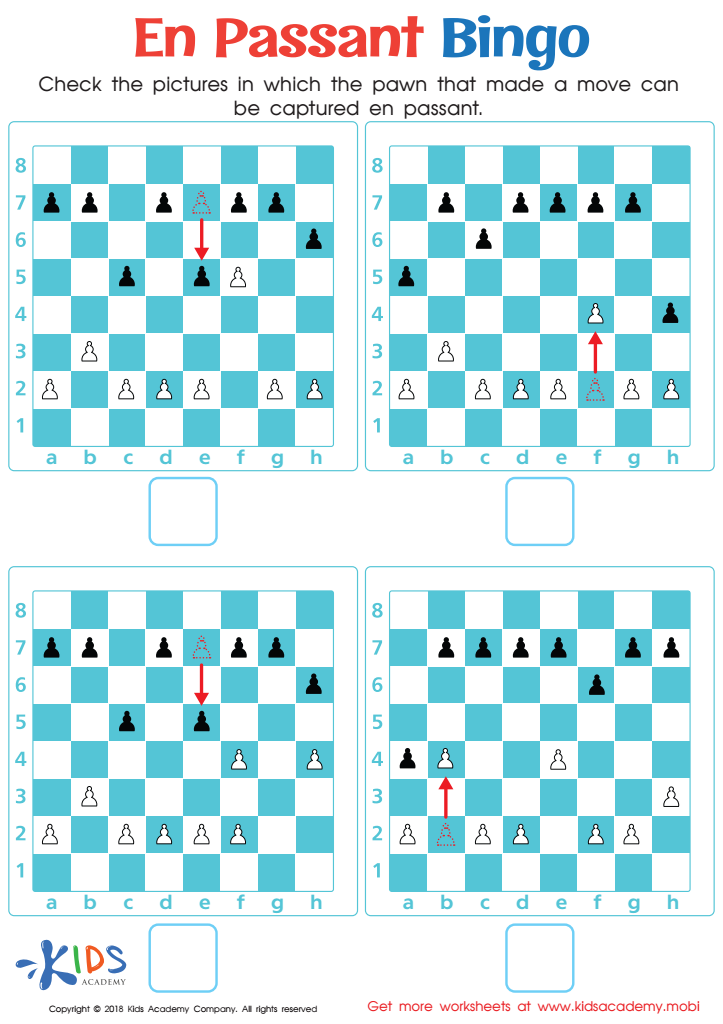
Think through each one before reading the solutions below.
- Top-Left: Black has just played ...e7-e5. The white pawn on f5 is on its fifth rank, and the black pawn moved two squares to land beside it. Yes, en passant (fxe6) is legal.
- Top-Right: White has just played f2-f4. The black pawn on e4 is on its fourth rank, so it has the potential to capture en passant. However, for Black to capture, the white pawn must be on its fifth rank (f5), not the fourth. No, en passant is not legal.
- Bottom-Left: Black has just played ...d7-d5. The white pawn on e5 is on its fifth rank. Yes, en passant (exd6) is legal.
- Bottom-Right: White has just played c2-c4. The black pawn on b4 is on its fourth rank (Black's fifth rank from their perspective). Yes, en passant (bxc3) is legal.
Now for a few more exercises to solidify your understanding. The following resource from Chess.com presents three test positions.
This article provides further examples and practice problems for the en passant rule.
Scroll down to the section titled "Test Your Skills". Read the instructions for each of the three tests and decide on the correct move. For each test, ask yourself: do all three conditions for en passant apply?
Let's review the answers to the "Test Your Skills" puzzles:
- Test 1: Black just moved ...d7-d5. White's pawn is on e5 (the 5th rank). All conditions are met. The correct move is to capture en passant with exd6.
- Test 2: Black moved ...e7-e5. The white pawn is on f5. This is another clear case where all conditions are met. The correct move is to capture en passant with fxe6.
- Test 3: Black's pawn moved from e7 to e6. Since the pawn only moved one square, not two, the en passant rule does not apply. You cannot capture it. Therefore, the only move presented is to push your pawn to f7.
Conclusion
In this lesson, we have demystified the en passant rule. While it might seem like a minor or obscure part of chess, knowing it separates the informed player from the beginner. Missing an en passant capture—or not realizing your opponent can use it against you—can be a costly error.
Key Takeaways:
- En Passant ("in passing") is a special pawn capture that exists to prevent pawns from avoiding capture by using their initial two-square move.
- The capture is only legal under three strict conditions:
- The capturing pawn must be on its fifth rank.
- An adjacent enemy pawn must have just moved two squares from its starting position.
- The capture must be made immediately on the next turn.
- The capturing pawn moves to the square the enemy pawn passed over, not the square it landed on.
You have now reviewed the two special moves involving multiple pieces or unique captures: castling and en passant. In our next lesson, we will cover the final special power of the pawn: pawn promotion, the exciting moment when a humble pawn reaches the end of the board and transforms into a much more powerful piece.