Hello! Welcome to the sixth and final lesson in our module on analyzing soundscapes in Moroccan film.
In our last session, we explored how a film's holistic sound design can engage with key postcolonial themes like memory, displacement, and exile, using Adios Carmen as our primary case study. We established how sonic choices—from language to musical references—are not merely descriptive but are powerful tools for articulating complex, hybrid identities.
Today, we will focus this analytical lens on one of the most significant and enduring dichotomies in Moroccan culture and cinema: the relationship between urban and rural identities. Your learning outcome for this lesson is to analyze how a Moroccan film's soundscape represents or negotiates this dynamic. Understanding this theme is fundamental to grasping the socio-cultural fabric of Morocco and will be an invaluable perspective for your doctoral research.
To begin, consider this image:
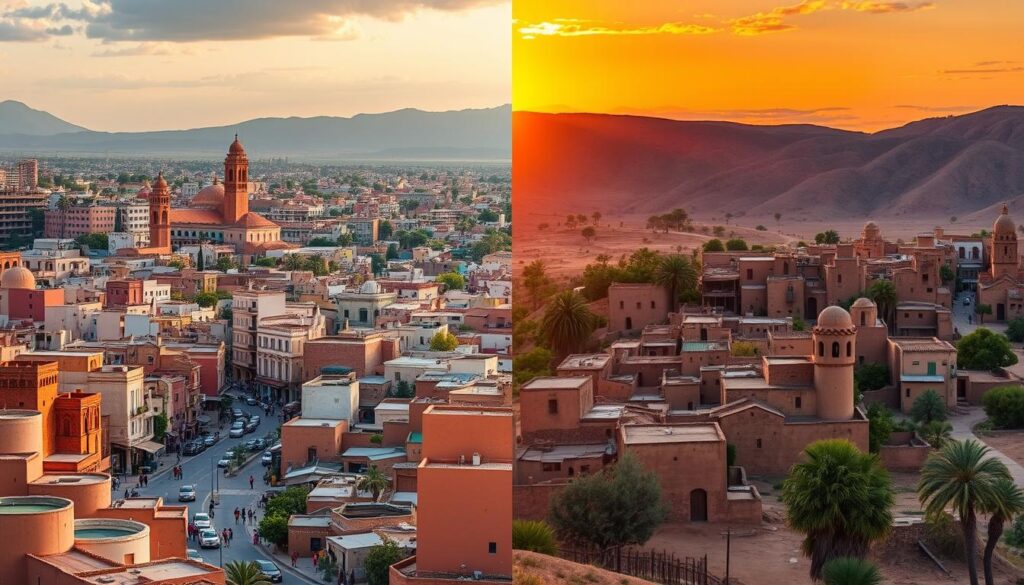
This image captures the physical poles of our discussion. The left implies a soundscape of traffic, commerce, and diverse crowds—a "lo-fi" environment in Schafer's terms. The right suggests a "hi-fi" soundscape dominated by nature, animal sounds, and perhaps the focused sounds of a smaller community. As we'll see, Moroccan filmmakers have used sound to explore, complicate, and challenge the meanings associated with these two distinct worlds.
1. Cinematic Foundations: Modernity, Tradition, and the Post-Independence Soundscape
The negotiation of urban and rural identities has been a central concern of Moroccan cinema since its inception in the post-independence era. Early filmmakers grappled with what it meant to be a modern nation while also holding onto, or rediscovering, ancestral traditions. The soundscape became a key battleground for this ideological work.
The following reading explores how filmmakers in the 1960s and 1970s used sound to construct complex portraits of both the city and the countryside.
[PDF] Vernacular Modernism, Film Culture, and Moroccan Short Film and ...
In his essay 'Vernacular Modernism, Film Culture, and Moroccan Short Film and Documentary,' Peter Limbrick analyzes several key short films from this formative period. His analysis provides us with precise examples of how sound was mobilized to represent urban modernity and rural tradition.
Please read the following three sections from the PDF: Start with the analysis of Mohamed Afifi's 'Retour à Agadir'. This section begins on the second page of the PDF with 'Afifi’s film Retour à Agadir/Return to Agadir...'. Focus on how the 'sonic landscape'—the mix of diegetic city sounds and non-diegetic jazz—is juxtaposed with the visuals of the ruined city. (approx. 2 pages) Next, read the analysis of Ahmed Bouanani’s '6 et 12'. This section starts with 'Such is also the case with 6 et 12/6 and 12...'. Note the description of the soundtrack (jazz, diegetic/non-diegetic noise) and how it's used to portray Casablanca. (approx. 3 pages) Finally, read the section on Bouanani’s 'Tarfaya, ou la marche d’un poète'. This section begins with 'If these films showed the capacity for a cinematic urban modernism...,' and continues to the analysis of Tarfaya. Pay attention to how this film, set in a rural region, uses sound (poetry, chant, music) to engage with history and tradition. (approx. 2 pages)
This reading provides a clear, foundational dichotomy in how sound was used:
-
The Urban Soundscape: In films like Retour à Agadir and 6 et 12, the city is sonically constructed as a site of modernity. The use of bebop and free jazz—itself a symbol of international modernism—is layered with diegetic urban noise (car horns, machines). This creates a soundscape that can be interpreted as either energetic and vibrant or, as critic Zakya Daoud suggests for 6 et 12, alienating and oppressive. The soundscape portrays the city as a complex, often cacophonous space where the promises and perils of modernization are audibly negotiated.
-
The Rural Soundscape: In contrast, Tarfaya presents the rural south as a repository of cultural memory. The soundscape is built from elements that signify tradition and deep-rooted history: popular poetry, chant, and traditional music. Here, sound connects the protagonist (and the audience) to an "ancestral capacity," as Limbrick puts it. The rural soundscape is framed not as backward, but as a source of wisdom and cultural authenticity.
This early cinematic language establishes a powerful set of sonic associations: the city with a complex, often dissonant modernity, and the countryside with a more harmonious, traditional past.
2. Contemporary Negotiations: The Politics of Urban and Rural Sound
This foundational dichotomy continues to resonate in contemporary Moroccan media, but it is also challenged and complicated. Let's turn to a more recent analysis that examines how urban and rural identities are negotiated in Moroccan hip-hop videos. While not feature films, these short-form works present potent and explicit audio-visual arguments about place and identity.
Sound, Vision, and Urban Space in Moroccan Hip-Hop Videos
Nicholas F. G. Vandermeulen's article, 'Sound, Vision, and Urban Space in Moroccan Hip-Hop Videos', offers a compelling analysis of how artists use sound to construct competing visions of the city and its relationship to the countryside.
Please read these sections to see how the urban/rural theme is debated today: First, read the section 'Making Hip-Hop Moroccan'. This provides essential historical context on the urban-rural divide and the emergence of the lhouma (neighborhood) as a key site of identity. Next, read the section 'Neighborhood Vibes: Audio-Visual Constructions of l-Houma'. Focus on the comparative analysis of Chawki's polished Marrakech versus Muslim's gritty Tangier. Note how sound, both audible and visually indexed (e.g., unheard weeping), is used to 'teach' the audience how to listen to the city. Finally, read the subsection within 'Contested Soundscapes' that analyzes Don Bigg's video 'TJR'. It begins 'The video for Don Bigg’s track “TJR,” however, offers a very different commentary...'. This is a direct example of an artist negotiating the urban-rural relationship by depicting a retreat to the 'authentic' countryside for moral renewal.
This article demonstrates how the urban/rural dynamic is actively debated in contemporary culture:
-
The Fractured Urban Identity: The city is no longer a single entity. Vandermeulen shows us at least three competing sonic representations: the glossy, touristic city (Chawki's Marrakech); the gritty, morally compromised houma that needs saving (Muslim's Tangier); and the peri-urban space of "nothing" that resists interpretation (El Haqed's Casablanca). This reveals that the negotiation of identity now happens within the urban space itself, often revolving around class and authenticity.
-
The Idealized Rural: Don Bigg’s “TJR” video provides a fascinating modern example of the rural-as-authenticity theme we saw in Tarfaya. The urban protagonist literally drives out of the city to the countryside to reconnect with his roots and find moral clarity. The video sonically reinforces this by indexing a "hi-fi" soundscape (the midwife's trill, the call to prayer) that stands in for cultural purity, a stark contrast to the implied "lo-fi" chaos of the city he leaves behind. This is a clear negotiation: urban life is presented as lacking, and rural identity is positioned as the solution.
3. Synthesis: From Representation to Negotiation
Putting these two historical moments together, we can see a clear evolution. Early post-independence filmmakers like Bouanani and Afifi used sound to represent the distinct identities of the modern city and the traditional countryside. Contemporary artists like Don Bigg are now using the soundscape to actively negotiate the relationship between them, often presenting the rural as a corrective to the perceived failures of the urban.
Let's apply this thinking to a specific film still.

Considering this image and our discussion today:
- What sounds would you, as a sound designer, prioritize in this scene to establish a distinctly rural identity? Think about both diegetic sounds (environmental, human, animal) and potential non-diegetic choices.
- How could the soundscape of this scene be designed to create a sharp contrast with the sonic environment of a city like Tangier, where much of the film is set?
- How might sound be used to signal whether this journey into the countryside is a hopeful return to authenticity (like in "TJR") or a more fraught and complicated encounter?
Your experience as a sound operator gives you a keen sense of how texture, perspective, and layering can shape an audience's perception of a space. The choice to emphasize the wind and footsteps over distant village sounds, for example, could create a sense of isolation, while a mix that brings the sounds of the village closer might evoke a feeling of homecoming.
Conclusion
Today we've delved into one of the core thematic tensions in Moroccan cinema: the dynamic between urban and rural life. We've seen how this is not a simple binary, but a rich site of cultural negotiation played out through sound.
Key Takeaways:
- Moroccan cinema has historically used distinct sonic palettes to represent urban and rural spaces: the city is often associated with modernist music and mechanical noise, while the countryside is linked to traditional music and natural sounds.
- This dichotomy is not static. The meaning of "urban" is itself contested, with soundscapes depicting the city as a site of tourist consumption, moral decay, or resilient everyday life.
- Filmmakers and artists use sound not just to depict these spaces, but to construct an argument about them. The trope of returning to an "authentic" rural soundscape is a powerful way to critique and negotiate the complexities of modern urban identity.
Preview of the Next Lesson
This lesson concludes our module focused on case studies. You are now equipped with a multi-layered analytical framework, drawing from soundscape theory, film sound theory, and postcolonial studies.
Our next module, "Advanced Research Methodologies," will shift our focus from analysis to synthesis. The first lesson, "Describe established methodologies for analyzing film sound at the academic level," will guide you in structuring these different theoretical tools into a coherent and rigorous method for your own research—the foundational work for your PhD proposal.