Hello! Welcome to the first lesson in our new module, "The Language of Causation."
In our last lesson, we explored Judea Pearl's Ladder of Causation. We established that to answer questions about interventions ("doing") and counterfactuals ("imagining"), we need more than just statistical data; we need a causal model. This model serves as the formal language that allows us to climb the ladder.
Today, we will begin to build our understanding of that language. Our learning outcome is to explain the philosophical motivation behind structural causal models (SCMs) as representations of autonomous causal mechanisms. We'll move beyond the abstract need for a model and investigate the principles that make SCMs such a powerful tool for causal reasoning.
1. Beyond Data: The Need for a Causal Story
As a statistician, you are an expert in modeling relationships found in data. However, as we've discussed, a statistical model that describes correlations, like , operates on the first rung of the causal ladder. To ascend to the second rung (Intervention), we need to formalize how the world works, not just how it appears in our dataset.
A Structural Causal Model (SCM) is the tool for this task. It is a set of equations that purports to describe the data-generating process. Crucially, these equations are not just descriptive summaries of data; they are statements about our theory of causation.
Let's begin with a foundational text that outlines the core components of an SCM.
Causal Inference: A Tale of Three Frameworks
This article, 'Causal Inference: A Tale of Three Frameworks', provides a clear, formal introduction to Nonparametric Structural Equation Models (NPSEMs), a general form of SCMs. It highlights the crucial distinction between a structural model and a purely statistical one.
Please read the section 2.2 Structural Equation Models. It begins after the table comparing the three frameworks. Focus on understanding the components of an NPSEM (endogenous variables V, exogenous variables ε, and functions f) and the key sentence that distinguishes it from a regression model: 'what makes NPSEMs structural is that they also define what would happen in an interventional world'.
As the reading explains, an SCM is composed of equations, typically of the form:
Here:
- is a variable within our model whose value is being determined (an endogenous variable).
- are the other variables in the model that are direct causes of (its "parents").
- represents all other factors not included in the model that could affect (an exogenous or "error" term).
- is the function that represents the causal mechanism itself, describing how the causes produce the effect.
The collection of these equations forms our SCM—our story about how the world works.
2. The Cornerstone Philosophy: Autonomy of Mechanisms
So, what gives these equations their causal, "structural" character? The central philosophical idea is autonomy. This principle, also called modularity or invariance, is the lynchpin of the SCM framework.
The autonomy assumption asserts that each structural equation represents an independent, self-contained causal mechanism that remains invariant even when other mechanisms in the system are altered.
To grasp this essential idea, let's turn to two more resources that explain it from slightly different angles.
Causal Inference: A Tale of Three Frameworks
Let's return to the arXiv paper to see the formal definition of the autonomy assumption and how it connects to intervention.
Please read the subsection just below the equations for the modified system (it starts with 'The key assumption in the SEM framework...'). This short section formally defines the autonomy assumption and connects it directly to Pearl's do-operator.
Now, for a more philosophical and intuitive explanation, let's read a passage from a critical review of Pearl's work by the philosopher James Woodward.
CRITICAL NOTICE: CAUSALITY BY JUDEA PEARL
In his review of Pearl's 'Causality', James Woodward provides an exceptionally clear explanation of what is meant by an 'autonomous causal mechanism'.
Please read the paragraph that begins 'Pearl thinks of each equation as representing a distinct ‘causal mechanism’...'. It is near the end of the second section. This paragraph defines autonomy as the possibility of interfering with one mechanism without disrupting the others.
Think of this in the context of your work in social research on relationships. A person's decision-making process for choosing a career might be one mechanism, . Their process for choosing whether to exercise might be another, . The autonomy assumption means we can theorize about an intervention on their career—for example, a new job offer—by changing only the inputs to without having to re-specify the entire logic of . The mechanisms are modular.
This modularity is the philosophical foundation that allows us to reason about "what if" scenarios in a structured way.
3. Model Surgery: The do-operator in Action
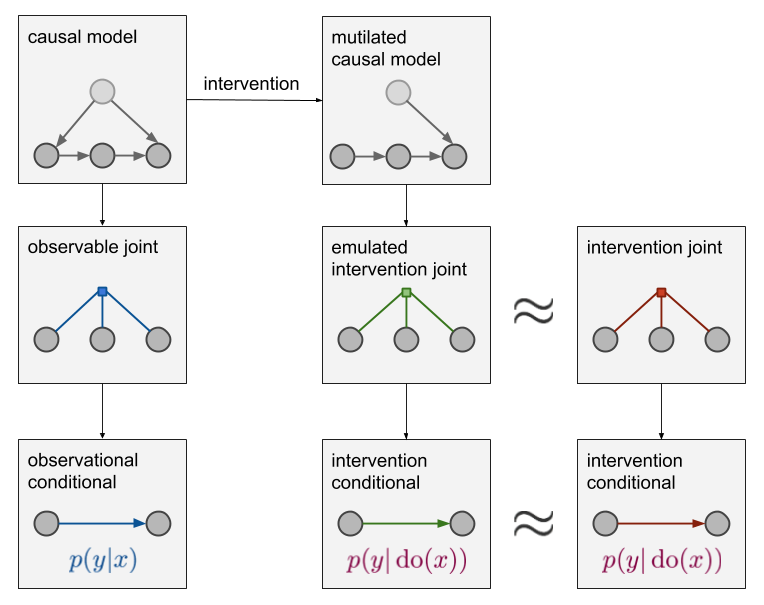
The autonomy of mechanisms gives us a powerful way to represent interventions. If each equation is a distinct module, then an intervention on a variable is simply a "surgical" replacement of its corresponding equation, leaving all others intact.
This is where the do-operator, which we encountered in the previous lesson, gets its formal meaning. The expression instructs us to perform surgery on our SCM.
Let's look at a clear visual of this process.
Now, let's hear Judea Pearl describe this concept of "model surgery" himself.
Judea Pearl: Causal Reasoning, Counterfactuals, and the Path to AGI | Lex Fridman Podcast #56
In this segment from his conversation with Lex Fridman, Judea Pearl explains the meaning of the do-operator and the idea of performing 'hypothetical surgeries' on a model.
Please watch from 00:30:08 to 00:34:37. In the first part, Pearl explains how the do-operator mathematically represents an intervention by 'liberating' a variable from its causes. In the second part, he uses the blood pressure example to explain that this 'surgery' is performed on the model, allowing us to reason about interventions that may be physically impossible.
As Pearl and Woodward both articulate, the do(X=x) operation amounts to:
- Locating the equation for , which is .
- Deleting this entire equation from the model.
- Replacing it with the simple assignment .
- Leaving all other equations untouched, thanks to the autonomy assumption.
This process gives us a new, "mutilated" model where the value of is determined not by its prior causes, but by our intervention. We can then calculate the resulting distribution of other variables in this new world.
4. Representation First, Discovery Second
This brings us to a final, crucial point about the philosophy of SCMs. They are, first and foremost, a language for representing causal knowledge.
In many statistical traditions, the process begins with data, and a model is then fitted to that data. The SCM framework inverts this. It argues that meaningful causal analysis begins with a theory, encoded in an SCM. The data is then used to test or refine this model. Pearl calls this guiding principle: "Representation first, discovery second."
Judea Pearl: Causal Reasoning, Counterfactuals, and the Path to AGI | Lex Fridman Podcast #56
In this short clip, Pearl explains why we must start by asking theoretical questions to build a causal model before we can even think about discovering causal relationships from data.
Please watch from 23:25 to 25:52. Listen for the 'AI slogan' and focus on Pearl's argument that before we can discover anything, we need a formal way to represent what we already know or hypothesize.
This "mechanistic perspective," as the arXiv paper calls it, sees causality as arising from the structure of the world's mechanisms. The SCM is our best attempt to write down that structure. It explicitly embraces the idea that science is not a purely objective reading of data, but a dialogue between our theoretical models and empirical reality—a perspective that aligns well with the epistemological focus of this course.
Conclusion
Today we have uncovered the core philosophical ideas that make Structural Causal Models a revolutionary tool for causal inference.
Key Takeaways:
- Models of Mechanism: SCMs are not just statistical descriptions of data. They are mathematical representations of our theories about the underlying, real-world causal mechanisms.
- The Autonomy Principle: The central philosophical assumption is that these causal mechanisms are autonomous (or modular). Each can be understood and, crucially, intervened upon, without altering the others.
- Intervention as Surgery: The autonomy principle gives a precise meaning to intervention. The
do-operator represents a "surgical" modification to the model, where we replace the natural mechanism for one variable with an external force. - Theory Before Data: The SCM framework champions the idea of "representation first." It provides a language to formally express our causal assumptions about the world, which can then be tested and refined with data.
In our next lesson, we will move from the philosophical "why" to the practical "how." We'll explore Directed Acyclic Graphs (DAGs), the intuitive visual language that is used to represent the qualitative structure of SCMs, and see how they are distinct from statistical models.