Hello! Welcome to the final lesson in our module on the philosophical shift from correlation to causation.
In our last lesson, we used Simpson's paradox to demonstrate that purely statistical reasoning is often insufficient for making sound causal claims. We saw that to decide on the best course of action, we need a causal story that distinguishes between merely observing a relationship and actively intervening to create one.
Today, we will formalize and expand upon this crucial distinction. Our learning outcome is to distinguish between observing, intervening, and counterfactual reasoning as the three levels of Judea Pearl's Ladder of Causation. This framework is a cornerstone of modern causal inference and provides a powerful new lens for thinking about data, knowledge, and rationality.
1. Introducing the Causal Hierarchy
Judea Pearl proposes that causal reasoning can be organized into a three-level hierarchy. Each level, or "rung," is characterized by the types of questions it can answer and the kind of information it requires. Climbing the ladder means gaining a progressively deeper causal understanding.
To get a concise overview of this hierarchy, please review the table in the following document from Judea Pearl.
The Three Layer Causal Hierarchy
This brief document provides a clear, tabular summary of the three levels of the causal hierarchy. It's a great reference point for the entire lesson.
Please read the introduction and study Figure 1, the table that lays out the three levels: Association, Intervention, and Counterfactuals. Note the typical activity, questions, and examples for each.
This table gives us the essential structure. Let's visualize it with the 'ladder' metaphor.
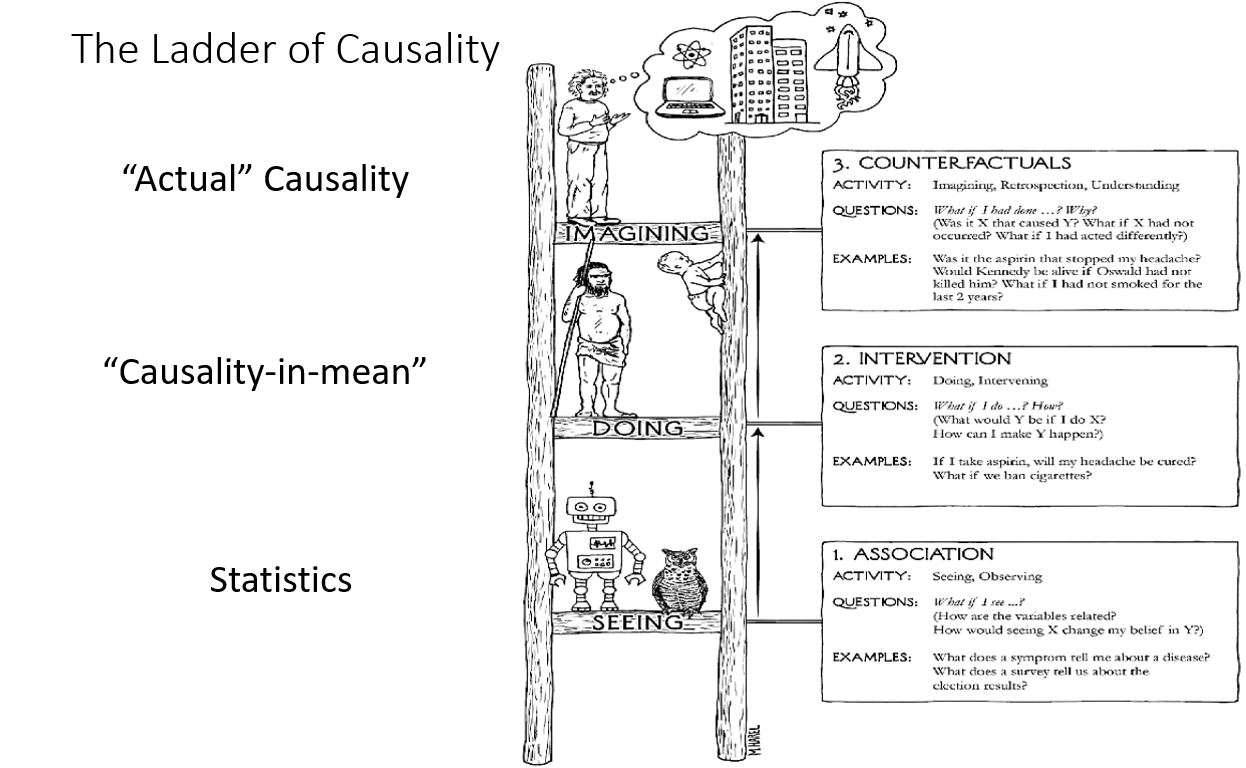
Now, let's hear from Judea Pearl himself as he introduces this powerful concept. His explanation will bring these ideas to life and emphasize the profound difference between the levels.
Keynote: Judea Pearl - The New Science of Cause and Effect
In this keynote, Judea Pearl personally walks through the Ladder of Causation. His explanation is invaluable for understanding the philosophical motivation and the distinct logical character of each rung.
Please watch the segment from 17:55 to 26:21. Pay close attention to how he defines each level (Association, Intervention, Counterfactuals) and the unique questions each one can answer.
As Pearl explains, these levels are not just a convenient classification; they represent a formal hierarchy. Questions at a higher rung cannot be answered using only information from a lower rung. This is a central and profound claim of the causal revolution.
2. A Deeper Look at Each Rung
Having established the framework, we'll now explore each rung in more detail using an excerpt from Pearl's seminal book, The Book of Why. This will solidify your understanding of the unique capabilities and limitations of each level.
Rung 1: Association (Seeing)
This is the world of traditional statistics and, as Pearl notes, most of modern machine learning. It's concerned with finding patterns in passively observed data.
- Activity: Seeing, Observing
- Key Question: "What if I see...?" (e.g., What does a symptom tell me about a disease?)
- Formalism: Conditional probability, . For you as a statistician, this is familiar ground, encompassing concepts like correlation and regression.
Now, let's read Pearl's description of this foundational level.
The New Science of Cause and Effect
This first section of our reading from 'The Book of Why' details Rung 1, explaining its power for prediction but also its fundamental limitations for causal reasoning.
Please read the section titled 'At the first level, Association...'. It begins after the introduction to the Ladder of Causation and ends just before the discussion of the next level. Focus on how this level relates to prediction and why Pearl argues that even advanced AI often operates only on this rung.
Rung 2: Intervention (Doing)
This is where we move from passive observation to active manipulation. Instead of asking what the world looks like, we ask what it would look like if we changed it.
- Activity: Doing, Intervening
- Key Question: "What if I do...?" (e.g., What will happen if we ban cigarettes?)
- Formalism: The do-operator, . This denotes the probability of Y if we force X to occur through an intervention.
Resolving Simpson's paradox required us to ask an interventional question: "Which treatment should I give to a patient?". This is fundamentally different from the associational question, "Which treatment was correlated with better outcomes in patients we observed?".
Let's read the next section, which explains this crucial step up the ladder.
The New Science of Cause and Effect
This section explains Rung 2, highlighting the critical distinction between 'seeing' and 'doing' and explaining why rung-one data is insufficient for answering interventional questions.
Please read the section that starts with 'We step up to the next level of causal queries...'. Focus on why passively collected data cannot, by itself, answer questions about interventions.
Rung 3: Counterfactuals (Imagining)
This is the highest level of causal reasoning, enabling us to go beyond what is or what could be, to what might have been. It involves retrospection and imagination.
- Activity: Imagining, Retrospection
- Key Question: "Why?" or "What if I had acted differently?" (e.g., Was it the aspirin I took that cured my headache?)
- Formalism: Counterfactual notation, e.g., , which reads "the probability of had been , given that we actually observed and ".
This level is the essence of explanation, regret, credit assignment, and moral responsibility. As a product manager, you might ask a counterfactual question like, "Would this user have churned if we had shown them the onboarding tutorial?". Answering such questions requires the deepest causal understanding.
Let's explore this final, most powerful rung.
The New Science of Cause and Effect
The final section of our reading delves into Rung 3, Counterfactuals. It explains why this level is uniquely human and essential for explanation and learning.
Please read the section beginning with '...it still does not answer all questions of interest...'. Notice how counterfactuals allow us to infer reasons and learn from past experiences.
Conclusion
Today, we have mapped the terrain of causal inquiry using Pearl's Ladder of Causation. This framework provides an indispensable philosophical and practical guide for anyone working with data.
Key Takeaways:
- Three Distinct Levels: Causal reasoning is not monolithic. It comprises three hierarchical levels:
- Association (Seeing): Finding patterns in data (). This is the realm of classical statistics and prediction.
- Intervention (Doing): Predicting the effects of actions (). This is the realm of decision-making and policy.
- Counterfactuals (Imagining): Understanding why things happened and what might have been (). This is the realm of explanation, reflection, and learning.
- Hierarchical Nature: The ladder is directional. Higher rungs are more powerful and can answer questions from lower rungs, but the reverse is not true. You cannot answer an interventional or counterfactual question with purely associational data and methods.
- Epistemological Shift: This framework marks a significant shift away from a purely data-centric view of knowledge. It asserts that to answer causal questions, data must be supplemented with a causal model—a representation of our knowledge about the world's underlying mechanisms.
In our next module, "The Language of Causation," we will begin to explore the tools that allow us to build these causal models and climb the ladder. We will start by examining the philosophical motivation behind Structural Causal Models (SCMs), the formal language that underpins this entire framework.