Introduction
In our last lesson, you took the crucial first step in your freelance journey by setting up your basic profiles on Upwork and Fiverr. You now have a digital storefront, but the shelves are still a bit bare. This lesson is about stocking those shelves with a message that grabs a client's attention and convinces them to buy.
Today, we will focus entirely on crafting a compelling service description. This is arguably the most important piece of text on your profile. It's your sales pitch, your handshake, and your first impression all rolled into one. By the end of this lesson, you will have transformed the placeholder descriptions you wrote previously into persuasive, client-focused narratives that clearly articulate the value you offer as a data researcher.
Part 1: The Client-Centric Mindset and What to Avoid
The single most important shift to make when writing your description is to stop talking about yourself and start talking about your client's needs. A potential client is reading your profile with one question in mind: "Can this person solve my problem?" Your description must answer a resounding "Yes" to that question.
Before we learn how to write a great description, it's incredibly helpful to see what a bad one looks like. Many new freelancers make the same common mistakes.
How to Write Upwork Profile Description - coachlancer
This article from Coachlancer does an excellent job of dissecting what works and what doesn't in a freelancer profile.
First, read the section 15 typical mistakes. You don't need to memorize all 15, but pay close attention to the core ideas behind mistakes like: Long lists of keywords Sounding desperate or lacking confidence Using cliché phrases ("100% satisfaction guaranteed") Making the profile all about you and your experience After reviewing the mistakes, read the next short section, "How to write Upwork profile description," to understand the shift towards a client-focused mindset.
As the article suggests, a successful profile isn't about listing every skill you have; it's about connecting your skills to a client's specific problems.
Part 2: A Proven Formula for Your Description
Now that you know what to avoid, let's build a structure for what to include. A great service description isn't just a block of text; it's a carefully constructed argument that guides the client from interest to action.
The Coachlancer article you just reviewed introduces an excellent four-part formula. A powerful profile description should:
- Name the people you are targeting (e.g., "busy entrepreneurs," "small business owners," "marketing teams").
- Specify the problems you can solve (e.g., "wasting time on manual research," "needing data on competitors," "struggling to build a prospect list").
- Highlight your relevant background (e.g., your experience from the projects in this course).
- Explain how to work with you (e.g., "Send me a message with your requirements, and I'll get back to you with a plan").
This annotated example of a successful Upwork profile shows this formula in action.
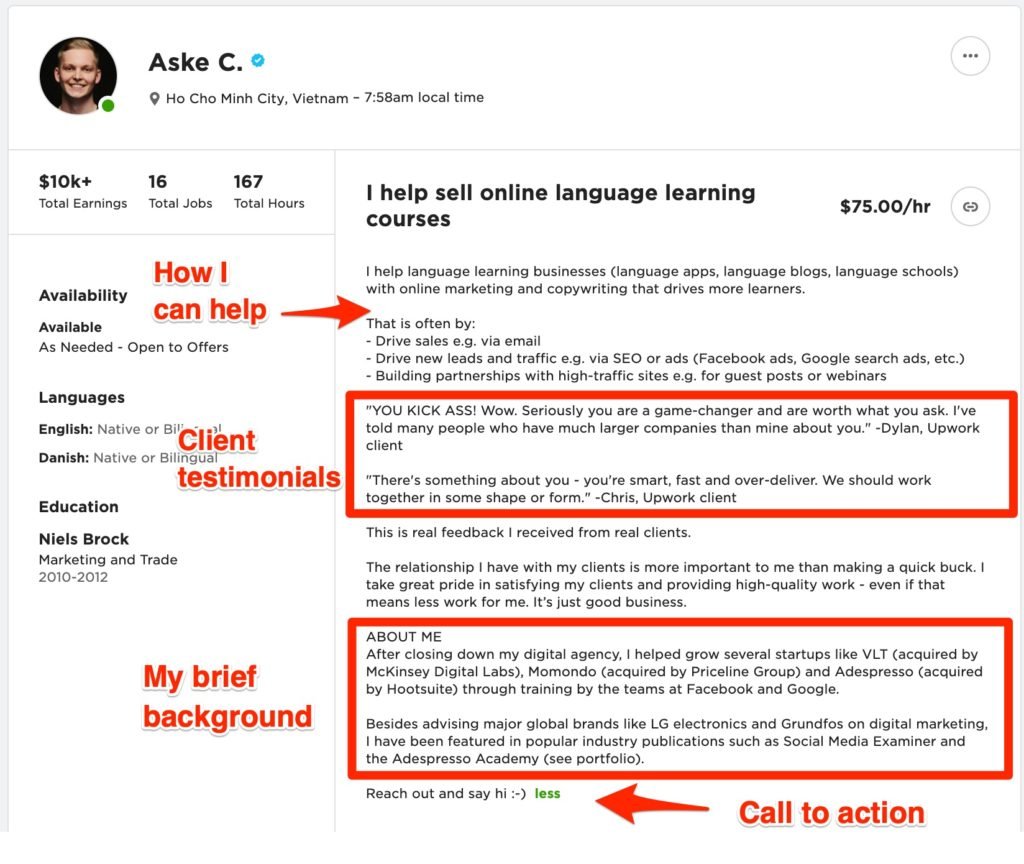
To turn this formula into a practical writing exercise, we'll use a step-by-step video guide that breaks the process down even further.
Write an AMAZING Fiverr Gig Description (Step by Step, With Examples)
This video, "Write an AMAZING Fiverr Gig Description," by Mike Nardi, provides a fantastic, hands-on framework that works for both Fiverr and Upwork.
Please watch the following sections: First, watch the part where he lists the eight questions you should answer before you start writing. This is your information-gathering step. Next, watch his explanation of the three-block text structure. This will be the template for your own description. Finally, watch the completed gig description example to see how he combines the answers to the questions into the three-block structure.
Your Task: Draft Your New Service Description
Now, it's your turn to apply this framework. Open a blank document and follow these two steps.
Step 1: Answer the Eight Questions for Your Data Research Service
Answer the questions from the video, but tailored to the skills you've learned. Here are some prompts to help you:
- What service are you offering? (e.g., Data research, web scraping, competitor analysis, lead list building.)
- What skills do you have? (e.g., Proficient in Google Sheets, advanced web search, data cleaning, market research.)
- How did you acquire those skills? (e.g., "Through a comprehensive, project-based data research course.")
- What problem does your service solve? (e.g., "I help busy entrepreneurs save time by handling their data collection and organization needs.")
- What benefit does your service provide? (e.g., "You get clean, accurate, and actionable data to make better business decisions.")
- If they don't purchase your service, what might that mean? (e.g., They'll have to spend hours on tedious research instead of focusing on growing their business.)
- Why should they choose you? (e.g., "I am detail-oriented, responsive, and dedicated to delivering high-quality, easy-to-understand work.")
- What is it like to work with you? (e.g., "The process is simple. You send me your requirements, we confirm the scope, and I deliver the structured data in a Google Sheet.")
Step 2: Assemble Your Draft Using the Three-Block Structure
Use your answers to write a draft of your service description following the video's structure.
- Block 1: The Opener (1-2 sentences). State what the client gets.
- Example: "Struggling with time-consuming research? I will help you save time and make smarter decisions by providing clear, accurate data on your competitors, market, or potential customers."
- Block 2: The Bulleted List. Detail what you offer, turning your skills and benefits into a scannable list.
- Example:
- Detailed Web Research
- Competitor Analysis
- Lead List Generation
- Data Entry and Cleaning in Google Sheets
- Market Trend Identification
- Example:
- Block 3: The Closer (About You & Call to Action). Explain why they should trust you and tell them what to do next.
- Example: "I am a dedicated researcher focused on providing actionable insights. My process is simple and transparent, ensuring you get exactly what you need, on time. Ready to get started? Send me a message, and let's discuss your project!"
Part 3: Refining and Polishing
You now have a solid draft that is client-focused and well-structured. The final step is to refine the language to make it as clear and persuasive as possible.
This infographic provides a great final checklist for your draft.

As a final tip, modern AI tools can be excellent writing assistants. While you should never rely on them to write your description from scratch (as it will lack your personal voice and an understanding of your specific skills), they can be very helpful for polishing your own writing.
How to Create a Data Entry Portfolio (No Experience Needed!)
The video "How to Create a Data Entry Portfolio" contains a useful short segment on using AI for this purpose.
Watch the section from "let me just write something from my mind" to see a practical example of taking a rough, self-written description and using ChatGPT to make it sound more professional.
Your Task: Finalize and Update Your Profiles
- Read through the draft you created in Part 2.
- Use the 6-step infographic as a checklist to see if you've missed anything.
- (Optional) Try pasting your draft into an AI tool like ChatGPT with a prompt like: "Can you help me improve this freelance service description to make it more professional and persuasive?"
- Copy your final, polished description and use it to update the "Bio/Overview" section of your Upwork profile and the "Gig Description" on Fiverr.
Conclusion
Well done! You have moved beyond a simple profile and created a strategic piece of marketing for your new freelance business. This is a skill you will use and refine throughout your entire career.
Here are the key takeaways from this lesson:
- Think like a client: The most effective service descriptions focus on solving the client's problems, not just listing your skills.
- Structure is your friend: Following a formula (like the 4-point or 3-block model) ensures your description is logical, comprehensive, and easy for a client to understand.
- A strong description has key elements: It hooks the reader, clearly lists the services and benefits, establishes trust, and tells the client exactly what to do next (the call to action).
In our next lesson, we will move from the "static" marketing of your profile to the "active" marketing of client communication. We'll cover how to develop questions to clarify a client's data research request and draft a project scope summary. This is the critical next step after a client reads your new, compelling description and decides to contact you.