Introduction
In our last lesson, you crafted a compelling service description to attract potential clients. That was about setting your stall and making it look inviting. Today, we'll focus on what to do when a client walks in. A client's initial message is often just the beginning of a conversation, a vague starting point like "Can you help me with some research?"
This lesson is dedicated to turning that initial inquiry into a concrete, well-defined project plan. We'll cover two essential skills: first, how to ask the right questions to clarify exactly what the client needs and why; and second, how to summarize that understanding into a clear project scope summary. Mastering this process is crucial for preventing misunderstandings, managing client expectations, and protecting yourself from "scope creep"—the dreaded situation where a project grows beyond its original boundaries without additional payment.
By the end of this lesson, you will be able to confidently lead a client from a simple request to a shared agreement on the project's objectives, deliverables, and limits. This clarity is the essential foundation for the topic of our next lesson: pricing your work accurately.
Part 1: The Art of Discovery
When a client contacts you, your first goal is not to immediately start working but to start a "discovery" or clarification process. Think of yourself as a consultant or a detective. Your job is to understand the problem behind the request. A client might ask for "a list of competitors," but what they really need might be to understand pricing strategies, identify marketing angles, or find gaps in the market. Your questions will uncover this deeper need.
The principles of a good sales discovery call are directly applicable here. It's about having a structured, predictable conversation to understand a prospect's needs before you propose a solution.
How To Run A Discovery Call - Strategy Session
This video, "How To Run A Discovery Call" by sales coach Patrick Dang, provides a powerful framework for these initial conversations. While he uses sales terminology, the process of uncovering needs is identical for a freelancer.
Please watch the following segments to understand the core concepts: First, watch the definition of a discovery call. Notice the emphasis on asking questions (80%) versus talking or pitching (20%). Next, see how he sets the agenda. This is a professional way to manage the conversation, letting the client know what to expect and making them comfortable. Finally, focus on the most important part: uncovering the client's "pain". In freelance terms, this means understanding their business problem, their goals, and what's stopping them from achieving those goals. This is the "why" behind their request.
Asking good questions not only gives you the information you need but also positions you as a thoughtful expert, not just an order-taker. This builds client confidence from the very first interaction.
Part 2: Your Clarification Toolkit
To guide your discovery conversation, it's helpful to have a "toolkit" of go-to questions. Whether you ask these in a live call, through email, or in a formal questionnaire, they serve the same purpose: to gather all the necessary details to define the project.
A client onboarding questionnaire is an excellent tool for this. It's a structured set of questions designed to capture key information about the client's business, goals, and expectations. Even if you never send a formal questionnaire, reviewing examples will arm you with the right questions to ask in any format.
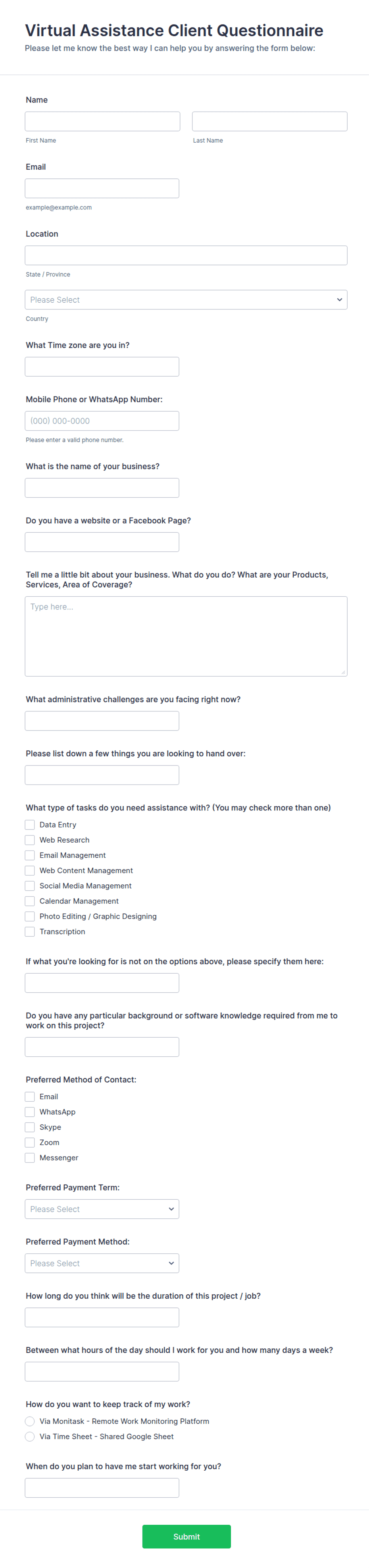
The following article provides a superb, categorized list of questions that you can adapt for your data research services.
Client Onboarding Questionnaire: 25 Questions You Must Ask - Lindy
This article from Lindy.ai is a practical guide to creating an effective client questionnaire.
As you read, focus on these key areas: Start with the definition and the benefits. This reinforces why this process is so valuable. Then, carefully study the list of 25 questions. Pay special attention to the categories: Client’s business and background: Helps you understand their context. Goals and success metrics: Tells you what a "win" looks like for them. Challenges and pain points: The core problem you are being hired to solve. Scope, priorities, and constraints: The specific boundaries of the project. Finally, review the best practices at the end. Tips like "keep it concise" and "explain why you're asking" are crucial.
Your Task 1: Draft Your Core Questions
Let's put this into practice. Imagine a potential client sends you this message on Upwork:
"Hi, I'm looking for someone to do some market research on the vegan cheese industry in the US. Can you help?"
Based on the videos and the article you just reviewed, open a document and draft 5 to 7 essential questions you would ask to clarify this request. Don't just ask "What do you want?" Think about uncovering their goals, success metrics, and specific needs.
Click here to see a sample set of questions after you've drafted your own.
- Goal-oriented: To start, could you tell me a bit more about what prompted this research? What business decision will this research help you make? (e.g., launching a new product, entering the US market, creating a marketing campaign).
- Success Metrics: What would a successful research delivery look like to you? What key information would make this project a "win"?
- Scope - Competitors: Are there specific competitor brands you are most interested in? If not, how many key competitors should I focus on (e.g., top 3, top 5)?
- Scope - Data Points: What specific information is most important for each competitor? (e.g., product range, pricing, customer reviews, marketing channels, retail locations).
- Deliverable: How would you prefer the final information to be presented? (e.g., A Google Sheet, a summary report in Google Docs).
- Timeline: Do you have a specific deadline for this research?
Part 3: Defining the Scope
Once you have the answers to your questions, the final step before pricing and starting the work is to summarize your shared understanding in a Project Scope Summary. This document is your most important tool for preventing future disagreements. It serves as a written confirmation of what you will do, what you will deliver, and just as importantly, what is not included.
A good scope summary contains several key elements.

Let's break down these components:
- Objectives: The high-level "why." The main goal of the project.
- Deliverables: The tangible "what." The specific files/outputs you will provide (e.g., "A Google Sheet with 5 tabs," "A 2-page PDF report").
- Requirements / Inclusions: The "how." The specific tasks you will perform (e.g., "Research the websites of 5 competitors," "Collect pricing for up to 15 products per competitor").
- Boundaries / Exclusions: What's not included. This is your primary defense against scope creep (e.g., "This project does not include analysis of social media engagement," "Data from non-US markets is excluded").
- Constraints: Time and budget. The deadline and the agreed-upon cost.
Having this document makes it much easier to handle situations where a client asks for something extra mid-project. It allows you to professionally point back to the agreed-upon scope and discuss the new request as a separate item, which may require more time and budget. The following video demonstrates this perfectly.
Freelance: How to Talk to Clients
The "Freelance: How to Talk to Clients" video by The Futur includes an excellent role-play on this exact situation.
Watch the segment where they role-play a client changing the scope of work. Pay close attention to how the freelancer handles the request. He doesn't say "no" outright. Instead, he: Acknowledges the client's need. Refers back to the effort and time of the original scope. Frames the new request in terms of "time and money." Offers alternative solutions that respect the original agreement.
This professional approach maintains a good client relationship while protecting your time and profitability.
Your Task 2: Draft a Project Scope Summary
Now, using your hypothetical answers from the "vegan cheese" client in Task 1, draft a brief project scope summary. Structure it using the headings from the diagram (Objectives, Deliverables, Inclusions, Exclusions, Constraints). This is a practical exercise in turning a conversation into a concrete plan.
Click here to see a sample scope summary after you've drafted your own.
Project Scope Summary: Vegan Cheese Market Research
-
Objective: To gather foundational data on the top 3 vegan cheese competitors in the US market to inform the client's product launch strategy.
-
Deliverables:
- A Google Sheet containing all collected data.
- A brief 1-page summary in Google Docs highlighting key findings.
-
Inclusions (Scope of Work):
- Identify the top 3 US competitors based on market share reports.
- For each competitor, collect the following data points:
- Full product list (up to 20 products per company).
- Price per ounce for each product.
- Main product ingredients.
- Stated value proposition (e.g., "melts like real cheese," "nut-free").
-
Exclusions (Out of Scope):
- Analysis of customer reviews or sentiment.
- Research on social media presence or marketing campaigns.
- Data on international (non-US) products or pricing.
-
Constraints:
- Timeline: Final deliverables to be sent within 4 business days of project start.
- Budget: TBD (To be determined in the next step).
Conclusion
Excellent work. You've just walked through the entire process of client clarification, from a vague request to a solid project plan. This is a fundamental pillar of a successful freelance career.
Here are the key takeaways from this lesson:
- Be a detective: Your first job is to ask questions and uncover the real business problem behind a client's request.
- Build your question toolkit: Having a structured set of questions about goals, success metrics, and scope allows you to lead the conversation professionally.
- Summarize in writing: A Project Scope Summary aligns expectations and is your best tool for preventing misunderstandings and scope creep.
- Defend your scope professionally: Use the scope summary as a basis for discussing any new requests in terms of their impact on time and budget.
In our next lesson, we will take the Project Scope Summary you just learned to create and use it as the foundation for the next critical step: estimating project scope and setting appropriate pricing. With a clear scope in hand, you'll be able to calculate your effort and confidently price your services.