Introduction
In our last lesson, you learned how to use Google search operators to navigate the vast ocean of online information with precision. While finding information quickly is a critical skill, your value as a data researcher hinges on the quality and reliability of that information. A beautifully organized spreadsheet is worthless if it's filled with inaccurate data.
This lesson addresses the crucial next step: evaluating the credibility of the sources you find. We'll explore practical frameworks and techniques used by professional researchers and fact-checkers to distinguish reliable information from misinformation. By the end of this lesson, you will be able to confidently assess any online source, ensuring the data you provide to clients is trustworthy and accurate.
Why Evaluate? Questioning the 'Who' and the 'Why'
Every piece of information you encounter online—whether it's an article, a social media post, a chart, or a video—was created by someone for a specific purpose. Understanding this 'who' and 'why' is the foundation of source evaluation. The creator's motivations, whether to inform, entertain, persuade, or sell, inevitably shape the information presented.
The following video from Crash Course provides an excellent introduction to this concept, explaining why we can't take information at face value.
Check Yourself with Lateral Reading: Crash Course Navigating Digital Information #3
This video, "Check Yourself with Lateral Reading," explains the fundamental principle that all information is produced by people with various, often complex, motives.
Please watch the beginning of the video from 00:48 to 03:01. Pay attention to the idea that even seemingly objective sources, like news articles or academic papers, are influenced by the choices and potential biases of their creators.
Frameworks for Evaluation: CRAAP and SIFT
To systematically evaluate sources, researchers often use structured frameworks. These aren't rigid rules but rather mental checklists to guide your investigation. We'll look at two popular and effective methods.
1. The CRAAP Test: A Detailed Checklist
The CRAAP test is a widely used framework in academia and libraries. It provides a comprehensive set of criteria to check against a source. The acronym stands for:
- Currency: The timeliness of the information.
- Relevance: The importance of the information for your needs.
- Authority: The source of the information.
- Accuracy: The reliability and correctness of the information.
- Purpose: The reason the information exists.

To get a clear understanding of each element, the following video offers a concise explanation.
Credible Source: Five tips to determine if your source is credible
The video "Credible Source: Five tips to determine if your source is credible" by Smart Student breaks down each component of the CRAAP test with simple examples.
Watch the following segments to understand each criterion: Introduction to the CRAAP test. Currency Relevance Authority Accuracy Purpose
2. The SIFT Method: Four Simple Habits
While CRAAP is thorough, the SIFT method, developed by digital literacy expert Mike Caulfield, is designed for the rapid pace of web research. It's less of a checklist and more of a set of habits.
- Stop: Pause and think before you share or use a source. Ask yourself what you know about the website or claim.
- Investigate the Source: Leave the page you're on and find out who is behind the information.
- Find Better Coverage: Look for other, more trusted sources covering the same topic.
- Trace Claims, Quotes, and Media: Trace the information back to its original context to see if it's being presented accurately.
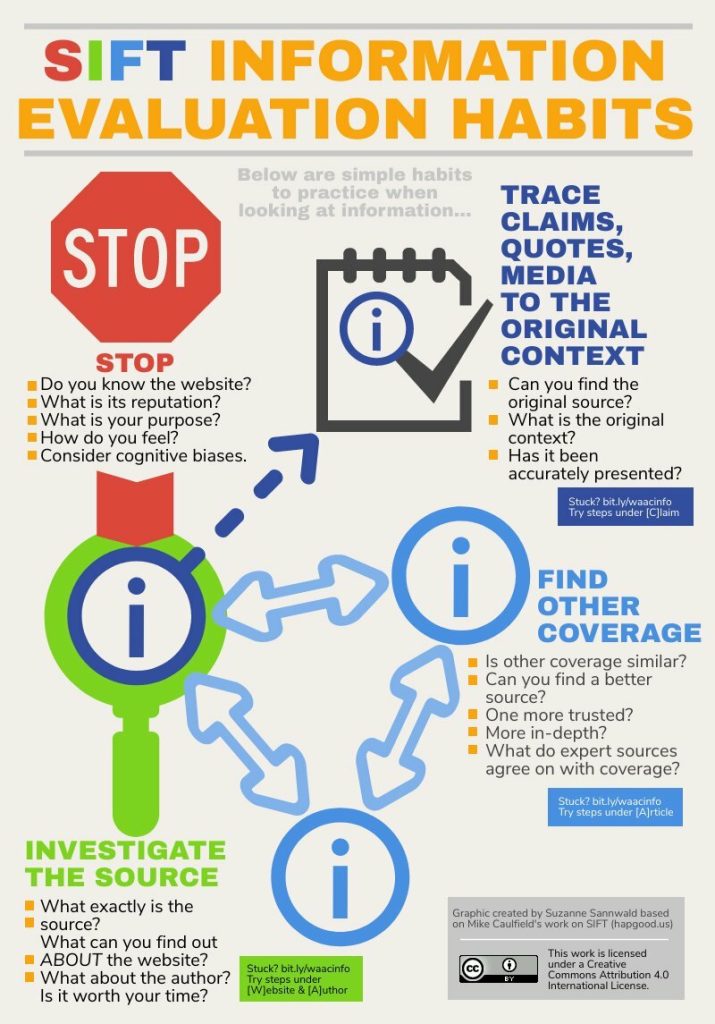
You'll notice SIFT strongly encourages you to leave the source you're looking at. This core technique has a name: lateral reading.
The Key Skill: Lateral Reading
Traditionally, we read "vertically"—we open an article and read it from top to bottom. On the web, this can be misleading. A website can be designed to look professional and authoritative, even if it's promoting biased or false information.
Lateral reading is the practice of professional fact-checkers. When they land on an unfamiliar site, they immediately open new browser tabs to search for information about that site. This is SIFT's "Investigate the Source" and "Find Better Coverage" in action.
Let's return to the Crash Course video, which demonstrates this technique perfectly.
Check Yourself with Lateral Reading: Crash Course Navigating Digital Information #3
This video provides a clear definition of lateral reading and a powerful, real-world example of how it works.
Watch these two key segments: First, watch the explanation of vertical vs. lateral reading. Next, watch the practical demonstration where the host investigates the American Legislative Exchange Council (ALEC) from 05:29 to 07:31. Notice how a quick search in a new tab reveals crucial context that isn't mentioned on ALEC's own website. The video goes on to mention helpful resources for lateral reading, such as established news sites, fact-checking organizations like Snopes and Politifact, and even Wikipedia (for getting a general overview and finding primary sources in the citations).
Resources for a Freelance Researcher
Now, let's connect these evaluation skills to your goal of freelance data research. Knowing where to find credible information is half the battle. This blog post is written specifically for freelance writers and researchers and is packed with practical advice.
How to Easily Find Credible Sources for Research and for Freelance ...
This article from Elna Cain's blog provides tips and a list of high-quality data sources relevant to freelance work.
Please read through the article, paying close attention to these sections: What defines credibility in an online context for freelancers. The sections on using Google's search tools and specific search hacks, which build on our last lesson. The lists of scholarly sources, digital marketing research sites like Statista, and the hack for finding industry reports. This list of resources (Pew Research, Statista, Google Scholar, etc.) is a great starting point for finding high-quality, reliable data for your projects.
Hands-On Practice Scenario
Let's put this into practice. Imagine a client asks you to find data on the key challenges small businesses faced in the past year.
Using the Google search skills from our last lesson, you run a query like: intitle:"small business challenges" after:2023.
One of the top results is an article titled "The 5 Biggest Hurdles for Small Businesses Today" on a site called businessgrowthpros.com. You've never heard of this site. How would you evaluate it?
Here’s how you could apply the SIFT method:
-
Stop: Don't immediately start pulling data from the article. Recognize that
businessgrowthpros.comis an unknown quantity. How do you feel about the name? It sounds promotional, which is a good cue to be skeptical. -
Investigate the Source: Open a new tab. Perform a few lateral reading searches:
who is businessgrowthpros.combusinessgrowthpros.com reviews- What do you find? Is it a reputable market research firm? Or is it a marketing agency selling services to small businesses? The "About Us" page might reveal that their goal is to sell consulting services. This is a crucial piece of context; their content is likely designed to lead you to their product (a "Purpose" check from CRAAP).
-
Find Better Coverage: Open another tab. Search for the same information but on sites you know are more reliable, using the
site:operator and the list from the article you just read."small business challenges" site:forbes.com"small business challenges" site:pewresearch.org"small business challenges" site:sba.gov(Small Business Administration)- Compare the information on these sites to the article from
businessgrowthpros.com. Do the claims match? Do these more reputable sources cite original surveys or economic data?
-
Trace Claims: The
businessgrowthpros.comarticle might say, "A recent study shows 70% of businesses struggle with cash flow."- A reliable source will link to that study. Can you click it? Does it go to a real research report?
- If there's no link, search for the specific claim:
"70% of businesses struggle with cash flow". This might lead you to the original source, or it might reveal that the number is fabricated or taken out of context.
By spending just a few minutes reading laterally, you can quickly determine whether businessgrowthpros.com is a trustworthy source or simply content marketing you should bypass in favor of higher-quality data.
Conclusion
You now possess the foundational skills not only to find information but to verify its integrity. As a freelance data researcher, this ability is non-negotiable and will be the bedrock of your professional reputation.
Here are the key takeaways from this lesson:
- Always question the author and purpose behind any piece of information.
- Use frameworks like CRAAP (a detailed checklist) and SIFT (action-oriented habits) to guide your evaluation.
- The single most important practical skill is lateral reading: opening new tabs to investigate a source and find alternative coverage.
- Build a personal list of trusted, high-authority sources (like Statista, Pew Research, government agencies, and major academic journals) to start your research.
In our next lesson, we will move to the next stage of the research process. Now that you know how to find and vet reliable information, we'll focus on how to plan the structure of a spreadsheet to efficiently capture the data you're about to collect.