Hello! Welcome back.
In our last lesson, we saw how a Turing Machine can act as a function computer, performing tasks like string copying and unary arithmetic. You may have noticed that implementing the string copy function, , on a single-tape TM was somewhat cumbersome, requiring a lot of back-and-forth "zigzagging" movement. This naturally leads to a question: what if we had a more convenient machine, perhaps one with multiple tapes? Would that give us more computational power?
This lesson addresses that exact question. We will investigate common variations of the standard Turing Machine model and explore their computational capabilities. Our learning outcome is to explain how variations like multi-tape and two-way infinite tape TMs are equivalent to the standard model. This concept of "robustness," where different models turn out to be equivalent in power, is a cornerstone of computability theory and a key piece of evidence for the Church-Turing thesis.
1. Multi-Tape Turing Machines
Let's start by imagining a Turing Machine with multiple tapes, say tapes, each with its own independent read/write head. The machine has a single finite control (a single set of states) that reads all symbols under the heads simultaneously and, based on its current state, decides on the next state, what to write on each of the tapes, and how to move each of the heads.
The transition function for such a -tape TM would look like this:
For many tasks, this is a much more convenient model. Consider the language . With a 3-tape TM, you could:
- Copy the input from tape 1 to tape 2.
- Scan the
a's on tape 1, theb's on tape 2, and thec's on tape 1 again, moving all three heads simultaneously to ensure the counts match.
This feels much more direct than the single-tape "marking and shuttling" approach. But does this convenience translate to more power? Can a multi-tape TM recognize a language that a single-tape TM cannot? The answer is no.
Proving Equivalence: Simulating Multiple Tapes on One
We can prove that for any multi-tape TM, there exists an equivalent single-tape TM that recognizes the same language. The proof is a proof by construction: we show how to build a single-tape TM, let's call it S, that simulates any given -tape TM, M.
The core idea is to represent the state of all tapes on a single tape. To understand how this works, let's start with an intuitive video explanation.
This video from Neso Academy provides a very clear, step-by-step walkthrough of how a multi-tape TM can be simulated by a single-tape TM. It will help build your intuition for the simulation process.
Watch the video from 00:29 to 16:33. Focus on these key ideas: How the contents of multiple tapes are laid out on a single tape using a special separator symbol (#). How the positions of the multiple tape heads are tracked on the single tape using 'dots' (a form of marking). The multi-pass process required for the single-tape machine to simulate just one move of the multi-tape machine. How the machine handles the case where a head needs to move past the currently stored content on its virtual tape.
As the video explained, the simulation works by cleverly encoding all the necessary information on one tape. Here's a more formal breakdown of the simulation strategy.
1. Tape Representation:
We can represent the tapes of M on the single tape of S by concatenating their contents, separated by a special delimiter symbol, like #. To keep track of the head positions, we expand the tape alphabet Γ. For every symbol a in Γ, we add a "marked" version ȧ. A marked symbol ȧ on the tape of S indicates that the corresponding head of M is currently scanning that cell.

2. Simulating a Single Move of M:
To simulate one move of the multi-tape machine M, the single-tape machine S must perform a sequence of operations:
- First Pass (Read):
Sscans its entire tape from the beginning to find all marked symbols. As it finds each one, it stores the symbol in its finite control. After this pass,Sknows the current state and all the symbols underM's heads. - Determine Action: Using the information it just gathered,
Sconsults the transition function ofM(which is hardcoded into the logic ofS) to determine the new state, the new symbols to write, and the direction to move each of the heads. - Second Pass (Write & Move):
Smakes another pass across its tape. When it finds a marked symbol, it updates it with the new symbol and "moves" the mark one position left or right by un-marking the current symbol and marking the adjacent one. - Tape Management: If a mark needs to move right onto a
#symbol, it means that one ofM's heads has moved onto a blank cell.Smust then shift the entire rest of the tape one position to the right to insert a blank symbol (⊔) for that virtual tape before placing the mark.
Since we have a general algorithm to simulate any move of any -tape TM, we have shown that single-tape TMs are just as powerful. The simulation is much slower, but it recognizes the exact same set of languages.
2. Two-Way Infinite Tape Turing Machines
Another common variation is a Turing Machine whose tape is infinite in both directions. The head starts at some designated cell (cell 0), and can move infinitely to the left or right.
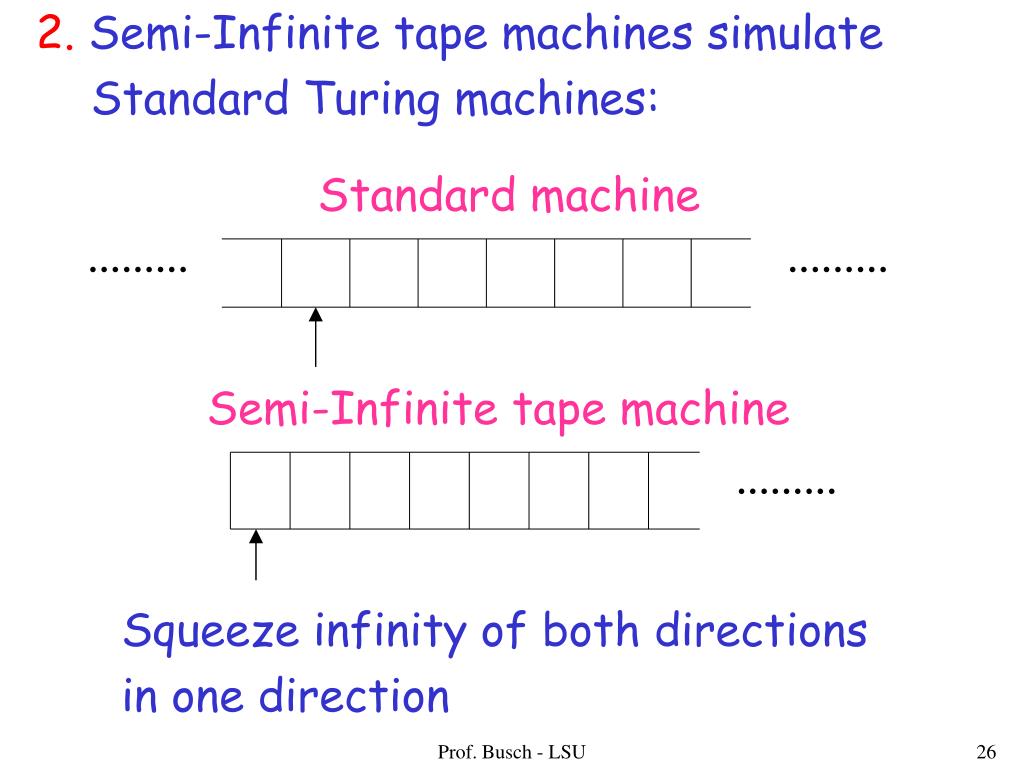
Does this extra "room" to the left add any computational power? Once again, the answer is no.
Proving Equivalence: The "Folding" Technique
We can simulate a two-way infinite tape TM M using a standard single-tape, semi-infinite TM S. The technique is to "fold" the two-way tape at cell 0 and store it on two "tracks" on the single tape.
For a deeper, more formal look at both multi-tape and two-way infinite tape simulations, the following reading is excellent.
Turing Machines and Effective Computability
These notes from a Cornell University course on computability provide a concise and formal explanation for the equivalence of these TM variations. This will solidify the intuitive understanding from the video.
Please read the section titled '3 Equivalent Models' (starts on page 10). Focus on the two subsections: 'Multiple Tapes': This provides a more formal description of the multi-tape simulation, introducing the concept of 'tracks' which is conceptually equivalent to the separator method. 'Two-Way Infinite Tapes': This explains the 'folding' technique for simulating a bi-directionally infinite tape on a semi-infinite one. Don't worry about the 'Two Stacks' or 'Counter Automata' sections for now, though they are further examples of this same principle of robustness.
As explained in the reading, the simulation works as follows:
- Tape Representation: The single tape of
Sis treated as having two tracks.- Top Track: Stores the cells of
M's tape with non-negative indices (0, 1, 2, ...). - Bottom Track: Stores the cells of
M's tape with negative indices (-1, -2, -3, ...) in reverse order. So, tape cell -1 ofMis at index 0 ofS's bottom track, cell -2 is at index 1, and so on.
- Top Track: Stores the cells of
- Simulating a Move: The finite control of
Sremembers whether it's simulating the head on the positive or negative part ofM's tape.- If
M's head is on a non-negative cell and moves Right,Smoves its head Right on the top track. - If
M's head is on a negative cell (say, -i) and moves Left (to -i-1),Smoves its head Right on the bottom track. - If
M's head is on a negative cell and moves Right,Smoves its head Left on the bottom track. - Crossing the "fold" (e.g., from cell 0 to -1) involves
Ssimply switching its attention from the top track to the bottom track at its current position (index 0).
- If
This construction proves that a standard TM can simulate a two-way infinite tape TM, meaning they are computationally equivalent.
Test your understanding!
In the two-track simulation of a two-way infinite tape, suppose the simulated head of TM M is on cell -3.
- At what index on the tape of the simulating TM
Sis the head located? - Which track (top or bottom) is
Soperating on? - If
M's transition rule isδ(q, a) = (p, b, L), what doesSdo? (i.e., where does its head move and which track does it operate on next?)
Show answer
- The head of
Sis at index 2. (Cell 0 is index 0, -1 is index 0, -2 is index 1, -3 is index 2). Sis operating on the bottom track.- The instruction is to move Left on
M's tape, from cell -3 to -4. On the bottom track ofS, this corresponds to moving Right, from index 2 to index 3.Swould writebon the bottom track at index 2, change state top, and move its head to index 3, continuing to operate on the bottom track.
Conclusion
Today we've established a critical property of Turing Machines: their robustness. Enhancements that seem powerful, like adding multiple tapes or an infinitely long left side of the tape, are ultimately just conveniences. They can make designing TMs easier and often much more efficient, but they do not expand the class of languages that can be recognized. This principle is fundamental to computer science.
Key Takeaways:
- Equivalence through Simulation: We prove that two models of computation are equivalent by showing that one can simulate the other. We've done this for multi-tape and two-way infinite tape TMs.
- Robustness of the TM Model: The fact that these variations don't add power is strong evidence for the Church-Turing Thesis—the claim that any function that can be intuitively "computed" can be computed by a Turing Machine. Many different proposed models of computation have been shown to be equivalent to the TM.
- Power vs. Efficiency: While not more powerful, variant TMs are often more efficient. Simulating a
T(n)-time multi-tape TM on a single-tape TM might take O(T(n)^2) time. This distinction between what can be computed and how efficiently it can be computed is the central theme of computational complexity theory, which we will touch on later in the course.
Preview of the Next Lesson:
We've explored adding tapes and space. What about adding a different capability: nondeterminism? In our study of finite automata, we saw that Nondeterministic Finite Automata (NFAs) were equivalent in power to DFAs. In our next lesson, we will define Nondeterministic Turing Machines (NTMs) and ask the same question: are they equivalent to deterministic TMs? The answer will be "yes," but the simulation will be our most intricate one yet.