Introduction
In the previous lesson, you engineered a critical piece of system architecture: a centralized error handler using the Error Trigger node. Your system can now reliably catch any unhandled, workflow-halting error, log it, and send an alert. This is the foundation of an observable system.
However, simply catching errors is a reactive measure. A truly resilient system anticipates and automatically recovers from temporary, or transient, failures. External APIs can become temporarily unavailable, rate limits can be hit, and network glitches can occur. A junior-level workflow fails and requires manual intervention; a production-grade workflow recovers on its own.
This lesson's objective is to design and implement retry mechanisms with exponential backoff for transient API or service failures. You will move beyond simple failure detection to proactive, intelligent recovery. Instead of hammering a failing service with immediate retries, we will implement an exponential backoff strategy—a standard industry practice that increases the delay between each retry attempt. This gives the external service time to recover and prevents your system from contributing to a service outage.
The Spectrum of Retry Mechanisms
Not all retry strategies are created equal. The simplest approach, available as a built-in feature in many n8n nodes, is a fixed-interval retry. Let's examine this first to understand its limitations.
Why 97% of n8n Workflows Fail in Production (And How to Fix It)
The video 'Why 97% of n8n Workflows Fail in Production' provides a quick overview of n8n's native 'Retry on Fail' setting. This is our baseline.
Watch from 06:07 to 11:16. Pay attention to how the 'Retry on Fail' option is configured within a node's settings. Note the parameters: number of retries and the fixed time between them. The video also touches on a fallback mechanism, which we will explore in later lessons.
This built-in feature is a good first line of defense, but it's a blunt instrument. It lacks two critical features required for a robust system:
- Conditional Logic: It retries on any failure. Retrying on a
401 Unauthorizederror is pointless; the API key is wrong and requires manual intervention. Retrying on a429 Too Many Requestsor a503 Service Unavailableerror, however, is exactly what we want. - Exponential Backoff: A fixed delay is problematic. If a service is overloaded, immediate, repeated retries from multiple systems (the "thundering herd" problem) can make the situation worse. Exponential backoff gracefully backs off, increasing the wait time after each failed attempt.
To address these limitations, we must engineer a custom retry pattern.
Architecting a Custom Exponential Backoff Handler
A professional retry mechanism is a self-contained error recovery loop that intelligently decides if and when to retry.
First, let's visualize the pattern.

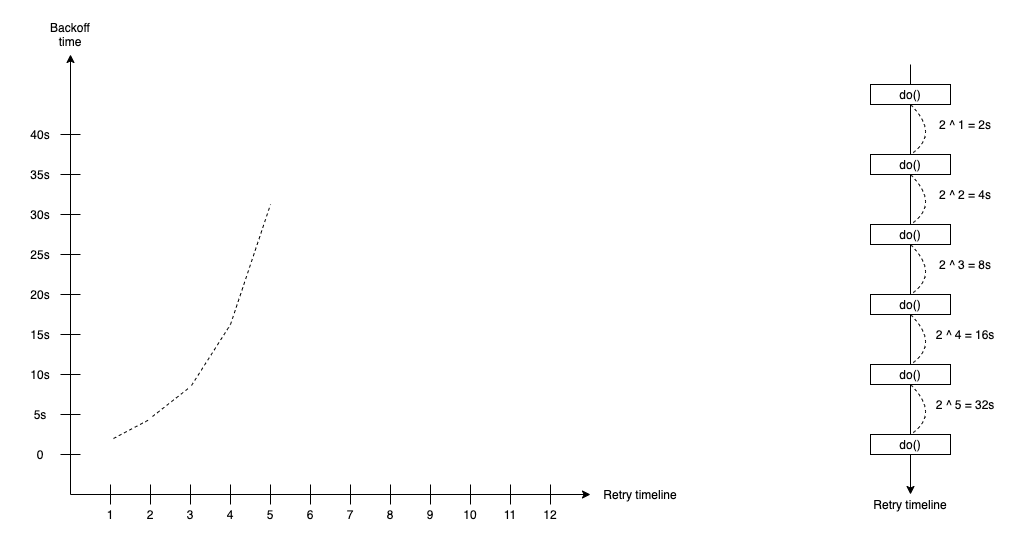
To implement this in n8n, we will construct a micro-architecture within our workflow using a combination of nodes.
Advanced Error Handling for n8n AI Workflows
The article 'Advanced Error Handling for n8n AI Workflows' from Vatech.io provides the precise blueprint for this pattern. It details how to use a combination of nodes to build a stateful, conditional retry loop.
Read the sections 'Implementing Custom Retry Logic with Exponential Backoff' and 'Conditional Error Processing'. Pay close attention to: The proposed architecture: Try/Catch -> Function -> Wait -> IF. The role of the Function node in managing state (retry count). The JavaScript snippet for calculating the exponential delay. The logic for using an IF or Switch node to retry only on specific HTTP status codes.
This pattern, often called an Error Recovery Pipeline, is a fundamental concept in distributed systems design, as reinforced by the "Essential Production Patterns" resource from withseismic.com (LINK). You are not just building a workflow; you are implementing a proven engineering solution.
Practical Task: Engineer an Error Recovery Pipeline
Scenario: Your [WIP] Webhook Lead Intake workflow makes an API call to an external data enrichment service. This service is critical but has a strict rate limit (returning 429) and occasionally becomes unstable (returning 5xx errors). You must architect the workflow to survive these transient failures by retrying intelligently, and to fail fast for permanent errors.
Your task is to wrap the API call in a custom-built exponential backoff retry mechanism.
Part 1: Isolate the Fallible Operation
- In your
[WIP] Webhook Lead Intakeworkflow, locate theHTTP Requestnode responsible for data enrichment. - Drag a Try/Catch node onto the canvas. This node is different from the global Error Workflow; it provides a local
try/catchblock within a single workflow. - Move your
HTTP Requestnode inside theTrybranch. TheCatchbranch will now execute only if theHTTP Requestnode fails.
Part 2: Implement Conditional Error Routing
In the Catch branch, we first determine if the error is worth retrying.
- Add a Switch node immediately after the
Catchoutput. - Configure the Switch node to route based on the HTTP status code of the error. You will access this with an expression like
{{ $input.first().json.error.httpStatus }}. - Create an Output for Retryable Errors:
- Rule 1:
Routing Rule->Add Condition->Number. Set theValue 1expression to{{ $input.first().json.error.httpStatus }}. Set theOperationtoEqualsandValue 2to429. Add OR.- Rule 2:
Routing Rule->Add Condition->Number. SetValue 1to{{ $input.first().json.error.httpStatus }}. SetOperationtoLarger Or EqualandValue 2to500.
- Rule 1:
- Create an Output for Non-Retryable Errors: This will be the
Defaultoutput. - Connect the
Defaultoutput to a Stop and Error node. Configure its message to be informative, e.g.,FATAL: Unrecoverable API Error - {{ $input.first().json.error.message }}. This will deliberately halt the workflow and trigger your global[SYS] Global Error Handler, which is the correct behavior for a permanent failure.
Part 3: Build the Exponential Backoff Loop
Now, on the "Retryable Errors" output path of your Switch node, build the recovery loop.
-
Manage State:
- Add a Function node. This node will manage the retry state.
- Paste the following code, which is adapted from the Vatech.io article. It initializes a retry counter, increments it, calculates the next delay, and passes this state along with the item.
const item = $input.first(); const retryAttempts = item.json.retryAttempts || 0; const maxRetries = 3; const baseDelayMs = 2000; // Start with a 2-second base delay if (retryAttempts < maxRetries) { const nextRetryAttempts = retryAttempts + 1; // Exponential backoff: 2s, 4s, 8s const delay = Math.pow(2, nextRetryAttempts - 1) * baseDelayMs; // Add jitter: a random value to prevent synchronized retries from multiple systems const jitter = Math.random() * 1000; item.json.retryAttempts = nextRetryAttempts; item.json.retryDelayMs = delay + jitter; item.json.lastError = item.json.error; // Store the last error for context // This item will be returned to the 'Wait' node return item; } else { // Max retries reached, mark for failure item.json.maxRetriesReached = true; item.json.finalError = item.json.error; // This item will be returned to the 'IF' node's false branch return item; } -
Enforce Delay:
- Add a Wait node after the
Functionnode. - Configure it to wait for a duration specified by the
retryDelayMsproperty we just created. SetValueunderWait Timeto the expression:{{ $json.retryDelayMs }}and the unit toMilliseconds.
- Add a Wait node after the
-
Loop or Exit:
- Add an IF node after the
Waitnode. - Set the condition to check if we have reached our max retries.
Condition->Boolean, withValue 1set to{{ $json.maxRetriesReached }}and the operationis false. - The true output (retries remaining) should loop back and connect to the input of the Try/Catch node. This completes the retry loop.
- The false output (max retries reached) should connect to a Stop and Error node. Configure its message to:
FAILURE: API call failed after ${{$json.retryAttempts}} attempts. Final Error: ${{$json.finalError.message}}. This provides a clear, terminal failure message to your global error logger.
- Add an IF node after the
Part 4: Test Your Implementation
Use a service like https://httpstat.us to test your logic. Temporarily change your HTTP Request URL to the following and observe the results in your execution log:
- Test Case 1 (Transient Error):
https://httpstat.us/503. Your workflow should pause, wait, and retry. After a few retries, change the URL back to a valid one and confirm the loop continues to a successful execution. - Test Case 2 (Non-Retryable Error):
https://httpstat.us/401. The workflow should immediately route to theStop and Errornode and trigger your global error handler. - Test Case 3 (Max Retries):
https://httpstat.us/503. Let the workflow run. It should attempt 3 retries with increasing delays and then finally hit the "max retries reached"Stop and Errornode.
Deliverables
- Architecture Screenshot: A full screenshot of your workflow canvas showing the complete
Try/Catchblock, including the conditionalSwitchand the retry loop (Function->Wait->IF). - Execution Log Screenshot: A screenshot of a successful execution log after at least one retry attempt. It should clearly show the path through the
Catchbranch and theWaitnode.
Evaluation Criteria
- Architectural Soundness: Is the Error Recovery Pipeline implemented correctly using the
Try/Catch,Switch,Function,Wait, andIFnodes? - Conditional Logic: Does the
Switchnode correctly differentiate between retryable (429,5xx) and non-retryable errors? - State Management: Does the
Functionnode correctly manage theretryAttemptscount and calculate the exponential delay? - Loop Integrity: Does the workflow correctly loop for retryable errors and exit the loop after hitting
maxRetriesor encountering a non-retryable error? - System Integration: Does the pattern correctly trigger the global error handler (via
Stop and Error) for all terminal failures?
Conclusion
You have now elevated your error handling from simple detection to intelligent, automated recovery. By implementing a conditional, stateful retry loop with exponential backoff, you've built a mechanism that makes your automations dramatically more resilient to the transient failures inherent in distributed systems. This is a significant step from being a workflow builder to becoming a systems architect.
Key Takeaways:
- Simple Retries vs. Engineered Recovery: You understand the limitations of basic retries and can now build a superior, custom solution.
- The Error Recovery Pipeline: This pattern (
Try/Catch->Switch->Function->Wait->IF) is a reusable, production-grade solution for handling fallible external calls. - Conditional Processing: Not all errors are equal. Routing errors based on their type (e.g., HTTP status) is essential for efficiency.
- Exponential Backoff with Jitter: This is the industry standard for retrying requests to avoid overwhelming a struggling service.
In the next lesson, we will address the final piece of this resilience puzzle. What happens to the items that fail all retries or are deemed un-retryable? Simply logging them is not enough. You will learn to build a dead-letter queue pattern to capture and store failed items for manual review and reprocessing, ensuring no data is ever lost.