Introduction
In our last lesson, we quantified the significant competitive advantage of the Tamil Nadu State Quota by comparing its closing ranks against the much higher ranks required for the All India Quota. This established a core strategic principle: for most candidates, the state quota is the most viable path to an MBBS seat in Tamil Nadu. However, cutoff ranks are not static; they evolve each year.
This lesson addresses a key factor that influences these changes: the establishment of new medical colleges. We will explore how an increase in the total number of MBBS seats impacts cutoff ranks and seat distribution. You'll learn why the simple logic of "more supply equals lower price" doesn't always hold true in the hyper-competitive environment of NEET. This understanding is crucial for setting realistic expectations for your sister and for building a robust choice-filling strategy.
The Theory: More Seats, Lower Cutoffs
On the surface, the relationship between seat count and cutoffs follows a simple supply-and-demand model. Let's frame this in terms you're familiar with from software development. Imagine you're managing a queue of asynchronous tasks, and you have a pool of 100 worker threads to process them. If the 100th task is picked up by a worker, that sets your "processing threshold."
In NEET counseling:
- Seats are the worker threads.
- Candidates, sorted by rank, are the tasks in the queue.
- The closing rank is the rank of the last candidate (task) to be assigned a seat (worker).
If the government adds 20 new seats (increasing the worker pool to 120), the system can now process up to the 120th candidate in the queue. This means a candidate with a lower rank (e.g., 120th instead of 100th) now secures a spot. The closing rank has "dropped," making admission slightly easier.
The following resource from the ZyNerd counselling guide explicitly confirms this fundamental principle.
NEET Seat Matrix and Cutoff Insights: ZyNerd Counselling Guide
This article explains the core concepts of seat matrix and cutoffs and directly connects changes in seat count to cutoff movements.
First, read the paragraph under the heading "Connecting Seat Matrix and Cutoff Data" that starts with "The seat matrix shows..." to understand the direct link between seat count and cutoffs. Next, under the "Avoiding the Most Common Counselling Mistakes" section, find the bullet point "Relying on one-year data" and read the advice given there. Focus on the sentence about seat additions, as it reinforces this logic.
This confirms the basic theory: an increase in the number of seats exerts downward pressure on cutoffs, making them less competitive.
The Reality: Why Cutoffs Keep Rising
While the theory is sound, the real-world data often tells a different story. Despite new medical colleges being added regularly in Tamil Nadu and across India, the cutoffs for government seats have been steadily climbing.
Why does this happen? The "demand" side of our equation is not static; it's growing at an explosive rate, often outpacing the increase in "supply."
The following article from CollegeSimplified breaks down the factors contributing to this trend.
NEET Cutoff Trends 2020–2026: Category-Wise Analysis for Government Medical Colleges in India
This article provides a sharp analysis of why cutoffs are rising despite the addition of new medical colleges, which is the central question of this lesson.
Begin by reading the section titled "Why is the Cutoff Increasing?". This part details the key reasons, such as the massive growth in the number of applicants and improved overall performance. Then, jump to the FAQ section and read the answer to question 4, "Does the increase in MBBS seats lower the cutoff?". This provides a concise summary of the net effect.
As the articles explain, several factors create intense upward pressure on cutoffs:
- Explosive Candidate Volume: The number of students appearing for NEET is growing much faster than the number of seats being added.
- Higher Performance: Due to better access to online coaching and a large number of students repeating the exam ("droppers"), the overall average score and the number of high-scorers are increasing each year.
Think of it like the job market for a popular tech stack like React. Even if the number of available developer jobs increases by 10% in a year, if the number of highly skilled applicants with strong portfolios doubles in the same period, the competition for each job actually becomes tougher.
This dramatic increase in high-scoring candidates is not just a theory. Look at the data from the Times of India comparing the number of students at each score level between 2023 and 2024.
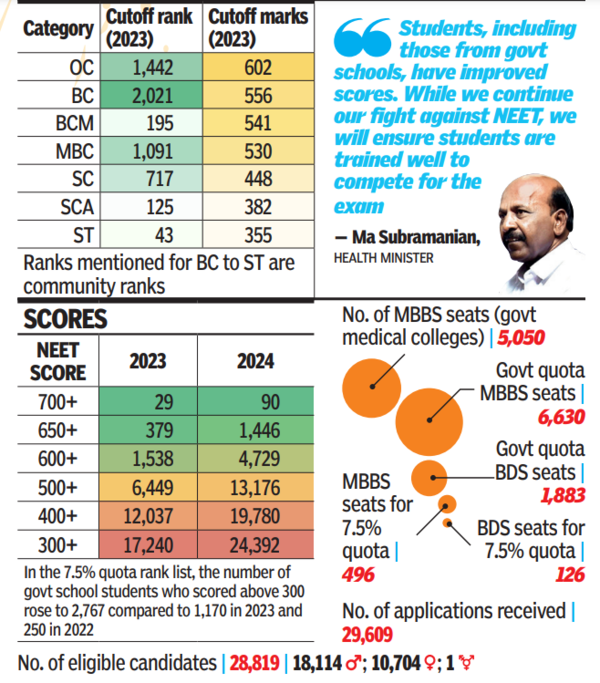
Let's analyze the "SCORES" table from the image:
- 650+ Score: The number of students jumped from 379 in 2023 to 1,446 in 2024—an almost fourfold increase.
- 600+ Score: The number grew from 1,538 to 4,729.
- 500+ Score: This bracket saw an increase from 6,449 to 13,176.
This data vividly illustrates the "demand surge." Even if several hundred new seats were added, they would be quickly absorbed by the thousands of new high-scorers entering the applicant pool. This is precisely why cutoffs for desirable colleges can remain stable or even increase.
The Net Effect: A Balancing Act
So, what is the ultimate impact of adding new medical colleges? It's a balancing act between two opposing forces:
- Downward Pressure: More seats are available, which tends to lower closing ranks.
- Upward Pressure: A larger and higher-scoring applicant pool competes for those seats, which tends to raise closing ranks.
In recent years, the upward pressure has been the dominant force, especially for established and mid-tier colleges. However, this does not mean new colleges have no effect.
The crucial takeaway is that new colleges help to absorb the increased competition. Without the addition of new seats, the cutoffs would rise even more sharply. New colleges expand the total number of opportunities, preventing the system from becoming impossibly competitive for everyone except the absolute top-rankers.
Strategic Implications for Your Sister
Understanding this dynamic is key to forming a realistic counseling strategy:
- Manage Expectations: Do not assume that the addition of a few new government colleges in Tamil Nadu will automatically make it much easier to get a seat. The competition will still be fierce.
- Leverage New Colleges in Choice Filling: Newer government medical colleges almost always have lower cutoffs (higher closing ranks) than older, more established institutions like Madras Medical College or Stanley Medical College. Therefore, these new colleges are excellent candidates to include in the lower half of your sister's preference list. They act as "safety" options that are still highly desirable government seats.
- Analyze Trends: When looking at past-year data, recognize the general upward trend in cutoffs. A closing rank from two years ago might not be a reliable target for this year. Always prioritize the most recent data while keeping the trend in mind.
By adding new colleges to the choice list, you expand the set of realistic possibilities, increasing the probability of securing a government seat, even if it's not at a top-tier, legacy institution.
Conclusion
In this lesson, we dissected the complex relationship between new medical college seats and NEET cutoffs. While intuition suggests more seats should lead to lower cutoffs, the reality is more nuanced due to overwhelming demand.
Here are the key takeaways:
- Two Opposing Forces: The addition of new seats creates downward pressure on cutoffs, while the rapidly growing pool of high-scoring applicants creates strong upward pressure.
- Demand Outpaces Supply: In recent years, the growth in the number and quality of candidates has outpaced the increase in seats, causing cutoffs for most government colleges to rise or stay stable.
- New Colleges Absorb Competition: The primary role of new colleges has been to absorb the surge in demand, preventing cutoffs from rising even more dramatically. They create essential new opportunities in a crowded field.
- Strategic Value: For choice filling, new government colleges are valuable additions to a preference list, typically serving as more attainable options compared to older, more sought-after institutions.
We have now examined all the key data points that influence counseling: ranks, quotas, seat matrices, closing ranks, and the impact of new colleges. With this analytical foundation, you are ready to move from analysis to synthesis.
In the next module, "Strategic Choice Filling and Scenario Planning," we will begin by focusing on how to formulate a prioritized preference list of colleges that integrates all these factors—cutoff data, fees, location, and your sister's personal preferences—into a single, coherent strategy.