Introduction
In our last lesson, we focused on interpreting the seat matrix, which you can think of as the real-time "supply" of available seats before each counseling round. Now, we shift our focus to the other side of the equation: "demand." We will analyze closing ranks to understand the level of competition for these seats.
This lesson directly addresses a critical strategic question for your sister: for a given medical college in Tamil Nadu, how much more competitive is it to get a seat through the 15% All India Quota (AIQ) versus the 85% Tamil Nadu State Quota? By comparing previous years' closing ranks for top South Indian colleges, you will be able to quantify the significant advantage that Tamil Nadu domicile provides and make informed decisions about which counseling pathway to prioritize.
The Two Pathways: AIQ vs. State Quota Competition
As a developer, you can conceptualize AIQ and State Quota counseling as two separate systems with different access controls.
- All India Quota (AIQ): This is like a public, global API endpoint. It pools 15% of the seats from government colleges across the entire country. Every eligible NEET candidate in India is competing for this same pool of seats. The competition is national and, therefore, extremely high.
- Tamil Nadu State Quota: This is like a private, geo-fenced API endpoint. It reserves 85% of seats in Tamil Nadu government colleges exclusively for candidates with Tamil Nadu domicile. The applicant pool is drastically smaller, limited only to candidates within the state.
Logically, the competition for the State Quota seats will be lower. Our goal today is to look at the data to see just how much lower it is.
Analyzing Aggregate Cutoff Data: The Big Picture
Before we dive into specific colleges, let's examine the overall closing ranks for government MBBS seats in Tamil Nadu. The following resource from MBBSCouncil provides a clean summary of cutoff data across multiple years.
Expected NEET cut off 2026 for MBBS in Tamilnadu – 2025,2024 ...
This article provides clear, tabulated cutoff data for both AIQ and State Quota in Tamil Nadu, which is perfect for a direct comparison.
Focus on the tables for NEET 2022. First, read the table "NEET 2022 cut off for government colleges All India Quota". Note the All India Rank (AIR) and score for the General Category (GN). This represents the last rank that secured any government MBBS seat in Tamil Nadu through AIQ. Next, examine the table "NEET 2022 Cut off for MBBS In Tamil Nadu State Quota Government Medical Colleges". Note the State Rank (SR) and score for the Open Competition (OC) category.
Let's break down the data from 2022 for the General Category:
- AIQ Closing Rank: An All India Rank of 19,363 (Score: 603) was the cutoff to get into a government medical college in Tamil Nadu.
- State Quota Closing Rank: A State Rank of 1,423 (Score: 581) was the cutoff.
The most striking observation is the score difference: a candidate needed a score of 603 for a government seat via AIQ, while a Tamil Nadu domicile candidate could secure one with a score of 581. This 22-mark difference is a clear quantification of the "domicile advantage." While a State Rank of 1,423 is not directly equivalent to an AIR of 1,423, it typically corresponds to a much higher (less competitive) AIR, illustrating the reduced competition within the state pool.
College-wise Comparison: AIQ vs. State Quota Ranks
Now let's drill down to the level of individual colleges. How does the competition for a top institution like Madras Medical College compare between the two quotas? Answering this is key to building a realistic preference list.
The resource below provides college-wise AIQ closing ranks for various states, including the top South Indian states.
NEET Cutoff 2023 for General Category; Check State-wise MBBS Cut off for GN Category
This article from Shiksha provides recent, college-specific AIQ cutoff data.
First, read the introduction "NEET MBBS Cutoff 2023 for General Category" to confirm the data is for the 15% AIQ. Then, scroll down to the Tamil Nadu section and examine the NEET 2023 Cutoff column for a few top government colleges like Madras Medical College, Coimbatore Medical College, and Government Kilpauk Medical College. Briefly review the tables for Karnataka and Kerala to get a sense of the AIQ competition for top colleges in neighboring states, such as Bangalore Medical College or Government Medical College Kozhikode.
Let's create a comparative table to visualize the difference. We'll use the AIQ closing ranks from the resource you just reviewed and illustrate the State Quota principle. Note that precise State Quota closing ranks for each individual college are found in detailed allotment lists published by DME TN, but the trend is clear.
| College Name | AIQ Closing Rank (2023) | State Quota Closing Rank (General Principle) |
|---|---|---|
| Madras Medical College, Chennai | 1,585 | The State Rank cutoff will be much lower (less competitive) than the AIQ rank, likely falling in the top few hundred State Ranks. |
| Coimbatore Medical College | 10,931 | Similarly, requires a significantly lower State Rank compared to the AIR needed for an AIQ seat. |
| Tirunelveli Medical College | 11,969 | The pattern continues. Access via State Quota is considerably easier. |
| Any TN Govt. College (Last Seat) | ~23,674 (GMC Nagapattinam) | A TN domicile candidate with a much higher AIR (e.g., 30,000+) could still secure a seat if their State Rank is within the state's cutoff. |
Key Observations:
- Top-Tier Competition: To secure a seat in a premier institution like Madras Medical College through AIQ, a candidate needs an exceptional AIR, well within the top 2,000.
- The Domicile Advantage: For that same college, a Tamil Nadu candidate competes only against other TN candidates for the 85% of seats. This means a candidate whose AIR might be 5,000 or 10,000 could still get into MMC via State Quota if their State Rank is high enough.
- Broader South Indian Context: As you saw in the Shiksha resource, top colleges in other South Indian states are also extremely competitive via AIQ. For instance, Bangalore Medical College (Karnataka) and Govt. Medical College Kozhikode (Kerala) had AIQ closing ranks of 1,337 and 1,391, respectively, in 2023. This reinforces that high AIQ ranks are needed for premier government colleges anywhere in the country.
Strategic Implications: Who Should Prefer Which Quota?
This data analysis leads to clear strategic takeaways for your sister's counseling process. The following chart provides a great visual summary of the decision-making process.
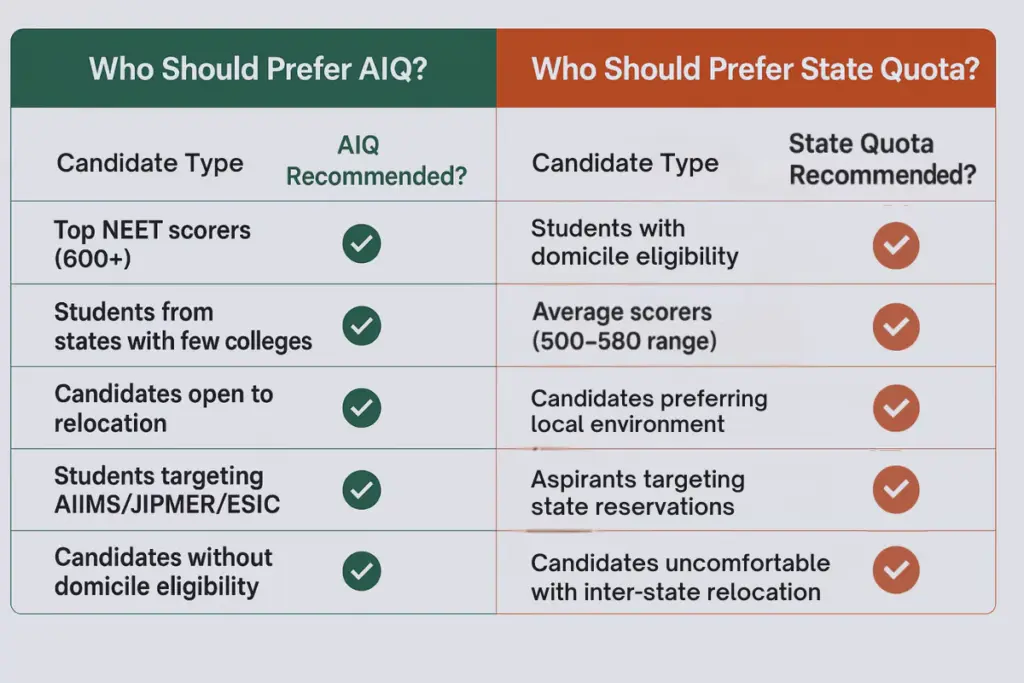
Based on this and our data analysis, here is the strategic breakdown for a candidate with Tamil Nadu domicile:
Primarily Focus on Tamil Nadu State Quota if:
- Her primary goal is to secure any government MBBS seat, and her score is in the average-to-good range (e.g., 550-620). The State Quota offers the highest probability of success.
- She prefers to study within Tamil Nadu.
- Her rank is not high enough for a top-20 national college via AIQ, but is strong enough for a good government college within the state.
Consider All India Quota Seriously if:
- She achieves an exceptionally high AIR (e.g., top 2,000) and wishes to target premier national institutes like AIIMS Delhi, JIPMER, or top colleges in other major cities (like Bangalore or Mumbai).
- Her rank is borderline, just missing the TN State Quota cutoff for a government seat. AIQ might provide a "backup" option for a government college in another state with a lower cutoff.
For most candidates, the optimal strategy involves participating in both, but prioritizing the choice filling for the State Quota counseling, as it represents the most probable path to a low-fee government MBBS seat.
Conclusion
In this lesson, we have moved from understanding seat supply to analyzing seat demand. By comparing AIQ and State Quota closing ranks, we've established a fundamental principle of NEET counseling: domicile provides a significant competitive advantage.
Here are your key takeaways:
- Quantifiable Advantage: The score and rank required to secure a government MBBS seat in Tamil Nadu is substantially lower through the State Quota compared to the All India Quota.
- AIQ is for the Top Tier: The 15% AIQ seats in desirable colleges are reserved for candidates with very high All India Ranks.
- Strategic Priority: For a candidate with Tamil Nadu nativity, the 85% State Quota is the primary and most realistic pathway to a government medical college in the state.
- Dual Participation: While the State Quota is the focus, participating in AIQ counseling provides optionality, either for aiming at elite national institutes or as a potential backup.
The cutoff ranks we've discussed are a reflection of past performance. However, they are not static and can change from year to year. One of the biggest factors influencing these cutoffs is the creation of new medical colleges. In our next lesson, we will explore how the addition of new medical colleges typically impacts cutoff ranks and seat distribution, adding another layer to your strategic planning model.