Introduction
In our previous lesson, we established a valuable framework by correlating NEET score ranges with different tiers of medical colleges in Tamil Nadu. This gives your sister an immediate way to gauge her prospects once the results are out. However, those correlations are based on historical data. Counseling decisions, in contrast, must be made using real-time information.
This brings us to the focus of today's lesson: interpreting the official seat matrix. Think of the seat matrix as a live inventory report or a real-time database snapshot published before each counseling round. It tells you the exact number of seats available in every college, for every category, at that specific moment. Mastering this document is essential for moving from strategic planning to tactical execution during choice filling. By the end of this lesson, you will be able to read and understand the seat matrix documents published by both the MCC for the All India Quota and DME TN for the State Quota.
What is a Seat Matrix?
The seat matrix is an official document that provides a detailed, tabular breakdown of available seats for an upcoming counseling round. It's the ground truth for seat availability. While last year's closing ranks tell you about historical demand, the seat matrix tells you about the current supply.
In your work as a full-stack developer, you might query a database to get the current inventory of a product before allowing a user to add it to their cart. The seat matrix serves the exact same purpose for a NEET candidate. It lists which "products" (seats in specific colleges) are "in stock" for their category.
For a comprehensive definition, let's turn to a guide from College Ustad.
Understanding NEET UG Seat Matrix: A Complete Guide - collegeustad.com
This guide provides a clear and structured overview of the seat matrix, its components, and its strategic importance.
Please read the following sections: Start with the definition to understand what it includes. Then, read the section on its importance, which explains why this document is a critical strategic tool. Next, review the list of components to familiarize yourself with the data you'll encounter. Finally, focus on the step-by-step guide on how to read it. This provides a practical framework for analysis.
Deconstructing the Seat Matrix: Understanding the Columns
As you've just read, a seat matrix contains several key columns. Let's analyze them from the perspective of your sister, who is applying under the General Category (OC) with a focus on Tamil Nadu.
- Institute/College Name: The name of the medical college.
- Quota: This is a critical field. It specifies which counseling body controls the seat. For your purposes, the main quotas are:
- All India Quota (AIQ): For the 15% of seats in government colleges nationwide, filled by the MCC. Your sister is eligible for these seats in any state.
- State Quota (SQ): For the 85% of seats in Tamil Nadu's government colleges, plus Government Quota seats in self-financing colleges. These are filled by DME TN and are exclusive to candidates with Tamil Nadu nativity.
- Branch/Course: This will be 'MBBS'.
- Category: This specifies the reservation category. For your sister, you will focus on the column labeled 'OP', 'OPEN', 'OC' (Open Competition), or 'UR' (Unreserved). These all refer to the General Category.
- Total Seats: The number of seats available for that specific combination of college, quota, and category.
Let's look at a real-world example. The image below shows a partial seat matrix for Round 2, specifically listing newly added seats.
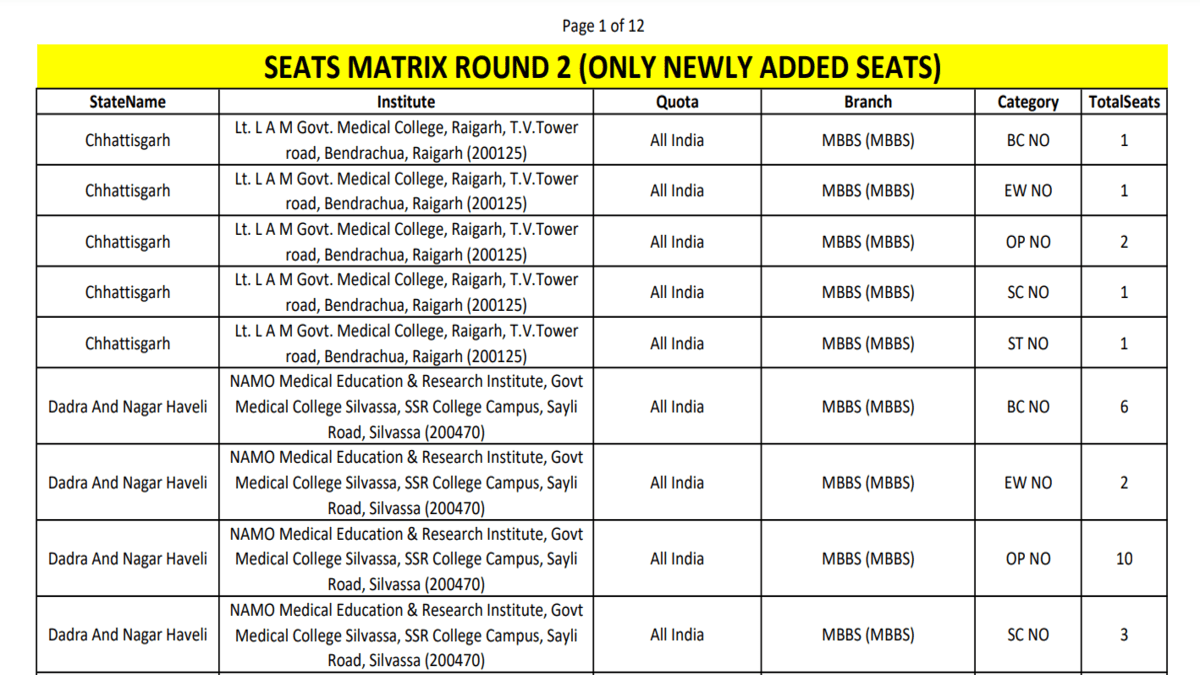
In this example, if we look at the NAMO Medical Education & Research Institute, we can see that for the All India Quota, in the MBBS branch, there are 10 seats available under the OP NO (Open) category. This is exactly how you would extract a piece of actionable information from the document.
The Dynamic Nature of the Seat Matrix
A crucial concept to grasp is that the seat matrix is not static. It is updated and re-published before each round of counseling.
- Round 1 Matrix: This is the initial state, showing all the seats available at the start of counseling.
- Round 2 Matrix: This matrix lists only the seats that are vacant after Round 1 is complete. A seat can become vacant for a few reasons:
- It was never filled in Round 1.
- The candidate who was allotted the seat took a 'Free Exit' and did not join.
- The candidate who was allotted the seat in Round 1 has been successfully upgraded to a higher preference in Round 2, thus vacating their Round 1 seat.
- Mop-Up & Stray Vacancy Round Matrices: These follow the same principle, showing any remaining seats from previous rounds.
This process is analogous to state management in a web application. The initial seat matrix is the initialState. Each counseling round is an action that modifies this state. The seat matrix for the next round is the new, updated state that gets rendered to the user (the candidate).
The following resource explains this dynamic process and highlights common mistakes to avoid.
NEET Seat Matrix and Cutoff Insights: ZyNerd Counselling Guide
This guide from ZyNerd explains the round-by-round changes in the seat matrix and how it connects to cutoff ranks.
Please read the following sections: Start with the section titled "How Is the Seat Matrix Updated Each Round?". This explains why you must check for new matrices before each round. Next, read the section "Connecting Seat Matrix and Cutoff Data". It clarifies the direct relationship between seat availability and competition. Finally, review the list under "Avoiding the Most Common Counselling Mistakes". Pay close attention to "Mixing up quotas" and "Not updating after each round," as these are directly related to interpreting the seat matrix correctly.
Where to Find the Official Documents
It is absolutely critical to use the official sources for seat matrices. Third-party websites can be helpful for analysis, but the definitive documents are published by the counseling authorities just before the choice-filling window opens for each round.
-
All India Quota (AIQ): The Medical Counselling Committee (MCC) is the authority. You will find the seat matrix PDFs on their official website:
mcc.nic.in. Look for them in the "UG Medical Counselling" section, typically under a "Current Events" or "Downloads" area. -
Tamil Nadu State Quota: The Directorate of Medical Education (DME), Tamil Nadu, is the authority. Their official website is
tnmedicalselection.net. The seat matrix for each round of state counseling will be published here.
Always download the latest PDF for the relevant round before your sister finalizes her choices. Checking this document ensures she is not filling choices for seats that don't exist in that round, and it might reveal unexpected opportunities in colleges where seats have become vacant.
Conclusion
In this lesson, you've learned how to decode one of the most important documents in the NEET counseling process: the seat matrix. It provides the real-time data on seat availability that is essential for making informed tactical decisions during choice filling.
Here are your key takeaways:
- The Seat Matrix is the "Ground Truth": It is the official inventory of available seats for a specific college, quota, and category in a given counseling round.
- It's Dynamic: A new seat matrix is released before each round (Round 1, Round 2, Mop-Up), reflecting the seats that remain vacant from the previous round.
- Key Columns to Analyze: For your sister's situation, you'll need to filter by Quota (AIQ or State), Course (MBBS), and Category (Open/OC/UR).
- Official Sources are Paramount: Always refer to the official MCC and DME TN websites for the definitive seat matrix documents for each round.
Now that you can identify what seats are available, the next logical step is to understand the relative competition for them. In our next lesson, we will directly compare the previous year's AIQ closing ranks for top South Indian colleges against their respective TN State Quota closing ranks. This will help you and your sister strategically weigh the pros and cons of applying through each counseling path.