Introduction
In our last lesson, we focused on transforming raw data into a powerful strategic tool: your sister's prioritized preference list. We established the four pillars for this—cutoff data, fees, location, and infrastructure—and stressed the "Top-to-Bottom" principle for choice filling. You now have a framework for creating a list that is ambitious, realistic, and financially sound.
This lesson adds another critical, and often overlooked, layer to your strategic analysis. We will address the learning outcome: Investigate the service bond requirements and financial penalties for different colleges in both AIQ and State Quota. These are essentially the "hidden terms and conditions" of a medical college admission. Understanding them is crucial, as they can have significant financial and career implications long after the counseling process is over. Think of these as contractual obligations that attach to the seat your sister accepts, much like a clawback clause in an employment contract that is tied to a signing bonus or relocation package.
Part 1: Financial Penalties in AIQ Counseling
The most immediate financial penalties you'll encounter are within the MCC's All India Quota counseling process. These are not service bonds, but rather penalties designed to ensure the counseling process runs efficiently by discouraging candidates from blocking seats they don't intend to take. The primary mechanism for this is the security deposit.
As you register for MCC counseling, you must pay a non-refundable registration fee and a refundable security deposit. The amount varies based on the type of college you are targeting.
MCC Counselling 2026 – AIQ Registration, Rounds ...
This guide from neet2seat.com clearly outlines the fee structure for MCC registration.
Please review the table under the heading "How to register". Pay close attention to the Security deposit column for AIQ/Central seats versus Deemed University seats. Note the significant difference in the deposit amount. Since your sister is targeting government colleges, the relevant amount is Rs 10,000 for the General (UR) category.
The crucial part is understanding the rules for when this deposit is refunded and when it is forfeited. The rules change with each round of counseling.
-
Round 1: The "Free Exit"
Round 1 is designed to be low-risk. If your sister is allotted a seat but decides not to join, there is no penalty. She can "exit" the process, and the security deposit will be refunded in full. This allows you to be ambitious with your choices in the first round. -
Round 2 and Beyond: The Cost of Indecision
From Round 2 onwards, the rules become strict. If your sister is allotted a seat (either a fresh allotment or an upgrade from Round 1) and she decides not to join the college, the security deposit is forfeited. She also becomes ineligible for any further rounds of MCC counseling for that year.
MCC Counselling 2026 – AIQ Registration, Rounds ...
The same guide explains the exit rules and consequences for each round.
First, read the paragraph under the sub-heading "Round 1". Note the explicit mention of the "free exit round." Next, carefully read the paragraph under the sub-heading "Round 2". This section clearly states the consequences of not joining an allotted seat in this round: your security deposit is forfeited. The section "What happens after allotment" reinforces this rule, stating that from Round 2 onward, non-joining forfeits the deposit.
This system functions like a transactional commit in a database. In Round 1, you can roll back without penalty. In Round 2, committing to choices and then failing to follow through results in a penalty. Therefore, your choice list for Round 2 must only contain colleges your sister is 100% willing to join if allotted.
Part 2: Bonds and Penalties in Tamil Nadu
When we turn to the Tamil Nadu State Quota, we encounter two different types of bonds mentioned in the official prospectus: the Discontinuation Bond and the Service Bond.
- Discontinuation Bond: This is a straightforward penalty for leaving the MBBS course midway after admission. If a student discontinues their studies for any reason, they are liable to pay a significant penalty.
- Service Bond: This is a commitment to serve the government, typically in a rural area, for a specified period after completing the MBBS degree.
The official information can be quite stark.
[PDF] Tamil Nādu State Counselling (MBBS/BDS) - Cloudfront.net
This document from Aakash Educational Services summarizes the information from the official TN prospectus.
Find the section titled "Bonds" near the end of the document. Read the two points: Discontinuation Bond and the details of the Service Bond.
As you can see, the terms are a ₹10 lakh penalty for discontinuation and a 5-year service commitment or a ₹5 lakh penalty. This often causes significant alarm. However, context is everything. The service bond, in particular, is not as absolute as it appears.
The following video provides a crucial clarification on how this service bond clause has been applied in practice over the years.
Bond and penalty Explained! | TN Medical Selection 2024
The "Biology Simplified Tamil" channel offers a detailed explanation of the bond mentioned in the Tamil Nadu prospectus, helping to separate the legal text from its practical application.
First, listen to the presenter read out the bond clause from the prospectus from the beginning. This is the text that causes concern. The key clarification comes next. Watch the segment from this timestamp. The presenter emphasizes that the bond is only activated if the government passes a "general or special order" demanding service. This is the most important part of the video. Finally, listen to the conclusion from this timestamp, where the presenter reassures viewers that this is a standard clause that exists every year and is not an automatic 5-year service requirement for every graduate.
The key takeaway is that the Tamil Nadu service bond is conditional. It's a legal provision the government can invoke, likely during a public health crisis or a severe doctor shortage, but it is not an automatic, mandatory service period for every student who graduates. The discontinuation bond, however, is a serious financial commitment to be aware of before confirming admission.
Part 3: The National Context and Strategic Implications
The existence of a service bond is not unique to Tamil Nadu. It's a factor you must consider when looking at colleges across India through the All India Quota. The terms—duration of service and penalty amount—vary wildly from state to state.
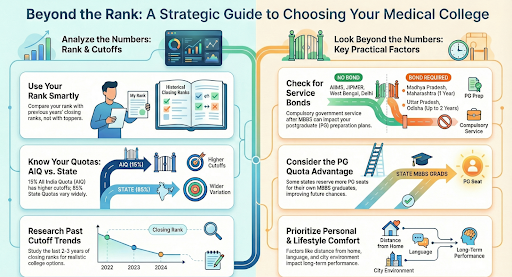
Some states have no bond, while others have very long service periods with high penalties, making them a "bond trap" for students who wish to pursue postgraduate studies immediately after MBBS.

How should this information influence your sister's strategy?
- For AIQ Choices: When creating the preference list for AIQ, the service bond of the state where the college is located becomes a major long-term consideration. A "top-ranked" college in a state with a 5-year mandatory bond might be less desirable for your sister than a slightly lower-ranked college in a "no-bond" state if her goal is immediate PG preparation.
- For Tamil Nadu Choices: The conditional nature of the TN bond makes it a lower-risk option compared to many other states. This strengthens the case for prioritizing TN colleges.
- For Decision Making: The Discontinuation Bond in Tamil Nadu underscores the importance of being absolutely certain before accepting a seat. Once joined, leaving is financially punitive. This reinforces the need for a well-thought-out preference list so that the allotted college is one she is truly happy to join.
Conclusion
You have now investigated another set of critical variables that influence the choice of a medical college. These financial and career obligations are just as important as the initial cutoff ranks and fees.
Here are the key takeaways from this lesson:
- Distinguish Penalties: AIQ counseling involves financial penalties (security deposit forfeiture) for not joining an allotted seat from Round 2 onwards. This is different from a service bond, which is a post-graduation commitment.
- AIQ Strategy: The "Free Exit" in Round 1 allows for risk-free, ambitious choices. In subsequent rounds, you must be conservative and only list colleges you are prepared to accept to avoid forfeiting the security deposit.
- Tamil Nadu Bonds: TN has a significant Discontinuation Bond (₹10 lakh penalty), making your final choice binding. The Service Bond (5 years or ₹5 lakh) is conditional and only activated by a specific government order, making it a lower practical risk than in many other states.
- Long-Term Planning: Always check the bond status of a college/state. This is a critical factor for long-term career planning, especially regarding immediate postgraduate studies.
In our next lesson, we will synthesize all the factors we've discussed so far—cutoffs, fees, location, infrastructure, and bonds—to simulate practical choice-filling scenarios. We'll explore how to apply the 'Top-to-Bottom' principle effectively and how to strategize for a borderline rank to balance ambition with security.