Introduction
In our last two lessons, we built the foundation for understanding NEET results. We first distinguished between marks, All India Rank (AIR), and State Rank, and then demystified the crucial concept of the qualifying percentile, which acts as the first gatekeeper to the counseling process. Now, we will bring these concepts together by examining the single most important document a candidate receives after the exam: the NEET UG Scorecard.
This lesson is designed to be a guided tour of the official scorecard. By the end of our session, you will be able to interpret every detail and rank provided on it. Understanding this document is not just about seeing a score; it's about extracting the specific data points that will drive every decision in the upcoming All India and State Quota counseling rounds.
Anatomy of the NEET Scorecard
Think of the NEET scorecard as a structured data object returned from an API call to the National Testing Agency (NTA). It contains a well-defined payload with distinct sections: personal information, performance metrics, and eligibility status. To begin, let's look at a sample scorecard. All the information we discuss will be found within a document structured like this one.

We will dissect this document into three logical parts, much like the presenter in the following video does. This will help us systematically understand the role of each piece of information.
NEET Scorecard Explained: Key Details You MUST Know!
This short video from Just Get MBBS provides an excellent visual breakdown of the scorecard's layout. It color-codes the main sections, which is a helpful way to conceptualize the document's structure.
Watch the initial overview from the introduction where the presenter divides the scorecard into three boxes. Then, continue through the explanation of the first section on personal details. Pay attention to the emphasis on verifying this information.
As the video highlights, the three key areas are:
- Personal Details: The candidate's identification data.
- Score and Rank Information: The core performance metrics.
- Qualifying Cutoff Details: The eligibility benchmarks for the year.
Let's examine each one. The personal details section is straightforward but critical. It includes the candidate's Roll Number, Application Number, name, date of birth, and category. Upon receiving the scorecard, the absolute first step is to verify that all these details are correct. Any error here can lead to significant complications during the document verification stage of counseling.
The Core Data: Scores and Ranks
This section is the heart of the scorecard and contains the data that determines a candidate's future. Let's break it down field by field, referring to the middle section of the sample scorecard image.
NEET Scorecard Explained: Key Details You MUST Know!
The same video provides a field-by-field explanation of this crucial section. The presenter offers practical advice on which numbers truly matter for counseling.
Please watch the detailed breakdown from this segment. Focus on the distinction made between "NEET All India Rank" and "All India Rank for Counselling," and the commentary on the usefulness of percentile and category rank.
Here’s a summary of the key fields and their significance:
-
Percentile Scores (Physics, Chemistry, Biology): As we discussed previously, percentile indicates relative performance. A 90th percentile in Physics means scoring better than 90% of all other test-takers in that subject. While this gives an idea of subject-wise strengths, these percentiles are not used for counseling. They are for informational purposes only.
-
Total Marks Obtained (out of 720): This is the candidate's raw score. It's calculated based on the NTA's marking scheme: +4 for a correct answer, -1 for an incorrect answer, and 0 for an unanswered question.
-
NEET All India Rank (AIR): This is the candidate's national rank among all test-takers. It is the primary determinant for seat allocation in the 15% All India Quota (AIQ) counseling.
-
All India Rank for Counselling: As the video points out, the scorecard lists two ranks. This is the rank you must use. For the vast majority of candidates, these two ranks will be identical. However, in the rare case they differ, the "All India Rank for Counselling" is the official one for all admission purposes.
-
Category Rank: This shows the rank within a specific reservation category (e.g., OBC, SC, ST). For your sister, who is in the General Category, this field is not relevant for seat allocation. Admission to an unreserved seat is based solely on the All India Rank for Counselling.
Tie-Breaking: The Sorting Algorithm
What happens if multiple candidates score the exact same mark? The NTA applies a pre-defined tie-breaking logic to assign unique ranks. From your perspective as a developer, this is analogous to a multi-level sort function on a dataset.
NEET Result 2025: Steps to Check Scorecard, NEET UG Merit List & Cutoff
This article section clearly outlines the sequence of rules used to resolve ties in NEET scores. Understanding this helps clarify why two students with the same score can have different ranks.
Please read the short section titled "NEET 2025 Result: Tie-Breaking Criteria".
The tie-breaking hierarchy is as follows:
- Higher marks in Biology (Botany & Zoology)
- If the tie persists, higher marks in Chemistry
- If the tie still persists, fewer incorrect answers across all subjects.
This deterministic process ensures that every candidate receives a unique All India Rank.
The Eligibility Flag: Qualifying Status
The third and final section of the scorecard confirms a candidate's eligibility to even participate in counseling. This part directly connects to our previous lesson on the qualifying percentile.
This table shows the minimum mark required to pass the exam for each category. For a General (UR/EWS) candidate, their "Total Marks Obtained" must be equal to or greater than the cutoff score listed for the 50th percentile. If it is, they are "Qualified"; if not, they are ineligible for MBBS admission that year.
The Missing Piece: Where is the State Rank?
After analyzing the entire NTA scorecard, you might notice a crucial piece of information is missing: the State Rank. This is a frequent point of confusion.
The NTA does not calculate or provide a State Rank.
The NTA's role is to conduct the exam and publish the All India Ranks. Each state's counseling authority, such as the Directorate of Medical Education (DME) in Tamil Nadu, is responsible for creating its own state merit list.
Here's how that process works:
- Candidates who have domicile in a particular state (e.g., Tamil Nadu) apply separately to their state's counseling authority.
- The state authority takes the list of all applicants from their state.
- They then use the NEET scores and AIRs of these applicants to create a new, state-specific ranking. This becomes the State Merit List or State Rank List.
This State Rank is what will be used for admission to the 85% of seats reserved under the Tamil Nadu State Quota.
Is NEET State Rank More Important or AIR for State Quota Admission in a Medical College?
This article from CollegeDekho provides an excellent comparison between AIR and State Rank and explains the process of how the state merit list is created.
First, study the comparison table in the section "NEET State Rank vs AIR". This clearly outlines the differences in scope, competition, and purpose. Then, read the next section, "How is State Rank Used...", which describes the creation of the state merit list.
To give you a visual, while the NTA provides the individual scorecard we've been studying, the state authority releases a public document that looks something like this:
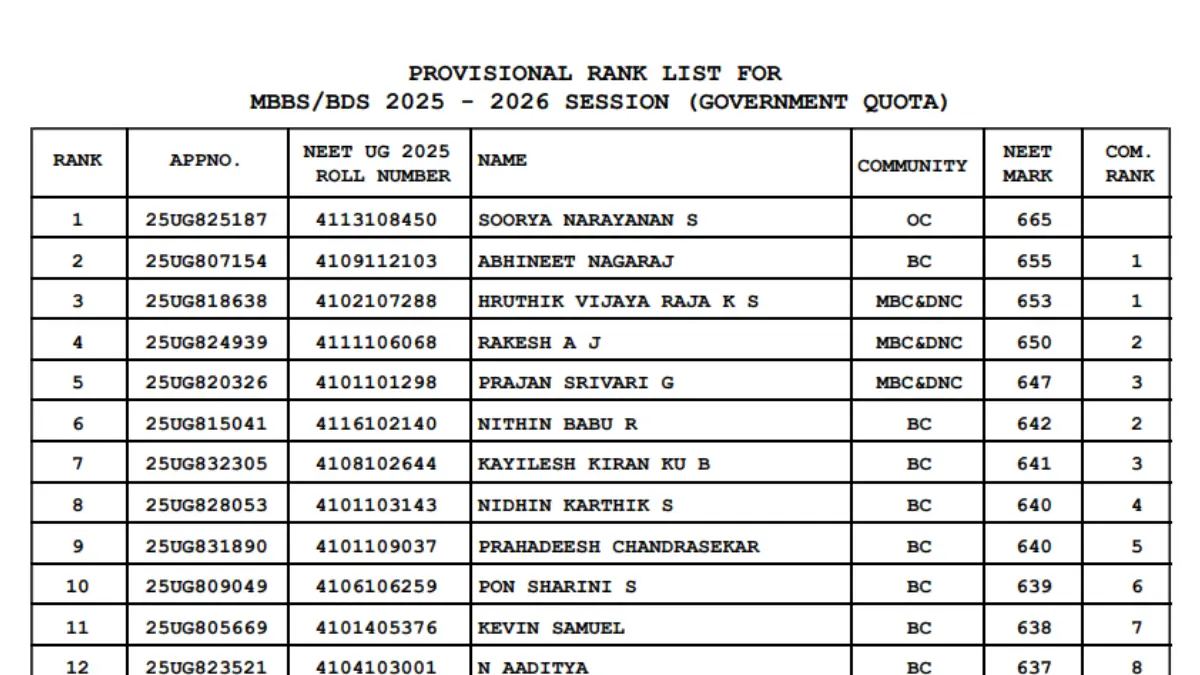
As you can see, this list is fundamentally different from the personal scorecard. It ranks all eligible candidates from a specific state, and this is the list that will be used for the Tamil Nadu counseling your sister will participate in.
Conclusion
In this lesson, we have thoroughly decoded the NEET UG scorecard. You can now confidently identify and interpret every piece of information it contains.
Here are the key takeaways:
- The scorecard is divided into three main parts: Personal Details, Scores/Ranks, and Qualifying Cutoffs.
- The most critical data points for counseling are the Total Marks Obtained and, most importantly, the All India Rank for Counselling.
- For General Category candidates, the Category Rank is irrelevant, and admission is based on the general merit list using the AIR.
- Tie-breaking rules (Biology score > Chemistry score > fewer negative marks) ensure every candidate gets a unique rank.
- Crucially, the State Rank is not on the NTA scorecard. It is calculated separately by state counseling authorities (like DME Tamil Nadu) for applicants with state domicile and is used for the 85% State Quota admissions.
You now have a complete picture of the data generated by the NEET exam. In our next lesson, we will begin Module 2 by exploring the two distinct counseling pathways that this data unlocks: the 15% All India Quota (AIQ) and the 85% Tamil Nadu State Quota. We'll contrast how they work, who runs them, and how their timelines often overlap.