Introduction
In our previous lesson, we established the core metrics of the NEET admission process: Marks, All India Rank (AIR), and State Rank. We clarified that while your score is the raw performance measure, it's the ranks—both national and state-level—that ultimately determine seat allocation during counseling.
Before any ranking comes into play, however, there is a fundamental hurdle every candidate must clear. This lesson focuses on that first critical gatekeeper: the NEET Qualifying Percentile. By the end of this session, you will be able to analyze exactly what the qualifying percentile for the General Category means, how it's calculated, and why it's crucially different from an admission cutoff. Understanding this concept is essential, as it determines a candidate's very eligibility to participate in the counseling process.
The Two Meanings of "Cutoff"
One of the biggest sources of confusion in the NEET process is the term "cutoff." It's used to describe two completely different concepts. Making a clear distinction between them is vital. From a development perspective, you can think of them as two separate checks in an application workflow: one for basic eligibility and another for resource allocation.
Let's break them down.
NEET 2026 Expected Cutoff Category Wise | Marks & Analysis
This article from Fut-Education provides a concise and clear distinction between the two types of cutoffs. It sets the foundation for understanding today's topic.
Please read the section titled "What Is NEET Cutoff?". Then, jump to the section "NEET Qualifying vs Admission Cutoff Differences" for a more detailed comparison.
As the article explains, the two types are:
- The Qualifying Cutoff: This is a minimum percentile set by the National Testing Agency (NTA). Think of it as a
pass/failflag. If a candidate scores above this percentile, they are deemed "qualified" and are eligible to register for counseling. If they score below it, they are not eligible for admission to any MBBS seat in India for that year. - The Admission Cutoff: This is not a predetermined number. It is the rank or score of the last candidate who secures a seat in a specific college during a specific round of counseling. It is determined by supply and demand and is only known after the counseling round is over.
Today, we are focusing exclusively on the Qualifying Cutoff.
Understanding Percentile vs. Percentage
To grasp the qualifying cutoff, we must first understand how it's measured: in percentiles, not percentages.
- A percentage is an absolute measure of your score. If you answer 144 questions correctly out of 180, your percentage is 80%.
- A percentile is a relative measure of your performance against all other candidates. If you are in the 90th percentile, it means you scored higher than 90% of all the students who took the exam.
The NTA uses a percentile system to ensure fairness and normalize results across a massive and diverse pool of candidates, where the exam's difficulty can vary each year.
NEET 2026 Expected Cutoff Category Wise | Marks & Analysis
The same article provides the formula and a clear explanation of how the percentile is calculated.
Please read the section under the heading "How Cutoff is Calculated". Pay close attention to the formula and the practical example provided.
The Qualifying Standard: 50th Percentile for General Category
For your sister, who is applying under the General Category (often denoted as Unreserved/UR or UR/EWS), the rule is straightforward: she must score at or above the 50th percentile.
This means she needs to have a score that is higher than the bottom 50% of all candidates who appeared for the NEET exam that year.
So, what score does that correspond to? This is where it gets dynamic. The exact mark equivalent to the 50th percentile changes every year depending on factors like the exam's difficulty and the overall performance of students. A tougher paper generally leads to a lower qualifying mark, while an easier paper pushes it up.
The following resource provides historical data on the qualifying marks.
Minimum Marks Required in NEET 2024 for MBBS: Category-Wise
This article from Propelld compiles past years' data, which clearly shows the annual variation in qualifying scores for the General Category.
First, review the table under the heading "NEET Cut Off Trends". Note the "Unreserved/EWS" row and see how the mark range changed between 2023 and 2024. Next, look at the table under the heading "Minimum Marks Required... - General Category". This gives you a year-by-year breakdown, clearly illustrating the fluctuating nature of the qualifying score. For example, notice the dip to 117 in 2022 and the return to 137 in 2023.
Visualizing the Qualifying Marks
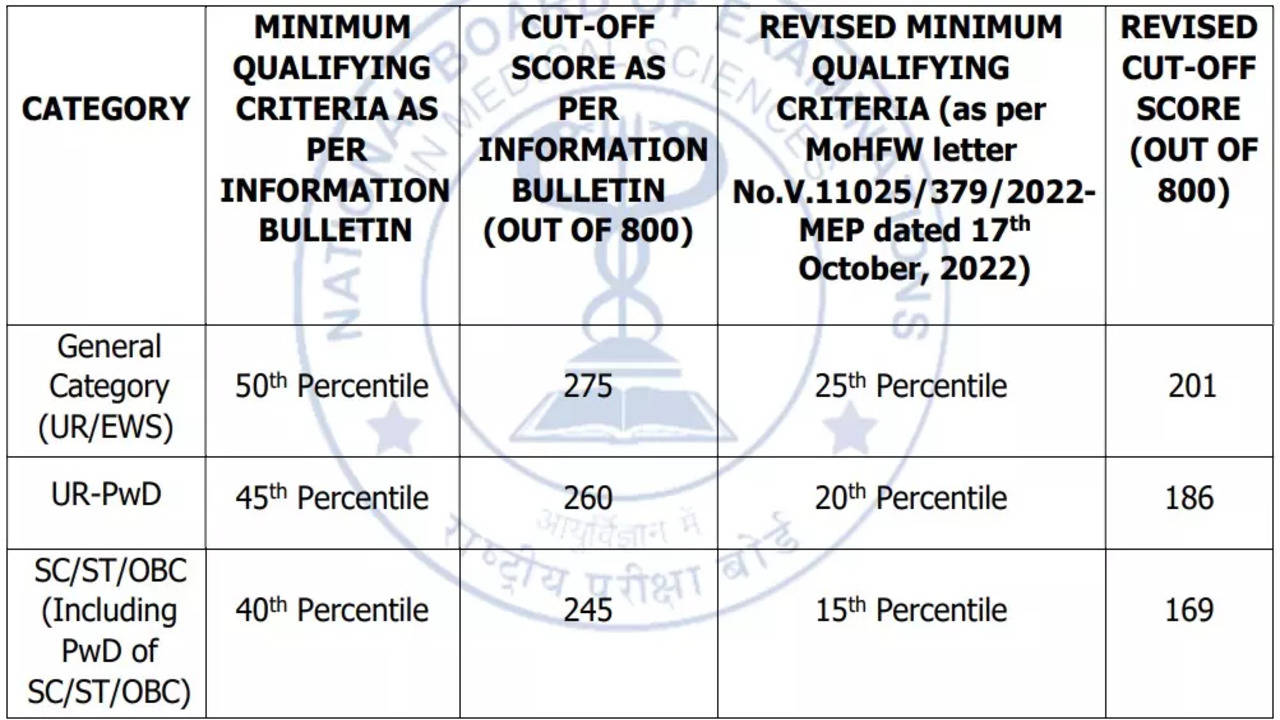
When the NEET results are released, the official scorecard explicitly states the qualifying cutoff scores for each category for that year. Below are examples of how this information is typically presented.
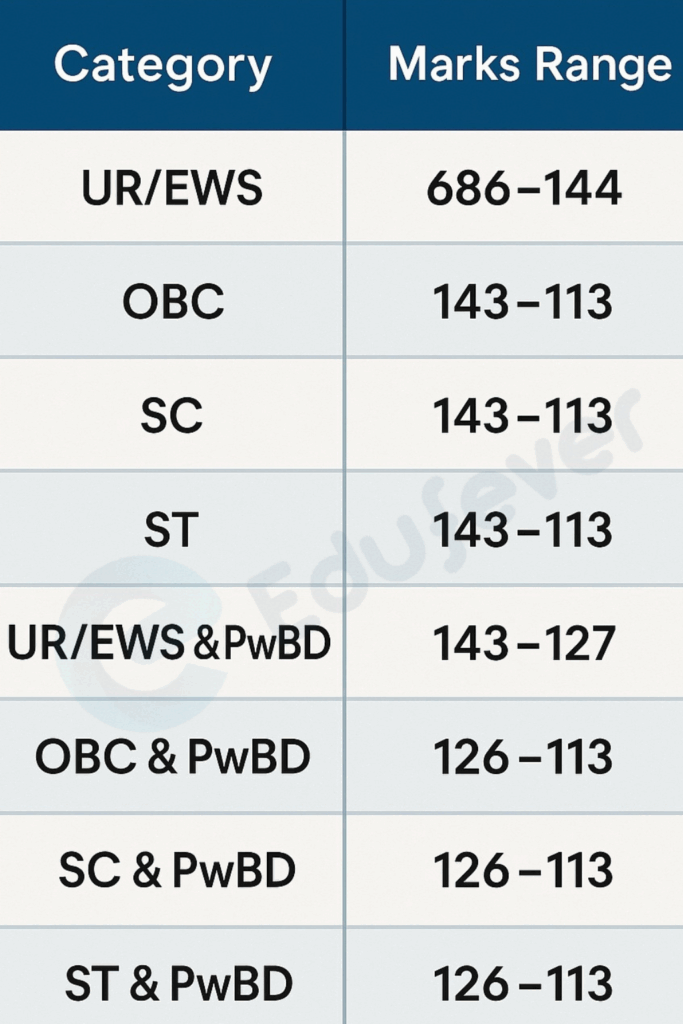
Sometimes, these cutoffs can even be adjusted after the initial results are declared. This is a rare but important scenario to be aware of. The government may decide to lower the percentile threshold to allow more candidates to be eligible for counseling, especially to fill seats in private colleges.
Tying it to Your World: An Analogy
To frame this in your domain as a full-stack developer, think of the admission process as a two-stage API gateway and microservice architecture.
-
The Eligibility Service (API Gateway):
- Millions of
candidateobjects, each with ascore, hit this first service. - This service first performs a calculation on the entire dataset of scores to determine the mark that corresponds to the 50th percentile. Let's call this
qualifyingMark_general. - It then acts as a filter. For each incoming candidate request where
candidate.category == 'General', it runs a simple check:if (candidate.score >= qualifyingMark_general). - If the check returns
true, the candidate is "qualified," and their request is forwarded to the next service (Counseling). - If
false, the process terminates for that candidate with a403 Forbiddenstatus – they are not eligible to proceed.
- Millions of
-
The Counseling Service (Microservice):
- This service only receives requests for candidates who passed the eligibility check.
- Its job is to run a complex allocation algorithm. It takes the pool of eligible candidates and the available
seats(in different colleges) and matches them based on a primary sort key (candidate.AIR) and user preferences (choiceList). - The Admission Cutoff isn't an input to this system. It's a piece of metadata generated after the process runs. It's simply the
candidate.AIRof the last person who was successfully allocated a seat incollege_X.
This distinction is crucial: Qualifying is a prerequisite check; Admission is a competitive allocation. Scoring 140 might make you eligible, but it won't get you a government MBBS seat, where the admission cutoff might be over 620.
To reinforce this final point, let's review one more resource that neatly summarizes the difference.
Minimum Marks Required in NEET 2024 for MBBS: Category-Wise
This table provides a side-by-side comparison that perfectly encapsulates the difference between these two critical concepts.
Please study the table under the heading "NEET Qualifying Marks vs NEET Admission Cut-Off Marks". This clearly contrasts the definition, purpose, and impact of each term.
Conclusion
In this lesson, we have dissected the concept of the NEET qualifying percentile, a fundamental step in the journey to an MBBS seat.
Here are the key takeaways:
- There are two distinct "cutoffs": the Qualifying Cutoff (to become eligible for counseling) and the Admission Cutoff (the final rank/score that gets a seat).
- The qualifying standard is based on percentile, a relative ranking, not an absolute percentage score.
- For the General Category, a candidate must score at or above the 50th percentile to qualify.
- The actual mark corresponding to the 50th percentile is dynamic and changes annually based on the exam's difficulty and overall candidate performance. Clearing this mark only grants eligibility; it does not guarantee admission.
You now have a solid grasp of the first filter in the NEET admission pipeline. In our next lesson, we will move on to the official document where this information is presented: the NEET UG Scorecard. We will interpret all the details it contains, including marks, rank, and the all-important qualifying status.