Introduction
Welcome to your first lesson in this course on the NEET counseling process. Our goal over the next few weeks is to give you a comprehensive, end-to-end understanding of how medical college admissions work, specifically tailored for your sister's journey towards securing an MBBS seat in Tamil Nadu.
Today, we'll start with the absolute fundamentals: the three key metrics that govern the entire process. By the end of this lesson, you will be able to clearly explain the difference between a candidate's NEET Marks, their All India Rank (AIR), and their State Rank. Understanding these concepts is the essential first step, as they form the data foundation upon which all counseling decisions are built. Think of it as understanding the core data model of an application before trying to build its user workflows.
NEET Marks: The Raw Score
The most straightforward metric is the NEET mark. This is the total score a candidate achieves out of a maximum of 720. The exam consists of questions from Physics, Chemistry, and Biology (Botany & Zoology), and the final score is a direct calculation of correct and incorrect answers.
This score is the raw measure of a candidate's performance in the exam itself. However, on its own, the score doesn't tell the full story. A score of 650 might be excellent in a year when the exam was difficult, but only good in a year when the paper was easier. To understand a candidate's relative performance, we need to look at their rank.
All India Rank (AIR): The National Leaderboard
The All India Rank (AIR) is a candidate's position relative to every other student who took the NEET exam across the entire country. This rank is calculated and published by the National Testing Agency (NTA) along with the results.
Your AIR, not just your mark, determines your national standing. This is because the competition and overall performance of candidates fluctuate each year. For instance, a drop of just a few marks can sometimes lead to a significant drop in rank by several thousand positions, especially in the highly competitive scoring bands.

If two or more candidates achieve the exact same NEET mark, the NTA applies a specific tie-breaking logic to assign a unique rank. The priority is as follows:
- Higher marks in Biology.
- If the tie persists, higher marks in Chemistry.
- If the tie persists, higher marks in Physics.
- If the tie still isn't broken, the candidate with fewer incorrect answers across all subjects gets the higher rank.
This process ensures that every candidate has a unique AIR, which becomes the primary sorting key for the national-level counseling process.
State Rank: Your Position in the Regional Pool
While the AIR is a national metric, the State Rank is a regional one. It represents a candidate's rank only among the group of candidates who are from the same state (e.g., Tamil Nadu) and have applied for admission under that state's 85% quota.
This rank is not generated by the NTA. Instead, it is prepared by the respective state's counseling authority—in your case, the Directorate of Medical Education (DME), Tamil Nadu. After the NEET results are out, eligible candidates apply to their state's counseling body. The DME then compiles a merit list of all its applicants, and the rank on this list is the State Rank.
Given your sister's primary goal of securing a seat in Tamil Nadu, her State Rank will be the single most important factor for admission into Government Medical Colleges and Government Quota seats in private colleges within the state.
How Marks, AIR, and State Rank Interconnect
So, how does a State Rank get calculated? Is it based on marks, 12th-grade scores, or other factors? This is a common point of confusion, but the process is quite logical, especially when you think about it from a data-processing perspective.
A fascinating and highly relevant explanation of this process for Tamil Nadu is provided in the following video. It clarifies that the State Rank is derived directly from the AIR.
How Tamil Nadu Rank List is Prepared? | Factors other than NEET Score?
Watch this video from the "Just Get MBBS" channel to understand how the Tamil Nadu rank list is prepared. The speaker directly addresses common misconceptions and clarifies the exact methodology.
Focus on these key segments: The one factor: The speaker explicitly states the single, crucial data point used for ranking. The data retrieval process: This part is particularly interesting. The speaker explains how the state counseling authority uses a candidate's application number to get their score and AIR from the NTA database. This is analogous to an API call where the application number is the key to fetch a candidate's performance data object. A ranking example: Here, a concrete example shows how a list of applicants is first sorted by AIR to generate the General State Rank. It then shows how this list is filtered by community to create category-specific ranks.
As the video makes clear, the flow is as follows:
- NTA calculates NEET Marks for all candidates.
- NTA applies tie-breaking rules and generates the All India Rank (AIR) for everyone.
- Candidates apply to their respective state counseling authorities (e.g., DME Tamil Nadu).
- The State Authority takes the list of its applicants and sorts them strictly according to their AIR.
- This sorted list becomes the State Merit List, which defines the State Rank.
So, a lower (better) AIR will always result in a lower (better) State Rank.
To solidify this understanding, the following article provides a structured comparison between AIR and State Rank.
Is NEET State Rank More Important or AIR for State Quota Admission in a Medical College?
This article from CollegeDekho neatly summarizes the different roles that AIR and State Rank play in medical admissions.
Please read the following sections: The table under the heading "NEET State Rank vs AIR for State Quota Admission". This gives a clear, side-by-side comparison of scope, eligibility, and competition. The section titled "How is State Rank Used for State Quota Admission in Medical College?", which reinforces its importance for the 85% state quota. Finally, read the conclusion under the heading "NEET State Rank or NEET AIR...", which directly answers the core question.
The Scorecard: Where to Find the Information
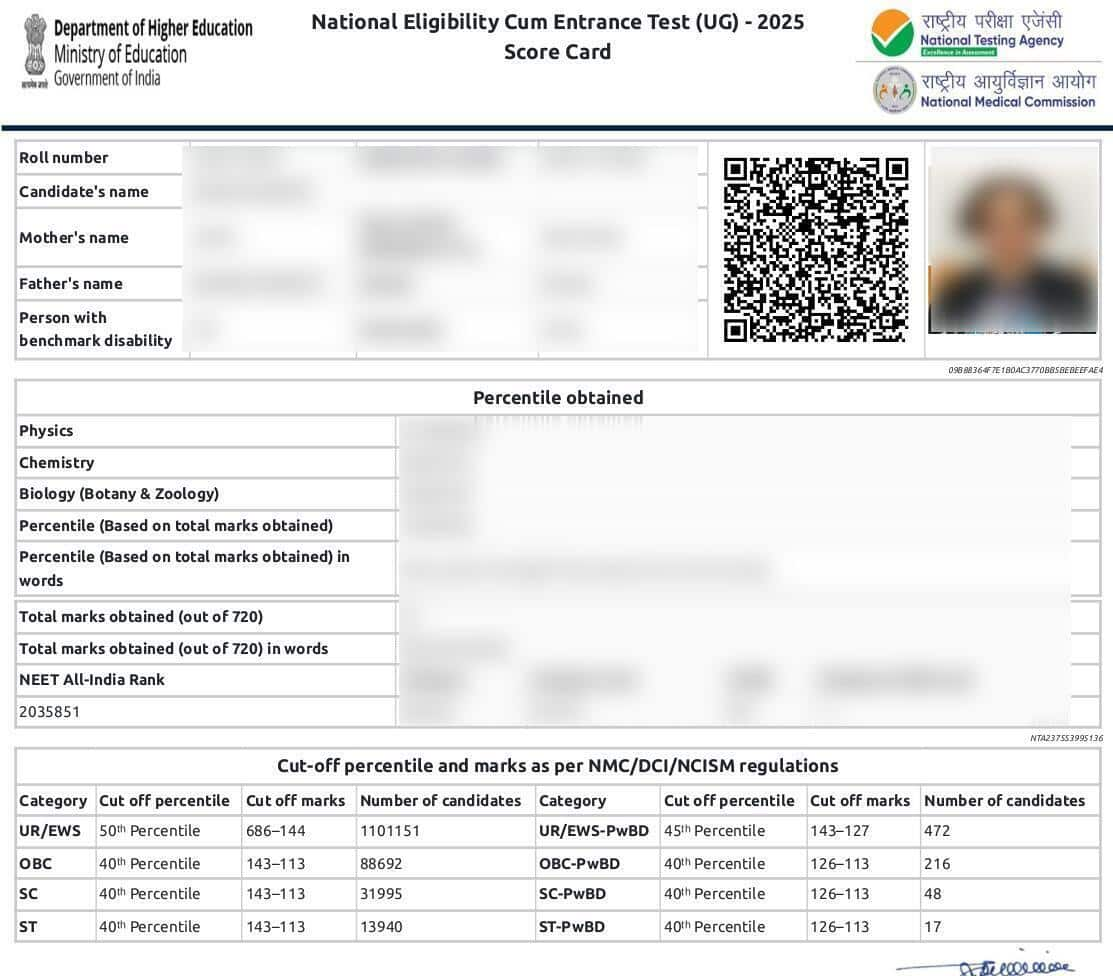
When the NEET results are declared, the NTA releases an official Score Card. This document will prominently feature the candidate's subject-wise and total marks, as well as their All India Rank. The State Rank is not on this document; it is published separately by the state authority at a later date.
Conclusion
In this lesson, we have established the foundational metrics of the NEET admission process. Let's summarize the key takeaways:
- NEET Marks are the raw score (out of 720), representing absolute performance on the test.
- All India Rank (AIR) is the national ranking determined by the NTA. It is the primary metric for All India Quota (15%) counseling and the basis for determining State Rank.
- State Rank is the regional ranking determined by the state counseling authority. It is derived by sorting state applicants by their AIR and is the crucial metric for State Quota (85%) counseling. For Tamil Nadu, the AIR is the only factor used to determine the State Rank.
You now have a clear understanding of the data that drives the system. In our next lesson, we will build upon this by analyzing the concept of the NEET Qualifying Percentile, which acts as the first gatekeeper determining who is even eligible to participate in counseling. We will also take a more detailed look at the official NEET scorecard to interpret all the information it provides.