Introduction
Welcome to the first lesson of our second module. In our previous discussions, we thoroughly analyzed the NEET scorecard, establishing that it provides the All India Rank (AIR) but not the State Rank. This distinction is the launching point for today's topic. Your sister's NEET AIR is the key that unlocks one door, while her eligibility for a Tamil Nadu State Rank unlocks another, entirely separate door.
Today, we will contrast these two fundamental pathways for medical college admission: the 15% All India Quota (AIQ) and the 85% Tamil Nadu State Quota. Understanding the differences between these two systems is the most critical strategic element of the entire counseling process. By the end of this lesson, you will be able to clearly differentiate their rules, scope, and the opportunities each presents, enabling you to guide your sister in making informed decisions.
The Two Counseling Architectures: National vs. State
After the NEET results are declared, the total pool of government medical college seats is partitioned. Think of this as a primary routing rule applied to the entire system's resources:
- 15% of seats in every government medical college (excluding those in the former J&K) are allocated to a central pool. This is the All India Quota (AIQ).
- The remaining 85% of seats in those same colleges are reserved for candidates who have domicile in that specific state. This is the State Quota.
This 15/85 split is the foundational principle of NEET counseling. It creates two parallel but distinct admission processes. A candidate like your sister, who is a domicile of Tamil Nadu, is eligible to compete in both systems simultaneously.
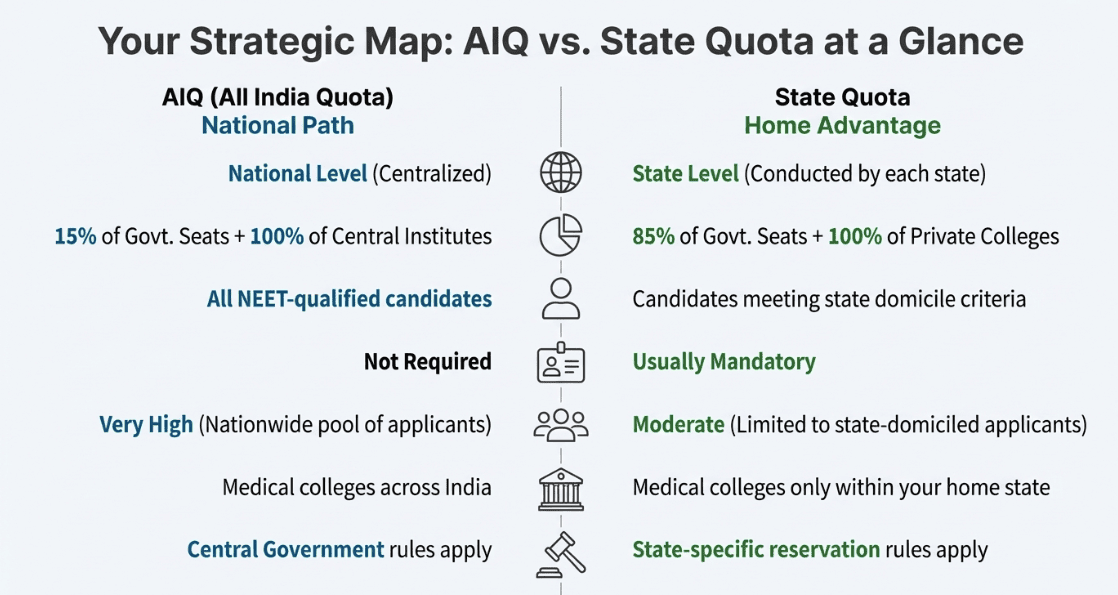
The following image provides an excellent high-level summary of these two paths. We will use it as our strategic map for this lesson, exploring each point in greater detail.
A Detailed Comparison: AIQ vs. Tamil Nadu State Quota
Let's break down the differences based on the parameters shown in the strategic map. This is analogous to comparing two different systems or APIs; they may serve a similar overall function (seat allocation), but their endpoints, request parameters (eligibility), and underlying logic (rules) are entirely different.
NEET AIQ vs State Quota - Know Differences, Seat Distribution
To get a structured overview of the differences, please start by studying the main comparison table in this article from CollegeDekho. It provides a solid framework for our discussion.
Read the table under the title "Particulars". Then, look at the smaller table in the next section, "Eligibility Criteria for NEET AIQ and State Quota Seats", which concisely summarizes the seat share and counseling authorities.
Now, let's elaborate on these points, with a specific focus on Tamil Nadu.
1. Seat Distribution and Scope
-
All India Quota (AIQ): This quota consists of 15% of seats from government medical colleges across the nation. Crucially, it also includes 100% of the seats in national institutions like AIIMS, JIPMER, and other central universities, as well as all seats in Deemed (private) Universities. This gives a candidate access to a vast, nationwide inventory of colleges.
-
Tamil Nadu State Quota: This quota consists of 85% of the seats in Tamil Nadu's government medical colleges. Importantly, it also governs admission to all seats in private, self-financing medical colleges within Tamil Nadu. These private college seats are further divided into "Government Quota" (with lower, government-fixed fees) and "Management Quota" (with much higher fees). Given your preference for low-fee options, the Government Quota seats in self-financing colleges are a vital part of the state counseling strategy.
Tamil Nadu NEET Counselling 2026: Dates, Registration, Process, Fees
This article from Careers360 provides a specific breakdown of the seat categories within Tamil Nadu counseling. It's essential for understanding where the low-fee private college seats fit in.
In the section "Tamil Nadu NEET counselling categories of seats", focus on the descriptions for Category A and Category B. These represent the primary targets for a General Category candidate seeking a low-fee MBBS seat through the state quota.
2. Eligibility and Domicile
This is the most significant filter.
- AIQ: Any candidate who has qualified NEET is eligible to participate. There is no domicile requirement. It's an open, national competition based solely on NEET AIR.
- State Quota: Eligibility is strictly limited to candidates who meet the domicile criteria of that specific state. For Tamil Nadu, this typically means the candidate or their parents have resided in the state for a certain period, and the candidate has completed their schooling there. Fulfilling this requirement (and having the necessary Nativity Certificate) is non-negotiable to access the 85% state quota.
3. Competition Level
The difference in the applicant pool directly affects the competition.
- AIQ: The competition is very high. Your sister will be competing with every qualified candidate from all over India for a relatively small number of seats in each college. This means a much higher rank is needed to secure a seat in a top government college via AIQ compared to the State Quota.
- State Quota: The competition is moderate. The applicant pool is filtered down to only Tamil Nadu domiciliaries. While still competitive, the chances of securing a seat are significantly better for a given rank compared to the AIQ. This is the "Home Advantage" mentioned in the diagram.
4. Counseling Authority
The two systems are managed by different governing bodies with their own separate websites, schedules, and rules.
- AIQ: Conducted centrally by the Medical Counselling Committee (MCC), under the Directorate General of Health Services (DGHS). The single portal for this is
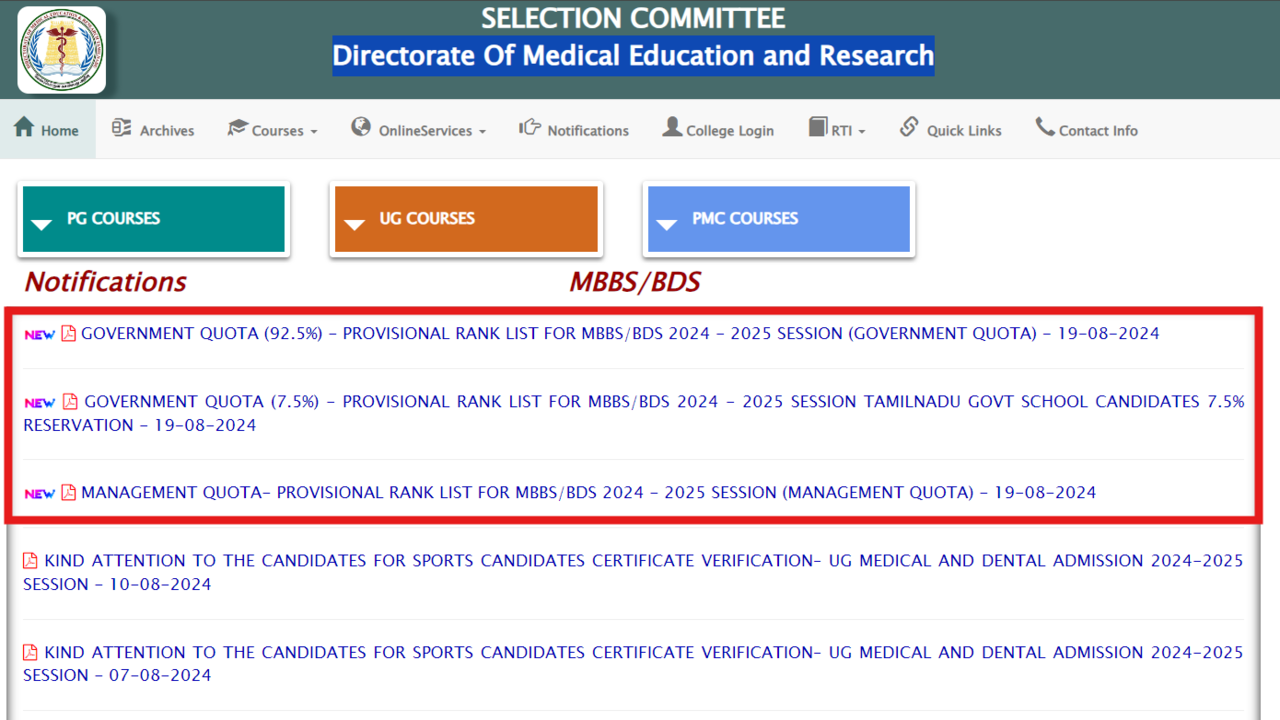
mcc.nic.in. - State Quota: Conducted by the respective state's authority. For Tamil Nadu, this is the Directorate of Medical Education and Research (DME), Tamil Nadu. Their official portal is
tnmedicalselection.net.
5. College Choice and Fee Structure
- AIQ: Offers the flexibility to apply to top colleges anywhere in India. If your sister has an excellent AIR, she could potentially get into a prestigious college in Delhi, Mumbai, or any other state. The fee structure for government colleges under AIQ is generally low and relatively uniform.
- State Quota: The choice is restricted to medical colleges located only within Tamil Nadu. However, this includes a large number of government and private colleges. The fee structure varies significantly, from very low fees in government colleges to subsidized fees for Government Quota seats in private colleges, and much higher fees for Management Quota seats. This is a critical factor in choice filling, which we will cover in a later module.
Conclusion
In this lesson, we have established the fundamental duality of the NEET counseling process by contrasting the All India Quota and the Tamil Nadu State Quota. You can now see them not as one confusing process, but as two distinct systems that your sister can and should engage with in parallel.
Here are the essential takeaways:
- The 15/85 Split: Government medical college seats are divided into 15% for the AIQ and 85% for the State Quota.
- Separate Authorities: AIQ is managed nationally by the MCC, while the Tamil Nadu State Quota is managed by the DME, Tamil Nadu. Each has its own portal, rules, and schedule.
- Eligibility Filter: AIQ is open to all qualified candidates based on AIR. The State Quota is restricted to state domiciliaries and uses a State Merit List.
- Competition vs. Choice Trade-off: AIQ offers a wider choice of colleges across India but has extremely high competition. The State Quota offers a more limited choice (only within Tamil Nadu) but with significantly lower competition, providing a "home advantage."
- Seat Types: The Tamil Nadu State Quota also governs admissions to private colleges, including the valuable low-fee Government Quota seats in self-financing institutions.
In our next lesson, we will build upon this by mapping the standard timeline of the counseling rounds. You will learn how the AIQ and State Quota rounds typically run concurrently and how a candidate must navigate both schedules to maximize their chances of securing a seat.