Introduction
In our previous lesson, we demystified the process of creating the Tamil Nadu State Merit List, establishing that your sister's State Rank is the single most important factor in the counseling process. You can think of the merit list as a sorted queue of users, each with a unique priority level (their rank). The question now is: what resources or services can be accessed with that rank?
This lesson will address that by exploring the two primary categories of MBBS seats available through the Tamil Nadu State Quota. We will differentiate between fully Government Medical Colleges (GMCs) and Government Quota (GQ) seats within Self-Financing Medical Colleges (SFMCs). For your sister, who is aiming for a low-fee seat in the General Category, understanding the distinction between these two options is the most critical piece of strategic knowledge in the entire counseling process.
Conceptually, you can view these as two different service tiers. Both are accessible through the same system (TN counseling), but they differ fundamentally in cost, features (prestige, infrastructure), and the access requirements (cutoff rank).
The Two Tiers of Medical Education in Tamil Nadu
When your sister fills her choices in the Tamil Nadu counseling portal, she won't just be choosing a college; she'll be choosing a specific type of seat within that college. The vast majority of these seats fall into two buckets.
-
Government Medical Colleges (GMCs): These are institutions fully owned, operated, and funded by the Government of Tamil Nadu. They include prestigious, long-standing colleges like Madras Medical College and Stanley Medical College, as well as newer government colleges established across the state. They represent the premier, highly-subsidized public medical education system.
-
Government Quota (GQ) in Self-Financing Medical Colleges (SFMCs): These are privately owned and managed medical colleges. However, through an agreement with the state government, they are required to allocate a significant portion of their seats to be filled by the state counseling authority (DME). These specific seats are designated as "Government Quota" seats.
The Vedantu article on NEET cutoffs for Tamil Nadu provides a clear breakdown of how seats are distributed in these private, self-financing colleges.
Tamil Nadu NEET Cutoff 2026 Expected MBBS BDS Category Wise
Please navigate to the section titled "Tamil Nadu NEET Cutoff 2026 Quota Wise."
Focus on the paragraph beginning "For government medical colleges" and the accompanying table "Tamil Nadu MBBS Admission Quota Wise Seat Distribution". This explains that while government colleges have an 85% state quota, private colleges split their seats into three categories: State Quota, Management Quota, and NRI Quota. Our focus here is on that first slice of seats in private colleges, which are filled through state counseling.
As the resource explains, private colleges typically allocate 50% of their seats to the State Quota. These are the "Government Quota" seats. The remaining seats are filled through the college's own "Management Quota" or an "NRI Quota," which have much higher fees and often different admission processes that we will not focus on.
The counseling procedure flowchart below visually separates the "Government Quota" and "Management Quota" pathways, highlighting distinct application fees and security deposits, which reinforces that these are treated as separate tracks from the very beginning.

Differentiator 1: The Fee Structure (The Billion-Dollar Question)
The single most significant difference between a GMC and a GQ seat in an SFMC is the cost. This is the primary trade-off your sister will face during choice filling.
- Government Medical Colleges: Being fully state-funded, the fees are extremely low. The annual cost is nominal and heavily subsidized.
- Government Quota in Self-Financing Colleges: Although the seat is filled through government counseling, the college is still a private entity. The government fixes the fee for these GQ seats, but it is substantially higher than in a GMC, as it must cover the private institution's operational costs.
Let's look at the numbers. The NEET UG Guidance website provides a clear breakdown of the fee structures for both types of institutions.
First, let's examine the fees for a fully government college.
NEET UG Guidance | Career World
On this webpage, scroll down to the first table under the heading "Tamil Nadu MBBS Fees Structure In Government Medical Colleges."
Review this table. Note the total annual fee. This is the baseline cost for a seat in a government-run institution.
As you can see, the total annual fee is approximately ₹13,610.
Now, let's compare this to the fixed fee for a Government Quota seat in a private, self-financing college.
NEET UG Guidance | Career World
This table is located just below the government college fee table on the same page.
Focus on the column titled "Government Quota Fees" in the large table. You can ignore the other columns for Management and NRI Quota for now. Observe the typical fee listed for most colleges in this column.
For these Government Quota seats, the annual tuition fee is typically ₹4,50,000, with a few exceptions.
Here is a summary of this stark contrast:
| Feature | Government Medical College | Government Quota in Self-Financing College |
|---|---|---|
| Ownership | Government of Tamil Nadu | Private Trust / Entity |
| Annual Tuition Fee (Approx.) | ~₹14,000 | ~₹4,50,000 |
This difference of over 30 times in cost is the central factor that drives competition and strategy in TN medical counseling.
Differentiator 2: The Cutoff Rank (The Access Requirement)
The massive difference in fees creates a clear hierarchy of preference among students. Almost every applicant prefers a GMC seat due to the low cost and high reputation. This intense demand leads to much higher competition.
Consequently:
- Government Medical Colleges have very high cutoffs (i.e., you need a very low/good State Rank to get a seat).
- Government Quota seats in Self-Financing Colleges have lower cutoffs (i.e., a higher State Rank can still secure a seat), as they are the next-best option for those who do not secure a GMC seat.
The Vedantu article explicitly confirms this dynamic.
Tamil Nadu NEET Cutoff 2026 Expected MBBS BDS Category Wise
Please review three key statements in this article.
Under "Key Highlights," read the first bullet point: "Government medical colleges...". Under "Expected Tamil Nadu NEET Cutoff 2026 for Government and Private Medical Colleges," read the last sentence of the second paragraph: "The recent trend also shows...". Finally, under "Factors Affecting NEET 2026 Tamil Nadu Cutoff," read point number 5: "Government vs Private College Preference." These sections collectively emphasize that GMCs are more competitive and have higher cutoffs than GQ seats in SFMCs due to student preference for lower fees.
This bar chart from the Times of India visually demonstrates the cutoff gap. For every reservation category, the cutoff mark required for Government Medical Colleges is significantly higher than that for Self-financing colleges.
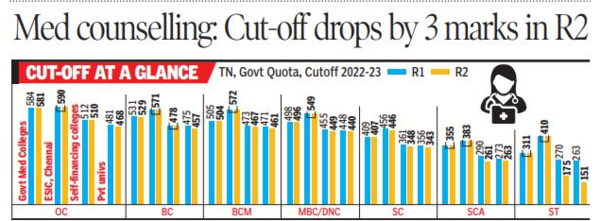
For your sister, applying in the OC (General) category, this means she would need a top-tier State Rank for a GMC, but a mid-tier rank might still be sufficient to secure a GQ seat in a good private college—provided the family is prepared for the higher financial commitment.
Conclusion
You are now equipped with the fundamental knowledge of the two-tiered system of medical seats in Tamil Nadu. This understanding moves beyond just rank and score, and into the practical realities of cost and competition that shape every family's counseling strategy.
The key takeaways are:
- The TN State Quota offers two main types of seats: those in fully Government Medical Colleges (GMCs) and Government Quota (GQ) seats in privately-run Self-Financing Medical Colleges (SFMCs).
- The primary difference is cost: GMCs have nominal fees (
₹14k/year), while GQ seats in SFMCs have government-fixed fees that are substantially higher (₹4.5L/year). - This cost difference directly impacts competition: GMCs are the most sought-after and have the highest cutoffs, requiring top State Ranks. GQ seats in SFMCs are less competitive, providing a crucial alternative for students with good but not top-tier ranks.
In our next lesson, we will dive deeper into the financial aspect. We will move beyond the headline tuition fee to explain the full fee structure differences between these two types of colleges, including other charges like security deposits, hostel fees, and miscellaneous expenses, giving you a complete picture of the total cost of attendance for the General Category.