Introduction
In our last lesson, we established the fundamental two-tiered system of medical seats in Tamil Nadu: the highly subsidized Government Medical Colleges (GMCs) and the more expensive Government Quota (GQ) seats in Self-Financing Medical Colleges (SFMCs). You learned that the headline tuition fee creates a difference of over 30 times between them, directly influencing competition and cutoffs.
This lesson drills down into the critical details of that cost difference. We will move beyond the headline tuition figures to conduct a comprehensive financial breakdown for the General Category. You'll learn about all the constituent parts of the fee structure—from tuition and special fees to one-time deposits and recurring annual charges. For your family, this detailed analysis is essential for accurate financial planning and for making informed decisions during choice filling. Think of this as analyzing the total cost of ownership (TCO) of a service; the sticker price is just the beginning, and understanding the full scope of expenses is key to avoiding surprises.
Government Medical College Fees: A Detailed Breakdown
The affordability of Government Medical Colleges is a cornerstone of public medical education in Tamil Nadu. The annual fee is not a single lump sum but is composed of several smaller, specific charges. The total is exceptionally low due to heavy state subsidies.
This infographic, based on the official prospectus, provides a clear and itemized list of the fees for a government college.
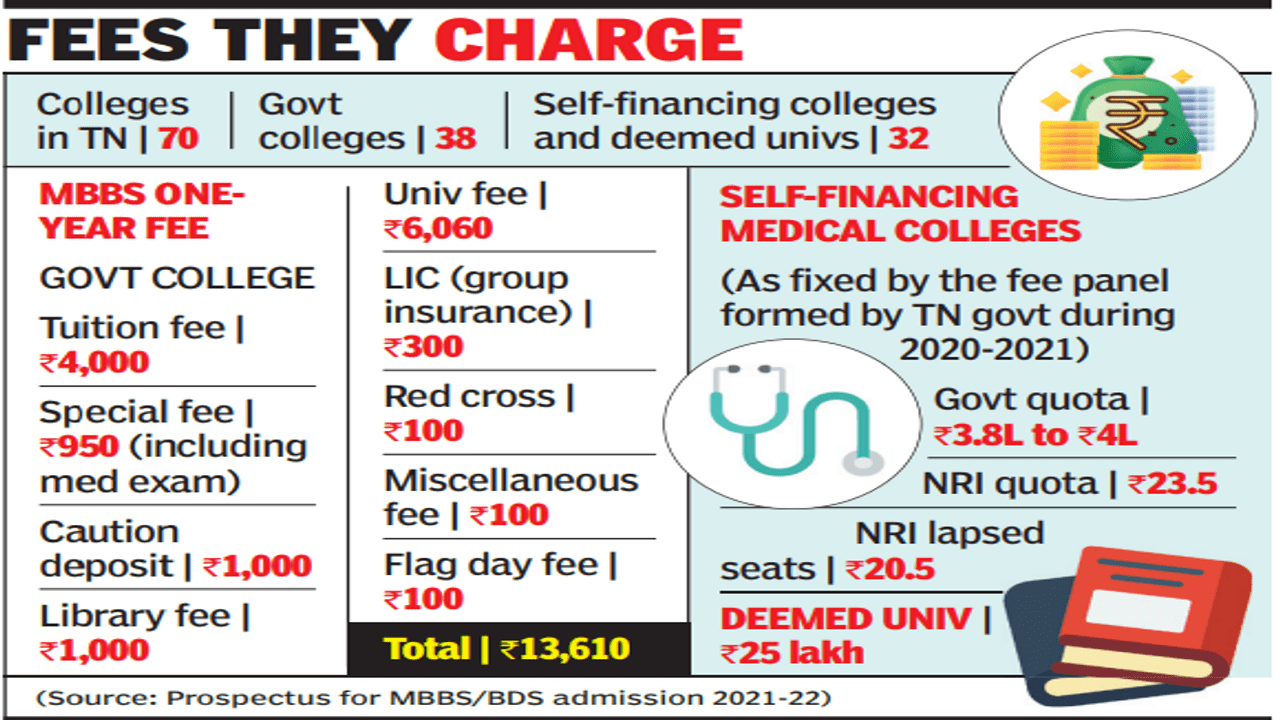
As you can see, the total annual fee is ₹13,610. Let's unpack the key components:
- Tuition Fee (₹4,000): This is the core fee for academic instruction.
- University Fee (₹6,060): A fee paid to the affiliating university, The Tamil Nadu Dr. M.G.R. Medical University.
- Caution Deposit (₹1,000): This is a one-time, refundable deposit paid at the time of admission to cover any potential damages. It's an important detail that this is not a recurring annual expense.
- Library Fee (₹1,000): A recurring annual fee for library access.
- Other Fees: The remaining charges are smaller amounts for specific purposes like special fees (including exams), group insurance, Red Cross, and Flag Day contributions.
The key takeaway is that the total payable fee for a year in a GMC is extremely transparent and manageable, with the bulk of the cost being covered by the state.
Self-Financing College (Govt. Quota) Fees: Beyond the Headline Number
Now let's turn to the Government Quota seats in Self-Financing colleges. As we saw previously, the government fixes the tuition fee for these seats, which is significantly higher than in a GMC.
The Aakash Institute's summary PDF offers a concise comparison of the fee structures.
[PDF] Tamil Nādu State Counselling (MBBS/BDS) - Cloudfront.net
In this document, please locate the two sections titled "FEE STRUCTURE".
First, review the fee for Govt. Medical Colleges, which confirms the ₹13,610 figure for the General Category (OC/BC/BCM/MBC). Immediately below that, review the fee structure for Private Medical Colleges, focusing specifically on the "SQ" (State Quota) line item.
The document confirms the fee for a State Quota seat is approximately ₹4.35 - ₹4.50 Lakhs per year.
While this figure appears as a single line item, it's important to understand what it typically includes. A government-appointed committee determines this fee, and it's intended to cover a bundle of expenses.
NEET UG Guidance | Career World
On this page from NEET UG Guidance, focus on the introductory paragraph under the heading "Tamil Nadu Self Financing Medical Colleges Fees Structure..."
Read the paragraph that begins "The Committee...". This text explains that the fixed fee is designed to encompass a wide range of costs, from tuition and lab fees to library and extracurriculars.
This means the ₹4.5 Lakh figure is not just for tuition; it's an aggregated fee for most of the college's academic and administrative services. However, unlike the all-inclusive government fee, this is where the similarities end. This bundled fee almost never includes two major expenses: hostel/mess fees and various one-time deposits.
The Real Cost: Factoring in Hostel, Mess, and Other Expenses
The most significant financial variable that differentiates GMCs and SFMCs, beyond tuition, is the cost of living. This is where the true total cost of attendance becomes apparent.
-
Hostel and Mess Fees:
- In GMCs: Hostels are owned by the government and run on a no-profit basis. The annual cost for accommodation and food is highly subsidized, typically ranging from ₹30,000 to ₹60,000 per year.
- In SFMCs: Hostels are run as a commercial venture by the private college management. Fees are significantly higher, often ranging from ₹1,00,000 to ₹2,00,000 per year, and sometimes more, depending on the city and facilities.
-
Other Deposits and Fees:
- While a GMC has a nominal caution deposit of ₹1,000, private colleges may require larger caution deposits (e.g., ₹25,000 or more) and may have separate, non-refundable admission fees or charges for university registration that are not covered by the main tuition fee.
Let's summarize this in a more comprehensive comparison of the estimated first-year expenditure.
| Fee Component | Government Medical College | Self-Financing College (Govt. Quota) | Financial Impact |
|---|---|---|---|
| Annual Fee (Tuition etc.) | ~ ₹13,610 | ~ ₹4,50,000 | The primary, 30x cost difference. |
| Caution Deposit (One-time) | ~ ₹1,000 | Varies, potentially ₹25,000+ | Higher upfront, though refundable. |
| Hostel & Mess (Annual) | ~ ₹50,000 (Estimate) | ~ ₹1,50,000 (Estimate) | A major, recurring hidden cost in SFMCs. |
| Books & Equipment (1st Year) | ~ ₹25,000 (Estimate) | ~ ₹25,000 (Estimate) | A necessary expense, roughly equal for both. |
| Total Estimated 1st Year Cost | ~ ₹90,000 | ~ ₹6,50,000 | The total financial gap remains immense. |
This analysis reveals that even after accounting for all expenses, a year at a GMC is substantially more affordable. A family must be prepared for a total annual outlay of well over ₹6 lakhs for a GQ seat in an SFMC, not just the ₹4.5 lakh tuition fee.
Notable Exceptions
It's worth noting that there are a few unique institutions with different fee structures. The most prominent example is Christian Medical College (CMC), Vellore. As a minority-run charitable institution, its Government Quota seats have a nominal fee of just ₹3,000 plus other minimal charges, making it as affordable as a government college. However, admission is exceptionally competitive, and it has its own selection criteria in addition to the NEET score.
Conclusion
In this lesson, we dissected the fee structures of Tamil Nadu's medical colleges, moving from a simple tuition fee comparison to a holistic view of the total cost of attendance. This provides your family with the realistic financial data needed to build a viable college preference list.
The key takeaways are:
- The annual fee for a Government Medical College is approximately ₹13,610, a bundled price that includes tuition, university fees, and other minor charges.
- The government-fixed fee for a Government Quota seat in a Self-Financing College is approximately ₹4,50,000, which covers tuition and most academic services but excludes major costs.
- The most significant "hidden cost" is for hostel and mess, which can add over ₹1.5 Lakhs annually to the bill of an SFMC, compared to a much lower subsidized rate at a GMC.
- The realistic total first-year expenditure for a GMC is under ₹1 lakh, while for an SFMC it is typically over ₹6.5 lakhs.
Now that you have a firm grasp on the different seat types and their comprehensive costs, we can turn to strategy. What happens if your sister is allotted a seat in an SFMC but was hoping for a GMC? In the next lesson, we will explore the rules and strategy behind the sliding/upgrading option in TN State counseling. This is a crucial mechanism that allows a candidate to accept an offered seat while remaining in the running for a better, more preferred college in subsequent counseling rounds.