Introduction
In our last lesson, we walked through the critical first step of the Tamil Nadu counseling process: completing and submitting the online application. You can think of that as the "data entry" phase, where your sister provides all the necessary information to the TN Medical Selection Committee. Now, we'll explore what happens on the "backend" once that data is received.
This lesson focuses on how the Selection Committee transforms thousands of individual applications into the single most important document for the entire counseling journey: the Tamil Nadu State Merit List. We will analyze how this list is compiled, how ranks are determined from NEET scores, and why this rank—not the score itself—becomes the definitive currency for securing a medical seat. Understanding this process is like understanding how a system assigns priority to API calls; it's the core logic that dictates the entire workflow.
From Application Data to a Ranked List
After the application window closes, the Directorate of Medical Education (DME) in Tamil Nadu begins the process of compiling the State Merit List. They take the information from all the applications submitted for the State Quota, verify the data—most importantly, pulling the NEET scores from the NTA database using the roll numbers provided—and then sort every eligible applicant into a single, ranked list.
The fundamental principle is straightforward: applicants are ranked in descending order of their NEET-UG scores. The applicant with the highest score gets State Rank 1, the second-highest gets State Rank 2, and so on.
You can read a clear summary of this process in the FAQ section of the Vedantu guide.
Tamil Nadu NEET Rank List 2025: Check Your Medical College Rank
In this article from Vedantu, please find the "Frequently Asked Questions (FAQs)" section at the end.
Read question and answer number 10, "How is the NEET Tamil Nadu Rank List 2025 prepared?". This confirms that the list is prepared based on the NEET score of candidates and is used for the counseling process.
The Tie-Breaking Algorithm: Resolving Equal Scores
What happens if multiple students score the exact same mark in NEET? This is a common scenario, and the DME has a well-defined tie-breaking protocol to ensure each candidate receives a unique rank.
From your perspective as a developer, you can think of the sorting logic not as a simple ORDER BY neet_score DESC, but as a multi-level sort with several tie-breaking conditions.
The Vedantu resource clearly outlines this hierarchy of rules.
Tamil Nadu NEET Rank List 2025: Check Your Medical College Rank
Navigate to the section titled "Tie-Breaking For Tamil Nadu MBBS Rank List 2025."
Read the four bullet points under this heading, starting from the first rule. This section details the sequential criteria used to break ties between candidates with identical NEET scores.
To summarize the tie-breaking logic:
- Higher Score in Biology: The candidate with more marks in the Biology section (Botany & Zoology) is given the higher rank.
- Higher Score in Chemistry: If the tie persists, the candidate with the higher score in Chemistry gets the preference.
- Fewer Incorrect Answers: If the tie still isn't broken, the candidate with fewer incorrect answers (i.e., less negative marking) across the entire exam paper is ranked higher.
- Older Age: As a final tie-breaker, the older candidate (by date of birth) is given the higher rank.
This deterministic algorithm ensures that every single applicant, even those with identical scores, can be placed in a unique, sequential position on the merit list.
Decoding the Merit List: State Rank vs. Community Rank
Once the sorting and tie-breaking are complete, the DME publishes the provisional merit list, usually as a PDF file on their website. This document is the master key for the entire counseling process. Let's look at what it contains.

As you can see in the sample rank list above, each candidate is listed with several key pieces of data:
- RANK: This is the State Rank (also called General Rank). It is the candidate's overall rank among all applicants in Tamil Nadu.
- NEET MARK: The candidate's score in the NEET-UG exam.
- COMMUNITY: The reservation category the candidate belongs to (e.g., OC, BC, MBC, SC).
- COM. RANK: This is the Community Rank. It is the candidate's rank within their specific community.
Let's break this down:
- State Rank (SR): This is your position in the main queue. A State Rank of 500 means you are the 500th person in line among all eligible applicants in Tamil Nadu.
- Community Rank (CR): This is your position in a separate, parallel queue for your specific reservation category. For example, in the image, the candidate with State Rank 7 has a Community Rank of 3. This means they are the 7th person overall, but the 3rd person within the 'BC' category.
Crucially, for your sister applying under the General Category (OC - Open Competition), the State Rank is the only rank that matters. As you can see for the candidate at Rank 1, who is in the OC category, the 'COM. RANK' column is blank. OC candidates compete for seats from the open pool, and their position is determined solely by their State Rank.
Why Rank is More Important Than Score
The State Merit List effectively translates a variable metric (the NEET score) into a stable, ordinal one (the State Rank). This is why all counseling discussions, strategies, and cutoff analyses revolve around ranks, not scores. The MBBSCouncil resource explains this point well.
Expected NEET cut off 2026 for MBBS in Tamilnadu – 2025,2024 ...
In this article, find the main heading "1. Expected NEET Cut off 2026 for MBBS In Tamilnadu".
Read the paragraph that begins "We recommend you". This section explains that using rank for prediction is far more accurate than using score, as it relates directly to the fixed number of seats available.
Think about it this way: The difficulty of the NEET paper changes every year, leading to score inflation or deflation. A score of 600 might be exceptional one year and average the next. However, the number of medical seats in Tamil Nadu is relatively stable. A State Rank of 1500 will always mean that there are 1499 people ahead of you competing for those seats, regardless of what score was required to achieve that rank in a given year.
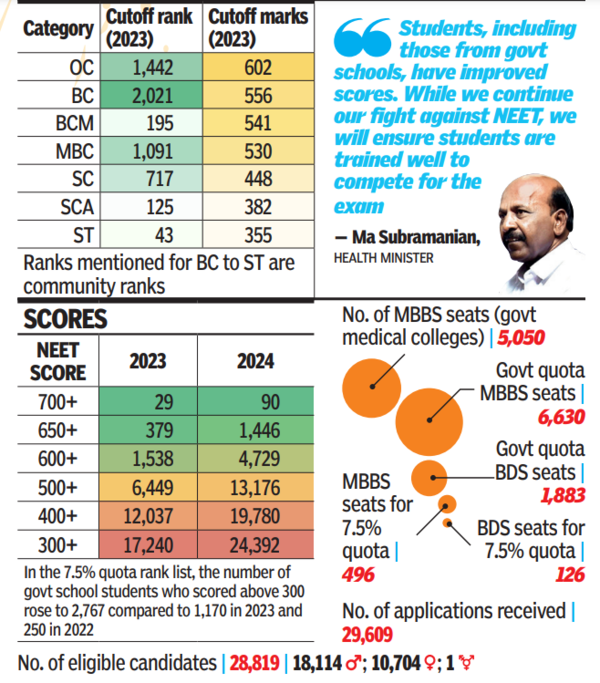
The image above illustrates this perfectly. The cutoff for the OC category in 2023 was a State Rank of 1,442. This means the last student admitted to a government quota seat under the OC category had that rank. The corresponding mark was 602. In another year, the mark for that same rank could be higher or lower, but the rank itself is the constant measure of one's position in the admission hierarchy.
Finally, it's worth noting that the DME releases separate merit lists for different quotas, such as the 7.5% government school quota and the Management Quota. However, for a General Category candidate targeting a government seat, the main Government Quota Merit List is the one that dictates their entire journey.
Conclusion
You now understand the process by which a NEET score is transformed into a powerful State Rank. This is not just an administrative step; it is the core mechanism that underpins the entire state counseling system.
Here are the key takeaways from this lesson:
- The Tamil Nadu State Merit List is created by sorting all eligible state applicants primarily by their NEET score.
- A specific tie-breaking algorithm (based on subject scores, negative marks, and age) ensures every candidate gets a unique rank.
- The list provides a State Rank (overall position) and a Community Rank (position within a reservation category).
- For a General Category (OC) candidate, the State Rank is the only operative rank, as they compete for seats in the open pool.
- State Rank, not the NEET score, is the most reliable metric for predicting admission chances and analyzing cutoffs, as it directly relates to the fixed number of available seats.
Now that we have established how your sister's rank will be determined, the next logical question is: what kinds of colleges can she get with that rank? In our next lesson, we will begin to answer this by differentiating between Government Medical Colleges and Government Quota seats in Self-Financing Medical Colleges in Tamil Nadu, exploring the critical differences in fees and opportunities between them.