Welcome to the final lesson of our module on motivation and the dopamine system. Over the past several lessons, we have journeyed from the fundamental neurobiology of dopamine to the high-level psychological principles that govern our drive. We explored the mesolimbic pathway, distinguished between 'wanting' and 'liking', analyzed the powerful effects of reinforcement schedules, and, most recently, connected these neural mechanics to the elegant framework of Self-Determination Theory.
Today, our objective is to synthesize this knowledge. We will distill these complex concepts into a set of clear, actionable rules for cultivating and sustaining motivation. This lesson is designed to be a practical capstone for the module, equipping you with a "cheat sheet" that translates the science of dopamine into a daily practice for enhanced focus, performance, and well-being.
Building Your Dopamine Regulation Cheat Sheet
Rather than simply presenting a list, we will construct this cheat sheet together, rule by rule, reinforcing the scientific justification for each principle. This process will solidify your understanding and ensure the rules are not just memorized, but deeply comprehended.
1. The Foundation: Maintain a Healthy Dopamine Baseline
Before we can manage the peaks of motivation, we must ensure there's enough "water in the wave pool," as neuroscientist Andrew Huberman describes it. A healthy baseline level of dopamine is the non-negotiable prerequisite for motivation, mood, and the capacity to pursue goals. Without it, striving for peaks is futile.
The video below outlines the core, research-backed behaviors that restore and maintain your dopamine reserves.
Improve Your Baseline Dopamine for Motivation & Drive | Dr. Andrew Huberman
This clip from Dr. Andrew Huberman explains the foundational practices for maintaining a healthy baseline level of dopamine.
Please watch from the beginning to 6:54. As you watch, identify the four fundamental pillars he describes for maintaining dopamine levels. These will form the first rule of our cheat sheet.
As the video details, these practices are not "hacks" but fundamental biological maintenance. They ensure your brain has the necessary resources and signaling to support a motivated state.
- Cheat Sheet Rule #1: Secure your baseline. Consistently prioritize a foundation of:
- Quality Sleep: To restore dopamine reserves.
- Morning Sunlight: To set a healthy cortisol and dopamine cascade for the day.
- Tyrosine-Rich Nutrition: To provide the essential amino acid precursor for dopamine synthesis.
- Regular Exercise: To maintain elevated baseline dopamine through the nigrostriatal pathway's interaction with motivation circuits.
2. The Engine: Attach Reward to the Effort, Not the Outcome
This is perhaps the most critical—and transformative—principle for sustainable drive. As we discussed, our advanced prefrontal cortex allows us to subjectively assign value. Instead of enduring effort solely for a future reward, we can learn to get the dopamine release from the friction and challenge of the effort itself.
Controlling Your Dopamine For Motivation, Focus & Satisfaction
This section of the Huberman Lab article explains the neural mechanism of cultivating a 'growth mindset' by learning to access the rewards from the effort itself.
Please read the part of the article beginning with the discussion on rewards and continuing through to where he explains how to attach feeling to an internal system. Pay close attention to how focusing on an external reward undermines the process.
This principle is the neurochemical basis of "growth mindset." When you tell yourself, "This is hard, and that's why I'm doing it," you are using your cognitive control to trigger the mesocorticolimbic pathway, releasing dopamine in response to the strain, not in anticipation of the prize.
- Cheat Sheet Rule #2: Reward the effort. During difficult tasks, consciously focus on the friction and tell yourself, "This is the part that builds the capacity I want." Learn to associate the feeling of strain with a sense of internal reward and progress.
3. The Sustainment Mechanism: Use Intermittent Reinforcement
Your background in probability theory gives you a unique appreciation for this concept. The most powerful schedule for maintaining a behavior is not continuous reinforcement, but variable-ratio reinforcement. This is the mechanism that makes gambling and video games so compelling. We can strategically apply this to our own goals.
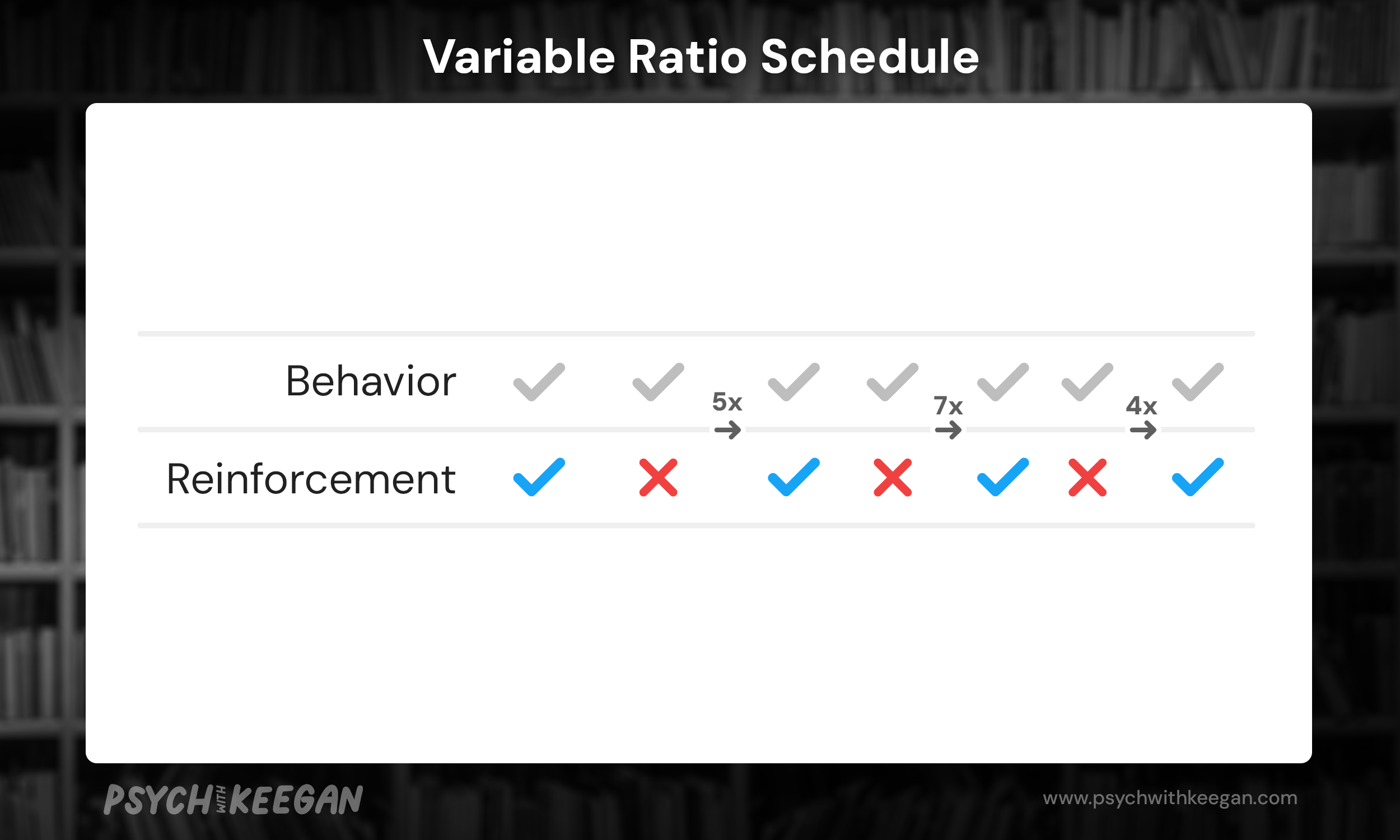
Instead of celebrating every win, which leads to hedonic adaptation and a drop in your dopamine baseline, you can make your self-reward unpredictable.
How to Increase Motivation & Drive | Huberman Lab Essentials
In this clip, Andrew Huberman explains how to "lift" the intermittent reinforcement schedule used by casinos and apply it for personal goal pursuit.
Watch from 28:42 to 33:20. He explains that the key is to occasionally and subjectively blunt the reward response for some intermediate goals to keep your dopamine system in check.
- Cheat Sheet Rule #3: Make rewards random. For long-term projects, don't celebrate every milestone. Reward yourself intermittently and unpredictably. Sometimes celebrate three wins in a row; other times, achieve ten things with no celebration at all. This keeps the dopamine system "guessing" and prevents it from taking rewards for granted.
4. The Purity Principle: Avoid "Dopamine Stacking"
To get the most out of an activity you want to enjoy, the temptation is to layer multiple sources of dopamine—your favorite music, a pre-workout stimulant, social check-ins. However, this is counterproductive.
Controlling Your Dopamine For Motivation, Focus & Satisfaction
This section of the article details the problem with layering multiple dopamine-enhancing activities, using the example of bringing a smartphone to workouts.
Read the section titled "Layering Multiple Dopamine-Releasing Activities." You can find this by searching for that heading in the text. Focus on the core argument about why this approach ultimately backfires, leading to a drop in baseline and making the primary activity less enjoyable.
Stacking sources of pleasure creates an artificially high peak that your brain cannot sustain. The subsequent drop in baseline is proportionally larger, which makes you require even more stimulation the next time. This teaches your brain that the activity itself isn't rewarding enough on its own.
- Cheat Sheet Rule #4: Don't stack pleasures. To maintain intrinsic motivation for an activity (e.g., exercise, creative work), do not consistently layer it with other dopamine-evoking stimuli. Let the activity be its own reward.
5. The Psychological Context: Engineer Your Environment for SDT Needs
As we concluded in our last lesson, the psychological needs for Autonomy, Competence, and Relatedness are not just abstract concepts; they are the inputs for a healthy intrinsic motivation system.
- Autonomy (choice) protects the dopamine system from being hijacked by external controls.
- Competence (mastery) provides the steady drip of progress-related dopamine.
- Relatedness (connection) is a powerful, evolutionarily conserved source of reward that buffers stress and supports motivation.
This principle is supported by broader research into what is sometimes called the "Dopamine Paradox."
The Dopamine Paradox: Why Pleasure Often Undermines Motivation
This article from GlobalRPH provides a clinical perspective on dopamine regulation, reinforcing our principles.
Please read two sections. First, review the "Therapeutic Interventions and Treatment Strategies," focusing on the behavioral, cognitive, and environmental interventions. Then, read the "Key Takeaways for Clinical Practice," which provides a concise summary of the principles. Notice how these clinical strategies align perfectly with fostering Autonomy and Competence.
- Cheat Sheet Rule #5: Foster Autonomy, Competence, and Relatedness. Actively seek and design situations that give you a sense of choice, allow you to tackle optimally challenging tasks, and provide meaningful social connection. This is the most reliable way to fuel your intrinsic dopamine system for the long term.
The Final Cheat Sheet
Here are the principles we've discussed, distilled into your requested format.
The Dopamine Regulation Cheat Sheet
-
Secure Your Baseline: Your capacity for motivation starts here. Prioritize daily:
- Quality Sleep
- Morning Sunlight Exposure (10-30 min)
- Tyrosine-Rich Nutrition (meats, nuts, cheeses)
- Regular Movement/Exercise
-
Reward the Effort, Not the Win: Train your brain to release dopamine during hard work. When you feel friction, tell yourself: "This is the feeling of growth. This is what I want."
-
Make Rewards Intermittent & Unpredictable: For long-term goals, do not celebrate every milestone. This prevents hedonic adaptation and keeps motivation high, mimicking the brain's most powerful reinforcement schedule. Flip a coin if you have to; the randomness is key.
-
Don't "Stack" Dopamine: Avoid layering multiple pleasures (e.g., stimulants + music + social media) to get through a task you want to find intrinsically rewarding. This erodes the value of the primary activity over time.
-
Let the Task Be the Reward: Do not use immediate external rewards for activities you want to enjoy for their own sake. Giving yourself a treat right after undermines intrinsic motivation by shifting your brain's "locus of reward" to the treat.
-
Architect Your Life for SDT Needs: Consciously engineer your work and personal projects to maximize:
- Autonomy: The feeling of choice and volition.
- Competence: The pursuit of mastery at an optimal challenge level.
- Relatedness: A sense of connection and belonging.
-
(Advanced) Use Cold Exposure for a Baseline Boost: Deliberate cold exposure (e.g., cold showers, ice baths) is a non-pharmacological tool proven to create a large and sustained increase in baseline dopamine for hours afterward.
Formula for Your Cheat Sheet:
Sustained Drive
Given an environment satisfying the needs for Autonomy, Competence, and Relatedness.
(This formula expresses that sustained drive is proportional to a healthy dopamine baseline, multiplied by the ratio of internally generated reward from effort versus externally provided rewards. The goal is to maximize this ratio within a psychologically supportive environment.)
Conclusion
In this module, you have gained a sophisticated, multi-layered understanding of your own motivational machinery. You now possess the knowledge to move beyond the simplistic and often counterproductive "dopamine hit" model, and instead cultivate a robust, resilient system for drive and focus.
We have established the why and the what of motivation. We have the foundational principles. In our next module, we will turn to the how. We will explore the 'Deep Work' framework, a practical methodology for structuring your professional life to create the very conditions of uninterrupted focus and optimal challenge that allow these intrinsic motivation circuits to flourish.