Welcome to the first lesson of our third module. In our previous module, we built a comprehensive understanding of the neuroscience of motivation, culminating in a practical "cheat sheet" for regulating your dopamine system. You now have the principles to fuel your drive. As we concluded, the next logical step is to explore how to structure your time and environment to apply that drive effectively.
This lesson introduces the foundational framework for that structure: Deep Work. Coined by computer science professor Cal Newport, this concept provides a powerful lens through which to view productivity and skill development. Our objective is to explain this framework and, crucially, to examine the scientific and empirical evidence that links the practice of uninterrupted focus to higher-quality performance.
The Great Divide: Deep Work vs. Shallow Work
At its core, the framework proposes a simple but profound dichotomy in how we can spend our professional time. Most modern knowledge work is a blend of two distinct types of activity.
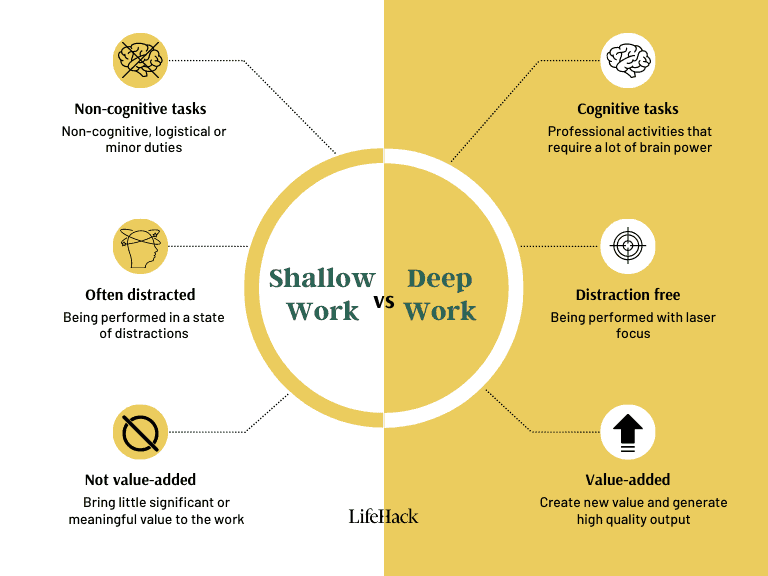
To formalize these ideas, let's turn to a detailed overview of the Deep Work principle.
Deep Work: Why Focused Concentration Creates Breakthrough...
This introductory section of the article clearly defines Cal Newport's concepts of "Deep Work" and "Shallow Work."
Please read from the beginning of the article down to the end of the introduction, marked by the start of the section titled "The Shallow Work Problem". Focus on grasping the precise definitions of the two work types and the paradox they present in modern professional life.
As the article lays out, the paradox is that our work environments and habits often optimize for shallow work—responsiveness, visible activity, and constant connection—while the activities that generate the most significant value demand the opposite: sustained, distraction-free concentration. The previous module on dopamine gives us a clue as to why this happens: shallow work often involves engaging with platforms that leverage variable-ratio reinforcement schedules (checking email, social media), providing a constant, low-level pull on our attention. Deep work, in contrast, requires us to harness intrinsic motivation, rewarding the effort itself.
The Evidence: Quantifying the High Cost of Distraction
To appreciate the value of deep work, we must first understand the demonstrable costs of its alternative: a state of fragmented attention. These costs are not just a vague sense of being "unproductive"; they are measurable phenomena at the neurological and psychological levels.
1. The Neural "Switching Tax"
Every time you switch your attention from one task to another—for instance, from writing a report to checking a notification and back—your brain pays a price. This isn't just about the few seconds the distraction takes; it involves reconfiguring neural networks, which consumes time and metabolic energy.
In the following clip, Dr. Cal Newport and Dr. Andrew Huberman discuss this exact phenomenon.
Avoiding Distractions & Doing Deep Work | Dr. Cal Newport & Dr. Andrew Huberman
This short clip explains the concept of "network switching cost" as a tangible, energy-consuming neural operation.
Please watch from 9:16 to 9:43. Note how they frame this not just as lost time, but as an expensive cognitive process.
This "network switching cost" is a fundamental piece of evidence. It shows that a day fragmented into ten 20-minute work blocks is not equivalent to a single 200-minute block, even if the "work" time is mathematically the same. The cumulative switching tax severely degrades cognitive capacity.
2. The Psychological Residue
Beyond the immediate switching cost, a more insidious effect lingers: attention residue. Even after you've returned to your primary task, a part of your cognitive resources remains stuck on the task you just switched from.
The following research paper provides an excellent empirical look at this. Given your background as a statistician, you'll appreciate the methodology. It's an exploratory field study that deployed software to block online distractions for a group of information workers for one week, comparing their self-reported focus and productivity to a baseline week.
[PDF] Effects of Individual Differences in Blocking Workplace Distractions
This research paper from Microsoft Research provides empirical evidence for the costs of distraction and the benefits of blocking them.
Please read two parts of this paper: In the "WORKPLACE DISTRACTIONS" section, read the paragraph that introduces the concepts of "interruption residue" and "chain of distraction." In the "Focus and Engagement" subsection of the results, read the two paragraphs that explain the findings through the lens of interruption residue and chains of distraction. Notice how the participants' qualitative feedback directly illustrates the concept of residue—the thoughts from the distraction "remain in one's head" and interfere with the primary task. The study used paired t-tests on the Cognitive Absorption scale to find a significant increase in "Focused Immersion" during the blocking week (p < .01).
This concept of attention residue proves that even a "quick check" of your email can impair your cognitive performance for many minutes after. Your brain doesn't just switch on and off; it leaves a cognitive "ghost" of the previous task that occupies precious working memory.
3. The Behavioral Addiction to Novelty
Finally, constant distraction isn't just a bad habit; it can train your brain to crave novelty and become uncomfortable with sustained focus. This is a direct extension of our discussion on the dopamine system. Unpredictable digital alerts act as a powerful intermittent reinforcement schedule, creating a "moderate behavioral addiction."
Avoiding Distractions & Doing Deep Work | Dr. Cal Newport & Dr. Andrew Huberman
In this clip, the discussion explores the idea that our attachment to our phones can be viewed as a behavioral addiction, driven by engineered dopamine feedback loops.
Please watch from 5:05 to 6:53. This directly links the problem of distraction back to the dopamine principles we covered in the last module.
When we repeatedly expose ourselves to this cycle, we erode our ability to tolerate the initial friction of deep work, which lacks immediate, novel stimuli. We are, in effect, conditioning ourselves for shallow work.
The Science Behind Deep Work's Efficacy
Having established the costs of distraction, let's examine the evidence for why deep work is so effective. The benefits stem from its alignment with fundamental principles of neuroscience and cognitive psychology.
The Neurochemical Orchestra of Focus
As a brief refresher from Module 1, sustained focus is not a single process but a symphony of neurochemicals. Dr. Huberman provides a useful metaphor of an arrow to visualize this:
- Epinephrine (Adrenaline): The shaft of the arrow. It provides alertness and energy. It is necessary, but not sufficient, for focus.
- Acetylcholine: The arrowhead. It acts like a spotlight, sharpening your focus on a specific set of neural circuits representing your task. A narrow arrowhead means precise focus.
- Dopamine: The engine. It provides the motivation to sustain the effort over time, keeping the arrow moving forward.
Deep work is the practice of creating an environment and a schedule that allows this entire system to be directed at a single target for an extended period, without being pulled off course.
Cognitive Performance and Skill Development
The true power of deep work lies in how it optimizes learning and the creation of high-quality output. By concentrating all your cognitive resources on a single, challenging problem, you trigger several key processes.
Deep Work: Why Focused Concentration Creates Breakthrough...
This section delves into the neuroscience and cognitive science that explain why deep work is so effective.
Please read the section titled "The Science Behind Deep Work." Pay close attention to the three subsections: Neural Mechanics: Focus on how concentration physically changes the brain (e.g., myelination). Cognitive Optimization: This reinforces the cost of multitasking by explaining attention as a zero-sum resource. Memory Enhancement: Note the key phrase, "Memory is the residue of thought."
As the article details, deep work isn't just about "trying harder." It facilitates superior performance because it:
- Strengthens Neural Circuits: Intense focus on a specific skill or problem leads to myelination—the process where glial cells wrap axons in a fatty sheath. This sheath acts like insulation on a wire, speeding up and strengthening the neural signal. Fragmented attention does not trigger this process as effectively.
- Maximizes Cognitive Resources: By eliminating the switching tax and attention residue, you can devote your full, limited prefrontal cortex capacity to the task at hand.
- Encodes Durable Memories: "Memory is the residue of thought." The depth at which you process information is the single greatest predictor of long-term retention. Deep work, by its very definition, is deep processing.
Conclusion
In this lesson, we have defined the 'Deep Work' framework and contrasted it with its less valuable counterpart, 'Shallow Work.' More importantly, we have reviewed the evidence showing that this is not a mere philosophical preference but a model grounded in the realities of our cognitive architecture. The costs of distraction are real and measurable in the form of neural switching taxes and psychological attention residue. Conversely, the benefits of deep, uninterrupted focus are rooted in its ability to optimize neurochemical systems, drive neural plasticity, and facilitate the deep processing required for high-quality output and lasting learning.
You now understand what deep work is and why it is the gold standard for cognitive performance. In our next lesson, we will move from the "what" and "why" to the "how," exploring practical, evidence-based techniques like time-blocking to begin structuring these powerful focus sessions into your own work life.
The Deep Work Cheat Sheet
Here is the distilled summary of today's core concepts, in your requested format.
-
The Deep Work Equation: . The framework's primary goal is to maximize the Intensity of Focus to produce elite-level output in less time.
-
The Cost of Shallowness Formula: . This highlights that the true cost of an interruption is always greater than its duration.
-
Core Principles:
- Work is Dichotomous: Separate all tasks into 'deep' (cognitively demanding, high-value) and 'shallow' (logistical, low-value). The goal is to maximize time spent on the former.
- Focus is a Skill, Not a Trait: The ability to concentrate is like a muscle. It atrophies with disuse (constant distraction) and strengthens with training (regular deep work bouts).
- Attention Residue is the Enemy: A "quick" glance at an inbox or social feed can impair your cognitive performance for many minutes after. Protect your focus zealously.
- Memory is the Residue of Thought: To learn, understand, and retain, you must process information deeply. Deep work creates the ideal conditions for this processing.