In our last lesson, we established the "what" and "why" of Deep Work, grounding our discussion in the measurable cognitive costs of distraction, such as attention residue and task-switching penalties. You now understand that maximizing the quality of your work is less about total time spent and more about the intensity of your focus during that time.
Today, we transition from theory to practice. This lesson addresses the "how": we will explore time-blocking, a powerful and practical scheduling method designed to operationalize the principles of deep work. Our goal is for you to learn how to apply time-blocking techniques to systematically structure your days, creating the large, uninterrupted periods necessary for high-quality, focused effort.
To begin, let's visualize the difference between a typical, fragmented workday and a time-blocked one.
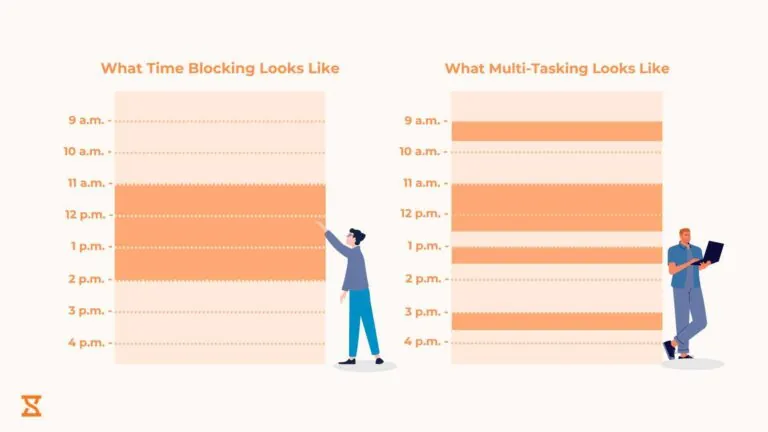
The Statistical Case for Time Management
Your background in statistics provides a unique lens for appreciating the arguments for single-tasking. While multitasking can feel productive, research suggests this feeling is often illusory. The cognitive costs we discussed previously manifest in tangible performance deficits.
A study on the effects of multitasking on academic performance provides a compelling statistical case. Given your expertise, you'll find the regression analysis particularly illuminating.
[PDF] Investigating the Effects of Multitasking on Time Management Skills ...
This study uses a mixed-methods approach to explore the relationship between multitasking, time management, and academic success. It provides quantitative evidence for the superiority of structured time management.
Please review the following sections of the paper: Start with the Introduction to understand the study's premise, which connects to Cognitive Load Theory. Read the "Results and Discussion" section to get an overview of the key findings. Finally, and most importantly, examine Table 4, the multiple linear regression analysis. Notice the beta coefficients (β). While multitasking frequency shows a small positive effect (β = 0.215), the coefficient for time management skills is nearly double (β = 0.401) and is highly significant (p < 0.001). This indicates that structured time management is a much stronger predictor of performance than the tendency to multitask.
This data reinforces a central theme: the path to higher performance isn't about doing more things at once, but about doing one thing at a time, with intention. Time blocking is the system that enables this.
Why Time Blocking Works: The Cognitive Benefits
Time blocking directly counters the "time confetti" effect—where meaningful blocks of time are shredded into tiny, useless moments—that we touched on previously. It does this by leveraging a few key cognitive principles.
Time block strategy to double your efficiency (and End Overload)
This article by Simply Psychology provides a clear breakdown of the psychological mechanisms that make time blocking so effective.
Please read the section titled "Why Time Blocking is 2x More Efficient." As you read, focus on how each of the three benefits directly addresses the problems we've discussed: Eliminating "Attention Residue" Tax: This connects directly to last lesson's topic. By pre-committing to a schedule, you remove the constant decision-making of "what's next?" and reduce the cognitive cost of switching. Utilizing All Available Time: This is the antidote to "time confetti." Creating a Realistic Workload Understanding: This feedback loop helps you calibrate your planning over time, moving from guesswork to data-driven scheduling.
The core principle is intention. Time blocking forces you to be proactive about your day rather than reactive to incoming demands. It simplifies your mental discipline into a single commitment: "Do I follow my plan or not?"
From Principles to a Practical System
Now, let's build the system. Who better to learn from than Cal Newport, the academic who popularized many of these concepts? In the following video, he walks through his personal, multi-scale planning system that he has refined over a decade. It shows how daily time blocking fits into a larger structure of weekly and strategic planning.
Cal Newport's Planning System (In Detail)
In this video, Cal Newport gives a detailed tour of his personal planning system, showing how big-picture goals translate into daily actions.
Please watch from 07:39 to 10:56. Pay close attention to the hierarchy he describes: Weekly Plan: He reviews strategic plans, his calendar, and task lists to create a rough guide for the week. Daily Plan: This is where time blocking happens. Each weekday, he creates a specific time block plan, assigning a job to every part of the day. Shutdown Ritual: He emphasizes the importance of a clear "shutdown complete" ritual to fully disengage from work, which we will explore more in a later module on relaxation.
Newport's system demonstrates that time blocking isn't just about scheduling tasks; it's about ensuring your daily actions are connected to your larger goals.
Advanced Time Blocking Techniques
Once you have the basic structure, you can enhance its effectiveness with more specific strategies like Task Batching and Day Theming. These are designed to further minimize the cognitive cost of context switching.
- Task Batching: Grouping similar, small tasks into a single, dedicated block. For example, instead of answering emails as they arrive, you would schedule a 30-minute "email processing" block.
- Day Theming: Dedicating an entire day to a single role or type of work. As a researcher, you might have "Writing Days" protected for deep work and "Admin Days" for meetings, email, and logistical tasks. This could also apply to your creative pursuits, with dedicated "Design Days."
The Simply Psychology article you read earlier provides excellent detail on these advanced methods.
Time block strategy to double your efficiency (and End Overload)
This resource explains how to implement more advanced versions of time blocking.
Please read the sections on Task Batching and Day Theming. Consider how you could apply these to your own mix of research, writing, and administrative tasks.
A Step-by-Step Guide to Your First Time Block Plan
Let's consolidate everything into a clear, daily practice.

Here is a practical workflow you can start using tomorrow morning:
- Choose Your Tool: This can be a physical notebook (like Newport's Time-Block Planner) or a digital calendar. The tool is less important than the practice.
- Capture Fixed Appointments: At the start of your day, block out any meetings or hard-landscape commitments from your calendar.
- Consult Your Lists: Review your weekly plan and primary task list to identify your key priorities for the day.
- Block Your Deep Work: Schedule 1-2 generous blocks (e.g., 90-120 minutes) for your most important deep work tasks. Align these with your peak energy periods, as discussed in the Huberman/Grant clip.
- Batch the Shallows: Group your shallow work (emails, quick calls, admin) into dedicated blocks.
- Schedule Overheads: Block out time for lunch, breaks, and transitions between tasks. As the infographic notes, adding buffers is crucial for a resilient schedule.
- Follow the Plan (and Adjust): The goal is not perfection. When you fall behind or an unexpected task arises, take a moment to stop and create a new plan for the rest of the day. This act of re-planning is what maintains intentionality.
Conclusion
In this lesson, we have moved from the "why" of deep work to the "how" of daily execution. We've seen statistical evidence favoring structured time management over multitasking and broken down time blocking into its core principles and a practical, step-by-step system. The key is to shift from a reactive mode, governed by a to-do list and incoming alerts, to a proactive mode, governed by an intentional schedule. By giving every minute a job, you reclaim control over your attention, creating the conditions for the deep work that produces high-quality results.
In our next lesson, we will build upon this foundation. With a structured time plan in place, the next step is to structure your physical environment. We will explore how to apply principles from environmental psychology to design a workspace that minimizes distractions and cues your brain for focus.
The Time Blocking Cheat Sheet
Here is a summary of today's lesson, distilled into your requested format.
-
The Time-Blocking Function: Let be the quality of work produced, be the intensity of focus, and be the time spent. While multitasking fragments and degrades , time blocking, , structures your time to maximize .
The goal of time blocking, , is to create a schedule function that holds at its maximum for sustained intervals.
-
Core Principles:
- Proactive vs. Reactive: Work from a schedule, not a to-do list. A list captures what needs to be done; a time block plan dictates when and with what level of focus it will be done.
- Intention Over Perfection: The plan is a guide, not a rigid script. When deviations occur, the discipline is not to abandon the plan, but to pause and re-plan the remainder of the day. This maintains control.
- Minimize Context Switching: Use task batching to consolidate shallow work and day theming to dedicate entire days to a single cognitive context. This drastically reduces the cumulative attention residue tax.
- Full-Day Accounting: Give every minute of your workday a job. This includes deep work, shallow work, meetings, breaks, lunch, and transition times. Unscheduled time is often wasted time.