Welcome back. In our previous lesson, we explored the neurochemical mechanics of sustained drive, focusing on dopamine scheduling and the power of intermittent reinforcement. You learned that the most robust form of motivation comes not from chasing external rewards, but from learning to associate the feeling of effort itself with an internal sense of reward.
Today, we will connect these neurobiological principles to a cornerstone of psychological research: Self-Determination Theory (SDT). You will discover that the conditions described by SDT as essential for human thriving are, in fact, the very inputs that cultivate a healthy and sustainable dopamine system. Our goal is to connect self-determination theory's framework of intrinsic motivation to the principles of dopamine regulation we've been discussing. This will provide you with a powerful psychological lens through which to understand and apply your knowledge of neuroscience.
From Amotivation to Intrinsic Motivation: The SDT Continuum
Self-Determination Theory, developed by psychologists Edward Deci and Richard Ryan, is a broad theory of human motivation and personality. It posits that people have an innate tendency toward growth and integration. However, this tendency requires a supportive environment. SDT organizes motivation not as a simple on/off switch, but as a continuum of different regulatory styles that vary in their degree of self-determination.
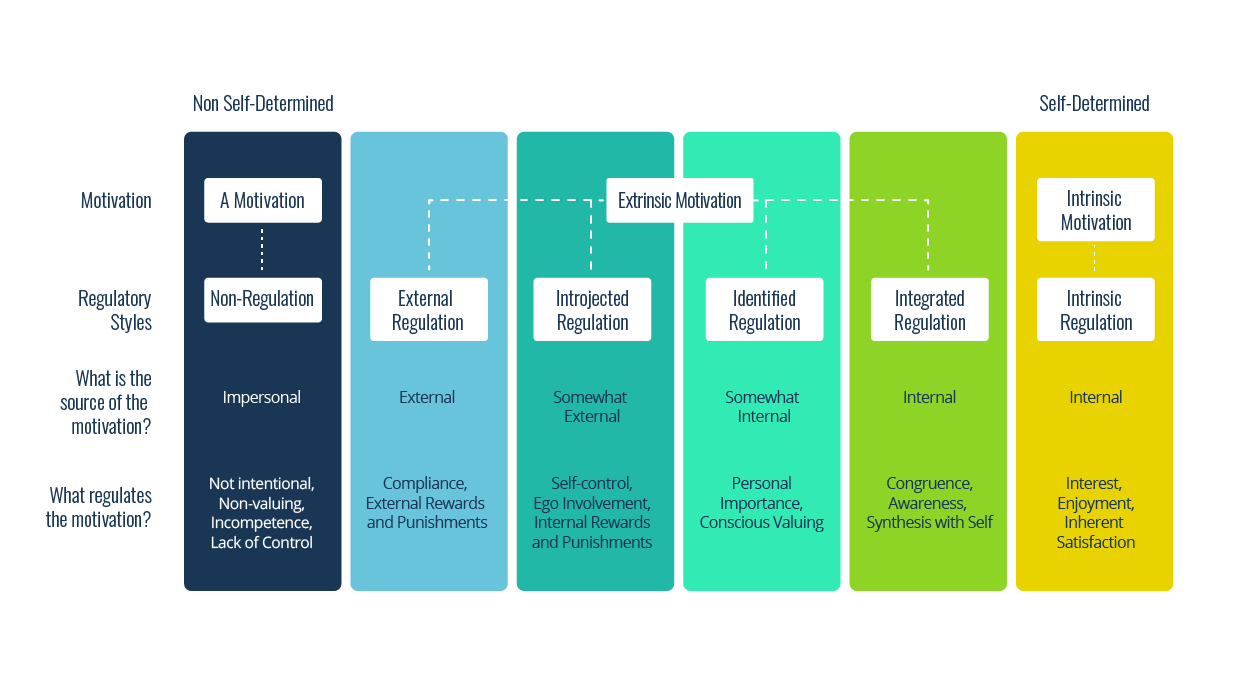
Let's explore these styles. The video below features an interview with Richard Ryan himself, where he explains the core concepts of SDT.
Richard Ryan || Self-Determination Theory & Human Motivation
This clip from "The Psychology Podcast" features Dr. Richard Ryan, the co-developer of SDT, defining the theory's core concepts.
Please watch the segment from 8:28 to 14:22. As you watch, map the different types of motivation he describes to the diagram above: External Regulation: Doing something for an external reward or to avoid punishment. Introjected Regulation: Doing something to avoid guilt or to gain pride—an internal pressure. Identified Regulation: Doing something because you consciously value the goal, even if the activity isn't enjoyable. Intrinsic Motivation: Doing something for its inherent interest and enjoyment.
As you can see, the left side of this continuum, particularly External Regulation, maps directly onto the reward-chasing behavior we discussed previously—the kind that leads to dopamine peaks and subsequent baseline drops. The right side, especially Identified Regulation and Intrinsic Motivation, aligns with the more sustainable strategy of finding value and reward in the process itself.
The Three Basic Psychological Needs
So, what moves a person along this continuum toward higher-quality, more self-determined motivation? SDT proposes that the key lies in the satisfaction of three innate and universal psychological needs. Just as a plant needs sunlight, water, and nutrients to grow, humans need these three "nutrients" to flourish.

Let's define each need:
- Autonomy: The need to feel a sense of volition and choice in one's actions. It’s the feeling of being the author of your own life, rather than a pawn controlled by external forces.
- Competence: The need to feel effective and capable. It’s the experience of mastery, of growing your skills and meeting challenges.
- Relatedness: The need to feel connected to, and cared for by, others. Given your background in social research on relationships, the profound impact of this need on well-being and motivation across domains like work and family life will be very familiar.
To understand how Deci and Ryan arrived at these three specific needs, let's return to the interview.
Richard Ryan || Self-Determination Theory & Human Motivation
In this segment, Dr. Ryan explains the empirical origins of the three basic psychological needs.
Watch from 23:49 to 25:16. Notice how the needs for autonomy and competence were first identified in research on intrinsic motivation, and relatedness was found to be crucial for internalization—the process of taking in values and regulations from others.
Now, let's build the crucial bridge: How do these psychological needs translate into the language of dopamine?
The Neurobiological Bridge: SDT and Dopamine
A groundbreaking paper by Stefano Di Domenico and Richard Ryan, "The Emerging Neuroscience of Intrinsic Motivation," explicitly connects the tenets of SDT to the functioning of the brain's dopamine systems. This work provides the scientific "how" behind the "what" of SDT.
The Emerging Neuroscience of Intrinsic Motivation: A New Frontier ...
This research paper is central to today's lesson. It outlines the proposition that intrinsic motivation, as described by SDT, is fundamentally supported by dopaminergic systems.
Please read the section titled "Proposition I: Intrinsic Motivation is Supported by Dopaminergic Systems." You can find this by searching for that heading in the text. Focus on these key points: The three lines of evidence linking dopamine to intrinsic motivation. The distinction between value-coding neurons which track progress and reward, and salience-coding neurons which drive curiosity and interest in novelty.
This paper provides the critical link. Let's break down how each psychological need "feeds" your dopamine system in a healthy way:
-
Competence and the Value-Coding System: The need for competence is satisfied when we make progress on an optimally challenging task. Think about solving a statistical problem, refining a lingerie design, or hitting a new personal best in powerlifting. The process itself provides a stream of small, positive feedback signals—"this is working," "I'm getting closer." These signals of progress act as endogenous rewards, driving the value-coding dopamine neurons. This is the neurobiological mechanism for deriving reward from the effort itself. You are not waiting for a single, large reward at the end; you are getting a steady drip of dopamine from the act of becoming more competent.
-
Autonomy as a Dopamine Protector: The need for autonomy is about feeling choice and volition. When you choose to engage in a task, your brain treats the outcomes differently. As the OPTIMAL theory paper by Wulf & Lewthwaite suggests, autonomy-supportive conditions can enhance performance expectancies. This anticipation of success is a known trigger for dopamine release. Furthermore, a sense of autonomy seems to protect the intrinsic reward system. Studies mentioned in the Di Domenico & Ryan paper show that when we have choice, brain regions associated with value (like the ventromedial prefrontal cortex) remain active even after failure, promoting persistence. Autonomy acts as a buffer, preventing the dopamine system from becoming dependent on external controls and rewards.
-
Interest and the Salience-Coding System: The salience-coding dopamine neurons are activated by novelty and the "incentive value of the possibility of gaining information." This is the neural signature of curiosity and interest—the core affective states of intrinsic motivation. When you explore a new research topic or a new hobby simply because you find it fascinating, you are directly engaging this system.
In essence, an environment that supports your autonomy and allows you to build competence in areas you find interesting is an environment that is perfectly tuned to promote sustained, healthy dopamine regulation.
The Undermining Effect Revisited
We can now fully understand the undermining effect we touched on in the last lesson. When an external, controlling reward (e.g., "you will be paid for every puzzle you solve") is introduced for an intrinsically interesting task, it thwarts the need for autonomy. The locus of causality shifts from internal ("I'm doing this because it's fun") to external ("I'm doing this for the money").
This psychological shift has a direct neural consequence. As described in the fMRI study by Murayama et al. (2010), the external reward hijacks the dopamine system. The brain's value-coding system stops responding to the inherent satisfaction of the task and starts responding only to the external reward. When the reward is removed, the motivation vanishes because the original, intrinsic source of dopamine has been downregulated.
Let's watch a brief clip that recaps the classic study demonstrating this effect.
Controlling Your Dopamine for Motivation, Focus & Satisfaction | Huberman Lab Essentials
Andrew Huberman discusses the classic experiment showing how external rewards can undermine intrinsic enjoyment.
Watch this short segment from 22:30 to 24:19. He explains the study with children who enjoyed drawing and how being rewarded for it, and then having the reward removed, reduced their intrinsic motivation to draw. This is the behavioral manifestation of the neural process we've been discussing.
Conclusion
Today, we have bridged the gap between the low-level neurobiology of dopamine and the high-level psychological framework of Self-Determination Theory. You've learned that SDT doesn't just describe abstract psychological principles; it provides a remarkably accurate map of the conditions required for a healthy, sustainable motivational system.
By creating environments and choosing activities that support your autonomy, build your competence, and foster relatedness, you are not just aiming for psychological well-being. You are actively engaging in the most effective form of long-term dopamine management. You are shifting away from a fragile system dependent on external rewards and toward a robust, resilient system fueled by the inherent rewards of growth, choice, and curiosity.
Key Takeaways:
- Self-Determination Theory (SDT) provides a psychological framework for understanding high-quality, sustainable motivation.
- The three basic psychological needs—Autonomy, Competence, and Relatedness—are essential for intrinsic motivation and well-being.
- These psychological needs directly map onto the mechanisms of dopamine regulation:
- Competence provides a steady stream of progress-related dopamine via the value-coding system.
- Autonomy protects the intrinsic reward system and enhances dopamine release via positive expectancy.
- Pursuing genuine Interest engages the curiosity-driven salience-coding dopamine system.
- Violating these needs, for example by imposing controlling external rewards, can thwart autonomy and undermine the brain's intrinsic motivation circuitry.
Formula for Your Cheat Sheet:
High-Quality Motivation where
(This formula expresses that high-quality, sustainable motivation is a function of intrinsic dopamine release, which is in turn dependent on the satisfaction of the three basic psychological needs described by SDT.)
We have now concluded our deep dive into the neuroscience and psychology of motivation. In the next module, we will begin translating this foundational knowledge into practice. We will start by exploring the 'Deep Work' framework, a methodology for structuring your professional life that creates the very conditions of autonomy and challenge-skill balance that are ideal for fostering the intrinsic motivation we've discussed today.