Welcome back. In our last lesson, we established that dopamine is the critical neuromodulator governing your willingness to expend effort. We saw how the brain performs a cost-benefit analysis for every action, with dopamine acting as the currency that "pays" the effort cost. This explains why, on any given day, your capacity for tackling difficult tasks can feel finite.
Today, we move from the economics of a single decision to the long-term financial planning of your motivation. If dopamine is your effort currency, how do you manage your account to ensure you have enough reserves to fund your most ambitious goals? This lesson will provide you with practical, evidence-based strategies for "dopamine scheduling" to build and sustain your drive over the long haul. Your learning objective is to apply these strategies, particularly strategic reward timing, to maintain high levels of motivation.
The Dopamine Seesaw: Peaks and Baselines
To schedule dopamine effectively, we must first understand its fundamental dynamics. Your dopamine system doesn't operate like a simple faucet that's either on or off. Instead, it maintains a constant, low-level baseline (or tonic) release, which influences your general mood and motivation. On top of this baseline, specific events can trigger sharp, transient peaks (or phasic release).
The most crucial rule of this system is that the peaks and the baseline are inversely related. A large peak in dopamine is inevitably followed by a drop in your baseline level of dopamine below where it was before.
Controlling Your Dopamine For Motivation, Focus & Satisfaction
This article from the Huberman Lab provides a foundational explanation of the relationship between dopamine peaks and baselines.
First, read the introduction to understand the core principle of tonic and phasic release. Pay close attention to the key takeaway: after a peak, your baseline drops. Next, jump to the section "Pleasure-Pain Balance" to understand the biological reason for this drop. It's not just a concept; it's rooted in the depletion of the readily releasable pool of dopamine vesicles. This explains why feeling "lousy" or unmotivated after a big success or indulgence is a real neurochemical phenomenon.
This dynamic is the neurochemical basis of the "pleasure-pain balance." The higher the peak of pleasure, the deeper and longer the subsequent trough of pain, which we often experience as craving, lethargy, or a lack of motivation. Chasing constant, high-amplitude dopamine peaks is a biologically unsustainable strategy that ultimately depletes your motivation.
The Power of Surprise: Reward Prediction Error
If predictable, large rewards lead to a motivational crash, what kind of reward sustains motivation? The answer lies in a concept we've touched on before: reward prediction error. Your dopamine neurons are most powerfully activated not by reward itself, but by the difference between the expected reward and the actual reward.
- Positive Prediction Error: If a reward is better than expected (or completely unexpected), you get a large dopamine spike.
- No Prediction Error: If a reward occurs exactly as expected, you get little to no dopamine spike upon receiving the reward. The dopamine release happened during the anticipation.
- Negative Prediction Error: If an expected reward fails to occur, your dopamine level drops below baseline, which registers as disappointment.
This is elegantly visualized in studies of dopamine neuron firing rates.

This mechanism explains why the novelty of a new restaurant, relationship, or hobby is so exciting at first. The initial experiences are full of positive prediction errors. But as these experiences become routine and predictable, the dopamine response wanes. The key to long-term motivation is to work with this system, not against it.
Intermittent Reinforcement: The Strongest Motivator
Casinos and video game designers have masterfully exploited the reward prediction error system for decades. They don't give you a reward every time you pull a lever or open a loot box. Instead, they use an intermittent reinforcement schedule (specifically, a variable-ratio schedule), where rewards are delivered unpredictably.
Given your background in probability, the mechanics here will be quite intuitive. In a variable-ratio schedule, a reward is delivered after a random number of responses. It might be after 3 attempts, then 10, then 1, then 7. This unpredictability is what makes it so compelling.
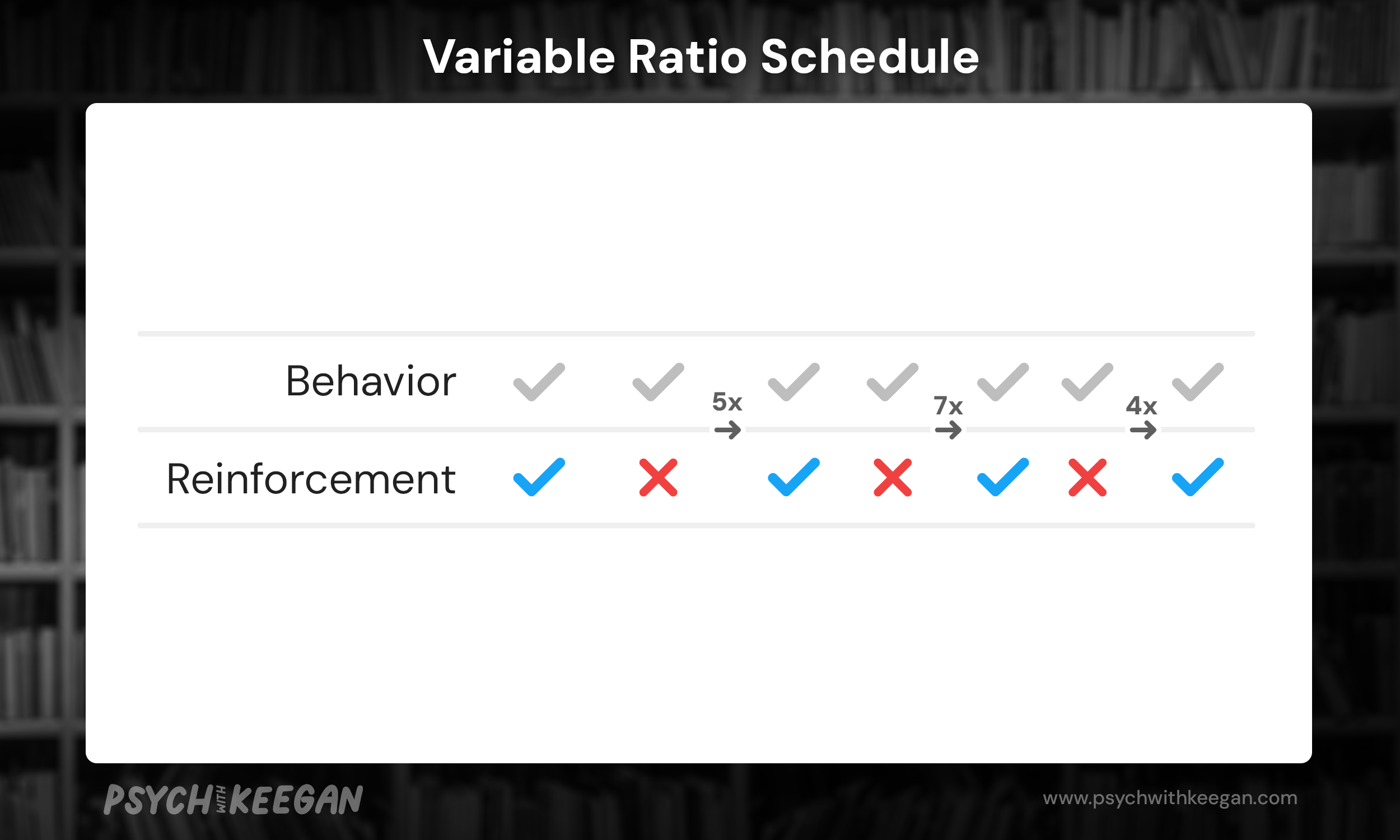
Why is this schedule so powerful?
Because you never know if the next action will be the one that pays off. This constant possibility of an unexpected win keeps your dopamine system engaged and your motivation to continue the behavior incredibly high. The anticipation, the hope of a reward, becomes the main driver.
Now, let's learn how to take this powerful principle back from the casinos and apply it to our own productive goals.
How to Increase Motivation & Drive | Huberman Lab Essentials
In this clip, Andrew Huberman explains how the intermittent reinforcement schedule used in gambling can be strategically applied to our own goals.
Please watch the segment from 28:48 to 33:05. Focus on the core idea: you can sustain long-term motivation by occasionally and subjectively removing the reward for achieving intermediate goals. The key is to make the self-reinforcement intermittent and unpredictable.
Your Dopamine Scheduling Toolkit
Based on these principles, here are concrete strategies you can use to manage your dopamine and sustain motivation for your goals.
1. Don't Celebrate Every Win (or at least, not in the same way)
It feels natural to celebrate when you complete a project, hit a new personal record in the gym, or finish a difficult chapter. While acknowledgement is important, attaching a large, predictable, external reward to every single success can be counterproductive. It teaches your brain to work for the reward, not for the satisfaction of the work itself, and can lead to habituation.
2. Practice Subjective and Intermittent Self-Reward
Instead of a big celebration every time, you can leverage the power of your own mind. The prefrontal cortex can modulate the dopamine system. This means you can consciously decide how to interpret and reward your own progress.
For many of your milestones, a simple internal acknowledgement is enough: "Good. I'm on the right track." By consciously blunting the reward response for some wins, you prevent your dopamine baseline from dropping and keep your system sensitive and eager for the next challenge.
To make this truly effective, do it intermittently. You can use a simple tool to ensure randomness. Before you start a work block, flip a coin. Heads: If you hit your goal, you'll allow yourself a small, satisfying reward (e.g., a 10-minute break with your favorite music). Tails: If you hit your goal, your reward is simply the knowledge that you're on track, and you move on to the next task. This practice directly implements a variable-ratio schedule for your own goal pursuit.
3. Avoid "Dopamine Stacking"
A common mistake is to "stack" multiple sources of dopamine to get through a difficult or unpleasant task. For example, listening to high-energy music, while drinking a pre-workout supplement, while scrolling social media between sets at the gym.
While this might feel motivating in the short term, it creates an enormous dopamine peak that is unsustainable. It also makes the primary activity (the workout) feel bland and unrewarding on its own. You're teaching your brain that the only way to exercise is with this massive cocktail of stimuli. The long-term solution is to delayer these sources and learn to find satisfaction in the activity itself. Try working out with no music, or studying without your phone in the same room. The first few times might feel harder, but you are recalibrating your dopamine system to be more sensitive to the rewards inherent in the effort.
4. The Master Strategy: Make the Effort the Reward
The most advanced and sustainable strategy is to stop attaching dopamine release to the outcome and start attaching it to the effort itself. This is the neurobiological foundation of what Carol Dweck calls a "growth mindset."
You can use your cognitive abilities to reframe the feeling of strain and friction. When you're deep in a challenging task and feel the urge to quit, you can consciously tell yourself: "This feeling of struggle is what it feels like to grow. This is the feeling of my brain getting stronger." By repeatedly and deliberately associating the feeling of effort with a positive, growth-oriented narrative, you are teaching your brain to release dopamine in response to the friction, not just in response to the finish line. This creates a powerful, self-sustaining loop of motivation where the process itself becomes the reward.
Conclusion
Today we've learned that sustaining motivation is not about chasing bigger and bigger rewards. It's about intelligently managing your internal neurochemistry. By understanding the dynamics of dopamine peaks and baselines, and leveraging the power of intermittent reinforcement, you can maintain a high level of drive for your most important goals over the long run.
Key Takeaways:
- Large, predictable dopamine peaks inevitably lead to a drop in your motivational baseline.
- Intermittent reinforcement (unpredictable rewards) is the most powerful schedule for sustaining behavior because it leverages reward prediction error.
- To sustain motivation, strategically blunt or skip rewards for some milestones, relying instead on cognitive acknowledgement.
- Avoid stacking multiple dopamine sources, as this undermines the intrinsic enjoyment of an activity.
- The ultimate strategy is to cultivate a growth mindset, learning to associate dopamine release with the feeling of effort itself.
Formula for Your Cheat Sheet:
Long-Term Motivation
(This formula suggests that sustained motivation is boosted by deriving reward from the effort itself and using unpredictable rewards, while it is diminished by layering too many dopamine sources and relying on predictable, external rewards.)
In our previous lessons, we've focused on the biological drivers of motivation. In our next lesson, we will bridge this knowledge to a key psychological framework: Self-Determination Theory. We'll explore how its core concepts of autonomy, competence, and relatedness map directly onto the principles of dopamine regulation we've discussed.