In our previous lessons, we've established the foundational pillars of your body's energy management system. We explored how light anchors your master 24-hour circadian clock, how your chronotype dictates your peak performance windows, and how meal timing synchronizes the clocks in your metabolic organs. Now, we will integrate these principles with a final, crucial layer: the shorter, faster rhythms that govern your focus and energy throughout the day.
This lesson addresses the learning outcome: Design a daily energy management protocol that integrates both circadian and ultradian principles. We will move from theory to application, synthesizing everything we've covered into a coherent daily structure. We'll introduce the concept of ultradian rhythms—the ~90-minute cycles of focus and rest—and show you how to layer them upon your foundational circadian rhythm to create a personalized template for peak performance and sustainable energy.
The Two Rhythms: Circadian and Ultradian
Your body's daily energy landscape is governed by two distinct but interconnected types of biological clocks.
-
Circadian Rhythms: These are the well-known biological cycles that operate on an approximately 24-hour schedule. Governed by the suprachiasmatic nucleus (SCN) in your brain, they regulate your sleep-wake cycle, body temperature, and hormone release. Think of this as the large, foundational wave of your day.
-
Ultradian Rhythms: These are shorter, recurrent cycles that repeat multiple times within a 24-hour day. The most relevant one for cognitive performance is the ~90-minute cycle of alertness and fatigue. Think of these as smaller waves riding on top of the larger circadian wave.

To understand the basics of ultradian rhythms and why they are relevant to productivity, the following article provides a concise overview.
Ultradian Rhythms: Enhancing Productivity and Well-being
This article from Lark provides a clear definition of ultradian rhythms and their relevance to sustained focus.
Please read the first two sections, starting from the introduction down to the end of the case study. Focus on how the text defines and distinguishes ultradian from circadian rhythms and how it connects them to productivity and focus.
These two rhythmic systems are not independent. The stability of your primary circadian rhythm directly influences how clearly and predictably your ultradian cycles are expressed. A chaotic or misaligned circadian rhythm (from poor sleep, erratic light exposure, or late-night eating) creates a noisy background that can mask or disrupt your natural ultradian fluctuations in focus.
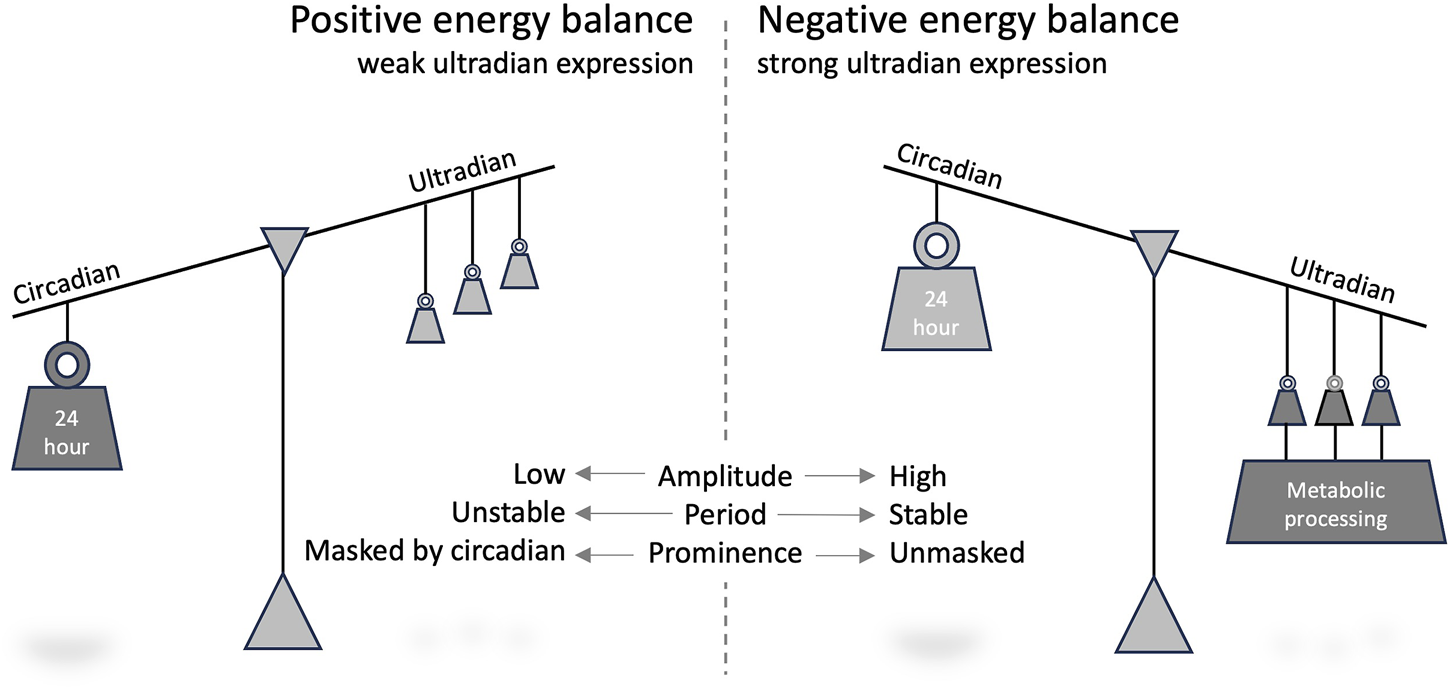
This means that to effectively leverage the 90-minute focus cycles, you must first establish a strong, stable 24-hour foundation.
Step 1: Anchor Your Circadian Rhythm
Building a robust daily protocol starts with setting powerful, consistent anchors for your master circadian clock. These are non-negotiable daily events that signal "day" and "night" to your brain and body. Neuroscientist Dr. Andrew Huberman provides an excellent walkthrough of a science-based daily routine. We will use his protocol as a model for constructing our own.
Maximize Productivity, Physical & Mental Health With Daily Tools | Huberman Lab Essentials
In this video, Dr. Huberman outlines his daily protocol, grounded in neuroscience, for optimizing mental and physical health. It serves as a fantastic template for building our own.
First, watch the introduction from context and structure to understand why the 24-hour day is the fundamental unit for optimization. Then, watch the detailed morning routine from upon waking. Pay close attention to the four key morning anchors: Noting your wake-up time to estimate your temperature minimum. Getting morning sunlight exposure to time your cortisol pulse. Using forward ambulation (walking) to reduce anxiety. Delaying caffeine intake by 90-120 minutes to prevent an afternoon crash.
The Temperature Minimum: Your Absolute Reference Point
Dr. Huberman introduces a critical concept that will be the central anchor for our protocol: the temperature minimum. This is the point in the 24-hour cycle when your core body temperature is at its lowest. It typically occurs about 2 hours before your average natural wake-up time.
Why is this so important? Because the temperature minimum is the absolute reference point around which your circadian clock can be shifted. All other events—light exposure, exercise, feeding—exert their effects relative to this point.
Given your background in statistics, you can think of the temperature minimum as the true, underlying parameter () of your circadian phase. While your wake-up time is a measurable observation (), it has some variance. Averaging your wake-up time over several days gives you a better estimate of , which you can then use to infer your temperature minimum: .
How to Defeat Jet Lag, Shift Work & Sleeplessness
This video provides the most detailed explanation of the temperature minimum and how to calculate and use it.
Please watch the section from temperature minimum. Focus on how to estimate your temperature minimum from your average wake-up time. Understand this key rule: Light/Exercise after T_min advances the clock (makes you wake up earlier). Light/Exercise before T_min delays the clock (makes you wake up later).
Your First Task:
- Track your wake-up time for the next 3-5 days.
- Calculate your average wake-up time.
- Subtract two hours to estimate your temperature minimum. This time will be the central anchor for the rest of your daily protocol.
Step 2: Layer on Ultradian Cycles for Deep Work
With your circadian anchors in place (morning light, eating window, wind-down time), you can now schedule your most demanding cognitive work. This is where we leverage ultradian rhythms. Your brain is not designed for 8 hours of continuous, high-level focus. Instead, it operates in cycles of approximately 90 minutes.
The goal is to intentionally structure your day around one to three of these 90-minute "deep work" blocks, during which you eliminate all distractions and focus on a single, high-priority task.
A crucial question arises: When is the best time to start these focus blocks?
The science points to a specific window. Your capacity for focus and alertness is not static; it rises with your core body temperature. The period of the steepest rise in your body temperature provides the most potent biological tailwind for intense cognitive effort. This period typically occurs 3 to 6 hours after your temperature minimum.
Maximize Productivity, Physical & Mental Health With Daily Tools | Huberman Lab Essentials
Dr. Huberman explains how to time your 90-minute ultradian work blocks to coincide with your body's natural rise in temperature.
Please watch this segment from heightened sense of focus. Note the explanation of the 90-minute ultradian cycle and the key insight on timing this work block to "catch the portion of the steepest slope of that temperature rise" following your temperature minimum.
Step 3: Design Your Integrated Daily Protocol
Now, let's put it all together. The goal is to create a template that you can adapt daily. Remember, the aim isn't rigid, neurotic adherence, but to have a default structure that aligns with your biology. This is your N-of-1 experiment.
The following resource provides a practical framework for integrating these focus blocks into a full workday, a challenge you might face with your demanding schedule.
What is the circadian rhythm for productivity? Is it always related to ...
This Q&A page from the Huberman Lab AI tool directly addresses the practicalities of implementing these cycles.
First, read the section on timing your cycles. It reinforces using the temperature minimum as your guide. Next, read the section addressing the question "How am I supposed to fulfill 11 hours of work per day?". This is critical. It explains that deep work blocks are for your most difficult tasks, while the time in between can be used for more routine work (emails, meetings, etc.). Finally, review the sample schedules. Use these as a template to think about your own day, but don't feel constrained by them.
Your Second Task: Draft Your Protocol
Using a journal or a document, draft a template for your ideal day based on these principles.
Part A: Circadian Anchors
- Wake-Up Time: (Your average time)
- Temperature Minimum (T_min): (Wake-Up Time - 2 hours)
- Morning Protocol (first 60-90 mins after waking):
- Sunlight Exposure: (e.g., 10-15 min walk outside)
- Hydration: (e.g., Water with sea salt)
- Caffeine Delay: First coffee/tea at
Wake-Up Time + 90 mins.
- Eating Window: Based on our last lesson, define your 8-10 hour window (e.g., 11:00 AM - 7:00 PM).
- Evening Protocol (2-3 hours before bed):
- Last Meal: (e.g., By 7:00 PM)
- Dim Lights / Avoid Screens: (e.g., Starting at 9:00 PM)
- Relaxation: (e.g., Reading, breathwork, hot shower to trigger temperature drop)
- Bedtime: (Your target bedtime)
Part B: Ultradian Work Blocks & Other Activities
- Optimal Deep Work Window: Calculate
T_min + 3 hourstoT_min + 6 hours. - Deep Work Block 1 (90 mins): Schedule this within your optimal window. Define the task.
- Recovery / Light Task (30-120 mins): What will you do after? (e.g., Answer emails, take a walk, NSDR).
- Deep Work Block 2 (90 mins): Can you fit a second one? When?
- Exercise: Where does your powerlifting or walking fit best? Consider Huberman's placement after a work block to replenish brain-derived neurotrophic factor (BDNF).
- Meals: Schedule your lunch and dinner within your eating window.
- Administrative/Shallow Work: Fill the remaining work hours with less demanding tasks.
Conclusion
You have now designed a comprehensive, multi-layered energy management protocol. The power of this approach lies in its integration of two systems. The circadian rhythm provides the stable, 24-hour container for your day, anchored by the non-negotiable signals of light and meal timing. Within that container, ultradian rhythms provide a framework for pulsing between intense, focused effort and deliberate recovery, allowing you to achieve high performance without burnout.
Your key takeaways are:
- Master the Foundation First: A stable circadian rhythm is a prerequisite for effective ultradian cycle management. Prioritize consistent sleep, morning light, and meal timing.
- Know Your Anchor: Your temperature minimum is the single most important data point for scheduling your day and shifting your clock when necessary.
- Work With Your Biology, Not Against It: Schedule your most difficult cognitive tasks for the period of the day when your body's physiology—rising temperature and alertness signals—provides a natural tailwind.
- Pulse, Don't Grind: Embrace the 90-minute cycle. True productivity comes from alternating between deep focus and intentional rest, not from attempting to maintain constant output.
In our next lesson, we will distill these complex rules and your newly designed protocol into a concise, actionable "cheat sheet," fulfilling the final learning outcome of this module and giving you a practical tool for daily planning.