Welcome to the next lesson in our journey to master energy management. In our last session, we explored your personal chronotype and how to align your most demanding tasks with your daily peaks in cognitive performance, a principle governed by the master clock in your brain and its primary cue: light. Today, we turn our attention to another powerful, yet often overlooked, time-giver for your body: food.
The timing of your meals is not just about managing hunger; it's a critical signal that coordinates the clocks in every organ of your body. Misaligning these clocks can create a kind of internal jetlag, impacting everything from your metabolism to your ability to think clearly. Our goal for this lesson is to explain the effects of meal timing on circadian alignment and cognitive function. We will delve into the science of "chrononutrition" to understand how when you eat can be as important as what you eat for achieving peak performance and well-being.
The Conductor and the Orchestra: Central vs. Peripheral Clocks
In the previous lesson, we focused on the suprachiasmatic nucleus (SCN) in the brain's hypothalamus. Think of the SCN as the conductor of your body's circadian orchestra, setting the master rhythm primarily based on the daily cycle of light and darkness.
However, this conductor isn't leading an empty stage. Nearly every organ and tissue in your body—your liver, pancreas, gut, muscles—has its own local, or peripheral, clock. These are the individual musicians in the orchestra. For the orchestra to play in harmony, the musicians need to follow the conductor's tempo. But they also listen for cues from their section leader. For the organs involved in digestion and metabolism, that crucial cue is food.
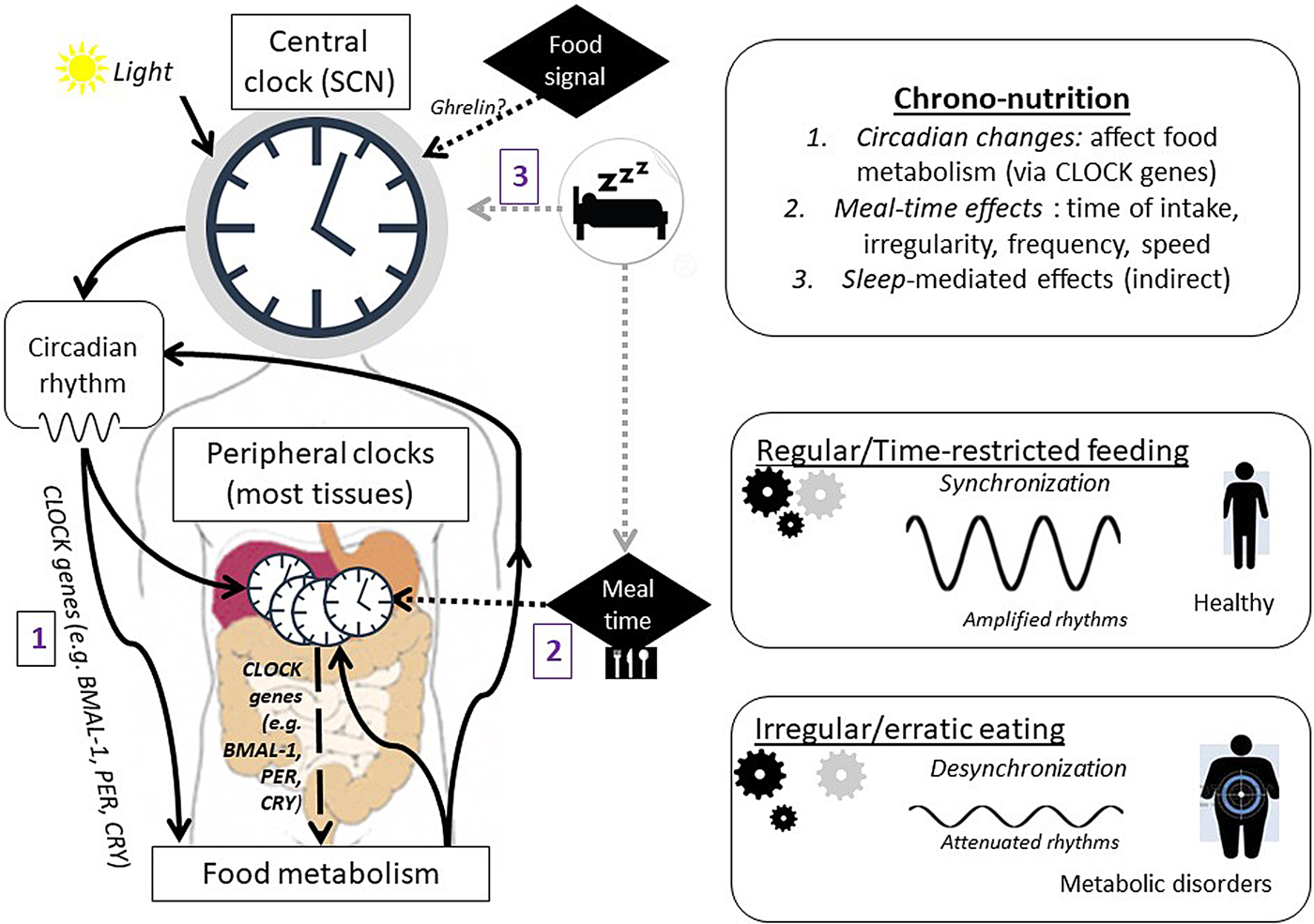
The field that studies this interaction is called chrononutrition. It explores how meal timing influences the alignment of these internal clocks and, in turn, our health.
The Role of Chrononutrition in Global Wellness
This review article provides a great introduction to the core concepts of chrononutrition.
Please read the initial abstract and the first section, "Introduction." Focus on how the article defines chrononutrition and establishes the dual role of the light-cued central clock and the food-cued peripheral clocks. Pay attention to the statement that food intake regulates peripheral clocks in the liver and intestine.
When your eating patterns are aligned with the day-night cycle, the orchestra is in sync. Your SCN signals "day," and your digestive system receives food, activating daytime metabolic processes. Conversely, when the SCN signals "night," your digestive system is at rest. The problem arises when we send conflicting signals, such as eating a large meal late at night. Your SCN (cued by darkness) is telling your body to prepare for sleep, repair, and restoration. But the arrival of food tells your liver, pancreas, and gut that it's time to work—to digest, absorb, and metabolize. This creates a state of circadian misalignment, or desynchronization, which has significant metabolic consequences.
The Metabolic Cost of Mistimed Eating
Your body is not equally prepared to handle food at all hours. One of the most critical daily rhythms is in your glucose metabolism. In the morning and early afternoon, your body is more insulin-sensitive, meaning it can efficiently move glucose from your bloodstream into your cells for energy. As evening approaches, you naturally become more insulin-resistant.
This rhythm is powerfully influenced by the hormone melatonin, which your brain begins to release a few hours before your biological night to prepare you for sleep. As a leading researcher in this field, Dr. Satchin Panda, explains, melatonin has a crucial, and until recently, underappreciated role in regulating your pancreas.
Dr. Satchin Panda on Circadian Insights into Exercise Timing, Melatonin Biology, and Peak Cognition
In this segment from an interview on FoundMyFitness, Dr. Satchin Panda explains the science behind why late-night eating is metabolically disruptive.
Watch from melatonin and glucose as Dr. Panda discusses the discovery of the melatonin receptor on pancreatic cells. He explains that just as melatonin puts the brain to sleep, it also puts the pancreas to sleep, inhibiting insulin secretion. Then continue from when to eat for the direct practical advice that stems from this science.
As Dr. Panda articulates, when melatonin levels are high, your pancreas cannot release enough insulin in response to a meal. The glucose from that meal lingers in your bloodstream, leading to elevated blood sugar. This phenomenon, known as "evening diabetes," has been observed for decades. What is new is our understanding that melatonin is a primary driver.
This has two immediate implications:
- Late-night eating is metabolically costly. Consuming carbohydrates or sugars in the two to three hours before bed forces your body to manage a glucose load when it is least equipped to do so.
- Early-morning eating can be problematic. Since melatonin can still be elevated for an hour or two after waking, eating immediately upon rising may also lead to a suboptimal glucose response.
Time-Restricted Eating: A Strategy for Synchronization
If erratic, late-night eating causes circadian desynchronization, the solution is to create a consistent and predictable daily eating window that aligns with your active phase. This approach is known as Time-Restricted Eating (TRE).
TRE is not about what you eat or how much you eat; it's about when you eat. It involves consuming all of your daily calories within a set window, typically between 8 and 12 hours, and fasting for the remaining 12-16 hours. As a social researcher, you'll find it interesting that while most people believe they eat within a 12-hour window, data from Dr. Panda's research app shows a different reality.
Dr. Satchin Panda on Circadian Insights into Exercise Timing, Melatonin Biology, and Peak Cognition
Here, Dr. Panda discusses the surprising findings from his "My Circadian Clock" app, which objectively tracked when thousands of people eat.
Please watch the clip from eating window data. Note the discrepancy he found between people's perceived eating window and their actual behavior, where 50% of adults were found to eat for 15 hours or longer.
This extended eating pattern robs our metabolic organs of the daily period of rest and repair they require. TRE restores this crucial fasting period, allowing the body to enter a different physiological state.
Dr. Satchin Panda on Circadian Insights into Exercise Timing, Melatonin Biology, and Peak Cognition
Dr. Panda provides a powerful analogy for why this daily fasting period is so essential for our organs.
Watch his explanation from repair and rejuvenation. The key insight is that digestion is a long process. It takes about five hours for a meal to be processed, meaning the "fasting" clock for your internal organs only starts long after your last bite. A 12-hour eating window leaves only about 7 hours for true organ rest and repair.
From Metabolic Health to Cognitive Function
A stable, well-regulated metabolic system is the foundation for a high-performing brain. The brain is the most metabolically demanding organ in the body, consuming about 20% of your total energy. When your metabolic health suffers from circadian misalignment, your cognitive function is one of the first casualties. The benefits of TRE for the brain are multifaceted.
1. The Metabolic Switch and Autophagy: After 12-14 hours of fasting, your body begins to shift its primary fuel source from glucose to ketones, which are derived from fat. This "metabolic switch" is believed to trigger a cascade of beneficial cellular processes. One of the most important is autophagy, a cellular housekeeping process that cleans out damaged proteins and old, dysfunctional components.
Your Brain on Intermittent Fasting: More Cognitive Benefits From Eating Less Often?
This Wall Street Journal video provides a concise and clear explanation of the metabolic switch and autophagy.
First, watch the introduction from the metabolic switch to understand the shift from glucose to ketone metabolism. Then, watch the explanation of autophagy, the cell's recycling system, from autophagy boost.
Think of autophagy as your brain's nightly cleaning crew. By ensuring a consistent daily fasting period, TRE gives this crew ample time to work, clearing out cellular debris that can impair neuronal function and contribute to age-related cognitive decline.
2. Improved Sleep Quality: As we've discussed, eating late at night can interfere with sleep by disrupting hormonal rhythms like cortisol and suppressing deep sleep. By finishing your last meal several hours before bed, you allow your body to transition into a restful state more effectively, leading to better quality sleep—which is itself essential for memory consolidation and cognitive restoration.
3. Enhanced Focus: While much of the research is in early stages, some studies suggest that fasting states can directly enhance focus. Neuroscientist Mark Mattson's research, mentioned in the WSJ video, found that in animals, fasting increases the activity of specific neurons in the hippocampus, improving learning and memory efficiency by effectively "turning down the noise" and sharpening focus.
For a comprehensive overview of the evidence, the Alzheimer's Drug Discovery Foundation has published an excellent scientific report.
[PDF] Time restricted eating - Alzheimer's Drug Discovery Foundation
This report provides a detailed, evidence-based summary of TRE, perfect for your analytical background.
First, review the observational data linking eating patterns to cognition. Read the section that begins here, noting the finding that skipping breakfast (often a proxy for late-night eating) was associated with faster cognitive decline. Next, read the section on "Mechanisms of action," specifically the part on Circadian rhythms, which reinforces how TRE helps align peripheral clocks. Finally, read the section on Sleep to understand the intricate connection between meal timing, sleep, and metabolic hormones.
Conclusion
We have now added another critical layer to your energy management framework. Light sets the master clock, but food provides the dominant timing cue for your metabolic organs. By consciously managing your meal timing, you can synchronize your internal orchestra, improve your metabolic health, and by extension, enhance your cognitive function.
Here is your cheat sheet for this lesson on chrononutrition:
- The Principle: Your body's clocks are synchronized by both light (for the central clock) and food (for peripheral clocks). Aligning these signals by eating during your biological day promotes metabolic health and cognitive function.
- The Problem: Modern lifestyles often involve extended eating windows (15+ hours) and late-night eating. This desynchronizes your internal clocks, leading to poor glucose control and impaired cellular repair.
- The Mechanism: Eating late at night coincides with rising melatonin levels. Melatonin suppresses insulin secretion, impairing your body's ability to handle glucose and disrupting sleep quality.
- The Strategy (Time-Restricted Eating): Confine your daily food intake to a consistent 8-10 hour window. This simple rule has powerful effects:
- Wait 1-2 hours after waking before your first meal. This allows morning cortisol to rise and melatonin to fully dissipate.
- Finish your last meal at least 2-3 hours before bedtime. This avoids the conflict between melatonin and insulin, promoting better sleep and metabolic health.
- This creates a daily 14-16 hour fast, which enhances cellular clean-up (autophagy) and improves metabolic flexibility.
In the upcoming lessons in our next module, we will shift our focus from when you eat to what you eat, exploring specific dietary patterns, foods, and nutrients that have been shown to directly support brain health and cognitive performance.