In our previous lesson, we examined the 90-minute ultradian rhythms that create waves of focus and fatigue throughout your day. We now have the "what" and the "how long" of your energy cycles. This lesson addresses the crucial question of "when." The potency of these ultradian cycles isn't uniform; it rises and falls according to a larger, predictable daily pattern that is unique to you.
Today, we will build upon our understanding of biological rhythms to master the art of timing. Our learning outcome is to apply chronotype-aware scheduling to align demanding tasks with your peak performance windows. We will explore the robust scientific evidence for daily performance fluctuations, provide you with a data-driven method to identify your personal chronotype, and translate this knowledge into a practical framework for scheduling your day to maximize productivity and well-being.
The Hidden Pattern of the Day
Across dozens of scientific disciplines, from economics to endocrinology, researchers have converged on a remarkable finding: our mood, cognitive ability, and performance don't stay flat throughout the day. Instead, for most people, they follow a consistent and predictable three-stage pattern: a Peak, a Trough, and a Recovery.
This isn't just a subjective feeling. Large-scale data analysis has quantified this pattern with striking precision. As a statistician, you'll appreciate the methodological diversity and scale of the evidence presented in the following talk by author Daniel Pink, whose work synthesizes this vast body of research.
WHEN: The Scientific Secrets of Perfect Timing - Daniel Pink
This segment from Daniel Pink's talk, "WHEN: The Scientific Secrets of Perfect Timing," provides a compelling overview of the research demonstrating the peak-trough-recovery pattern.
Please watch the section from peak, trough, and recovery. As you watch, pay attention to the different domains where this effect has been measured: The emotional content of 500 million tweets. The tone of 26,000 corporate earnings calls and its effect on stock prices. The performance of Danish students on standardized tests. The alarming increase in medical errors, from anesthesia to missed polyps in colonoscopies, during the afternoon trough.
The data is clear and compelling. The time of day can explain about 20% of the variance in human performance on workplace tasks. This is a massive effect. Anesthesia errors are four times more likely at 3 p.m. than at 9 a.m. Students taking tests in the afternoon score as if they have missed two weeks of school. These are not minor fluctuations; they are significant, predictable changes in our cognitive capacity. The afternoon trough is a real and dangerous time for high-stakes analytical work.
Identifying Your Chronotype
While the peak-trough-recovery sequence is a universal human experience, the timing of that sequence varies from person to person. This individual variation in our internal biological clock is known as your chronotype.
You've likely heard the common archetypes: "larks" are morning people who wake early and feel most alert in the first part of the day, while "owls" are evening people who peak much later and go to bed late. Most of the population, about 60-80%, falls somewhere in between, sometimes called "third birds." More recent popular science has assigned animal names to these patterns, but the underlying biology remains the same.

Rather than relying on archetypes, we can use a more precise, data-driven method to locate yourself on this spectrum. Researchers use a measure called the Mid-Sleep point on Free days (MSF), which is the halfway point between when you go to sleep and when you wake up on days when you don't have to use an alarm clock. Because we often accumulate a "sleep debt" during the work week and "oversleep" on weekends to compensate, a corrected formula (MSFsc) provides a more accurate marker of your biological clock.
The following resource from a Cornell University study on cognitive rhythms explains this calculation.
[PDF] Cognitive Rhythms: Unobtrusive and Continuous Sensing of ...
This paper details how researchers measure chronotype in real-world settings.
Please read the subsection titled "Sleep and Chronotype Information." Focus on the description of the MSFsc formula and calculation. You can use your own sleep data from a few free days to calculate your personal MSFsc and determine if you lean toward an early or late type. Pay attention to the concept of "internal time", which reframes the day around your biological clock rather than the wall clock.
This misalignment between our internal biological time and the external social time imposed by work, school, and other obligations is what chronobiologists call social jetlag. It's the feeling of being perpetually in the wrong time zone, and it has significant consequences.
[PDF] Sleep Chronotypes and Performance Synthesis - UNC
This meta-analysis from UNC provides a rigorous overview of the impacts of chronotype.
Read the introduction to understand the formal definition of social jetlag and its role as the central conflict between our biology and modern schedules.
The Synchrony Effect: Designing Your Optimal Day
Knowing your chronotype is the first step. The second is to apply that knowledge by scheduling your activities to align with your internal rhythms. This principle is known as the Synchrony Effect: performance is highest when the demands of a task are synchronous with our biological peak.
Daniel Pink provides a simple yet powerful framework for this. He categorizes work into three types and maps them onto the three phases of the day.
WHEN: The Scientific Secrets of Perfect Timing - Daniel Pink
Returning to Daniel Pink's talk, this section delivers the core practical framework for chronotype-aware scheduling.
Please watch the segment from chronotypes and task types. He outlines three types of work to match with your daily rhythm. Note the crucial distinction he makes for owls, whose daily pattern is reversed.
Here is the framework for most people (larks and third birds):
- Peak (Morning): This is the time of highest vigilance and focus. Your brain is best able to bat away distractions. Schedule your analytic work here. This includes tasks that require heads-down, focused attention: writing, strategic planning, analyzing data, or any complex problem-solving.
- Trough (Early-Mid Afternoon): This is the danger zone for cognitive errors. Your alertness is at its lowest. This time is best reserved for administrative work. This includes answering routine emails, filling out expense reports, or any simple, low-stakes tasks that don't require intense brainpower.
- Recovery (Late Afternoon/Evening): During this phase, your mood has rebounded, but your vigilance is lower than it was during the peak. This combination of positive mood and reduced inhibition is ideal for insight work. This includes tasks like brainstorming, creative problem-solving, and collaborative discussions where looser, more expansive thinking is an asset.
For owls (evening types), this pattern is inverted. Their day unfolds as Recovery -> Trough -> Peak. Their morning is best for creative work, the afternoon remains a trough for administrative tasks, and their late afternoon and evening are prime time for deep, analytical work.
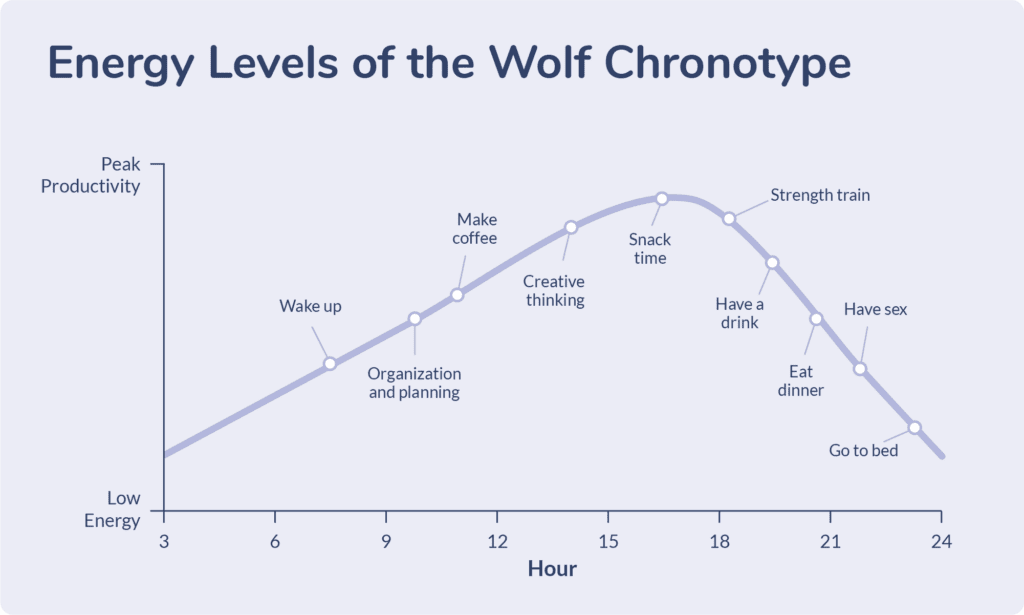
The evidence for the Synchrony Effect is robust. The UNC meta-analysis you looked at earlier provides a wealth of data on this topic, showing how performance on specific cognitive tasks differs by chronotype and time of day.
[PDF] Sleep Chronotypes and Performance Synthesis - UNC
This resource provides the statistical backbone for the Synchrony Effect.
First, read the section on "The Synchrony Effect and Circadian Arousal," focusing on how specific cognitive functions like inhibitory control and memory vary predictably for different chronotypes throughout the day. Then, jump to the "Conclusions and Future Directions" section and review the list of Key Findings. Note the specific effect size reported for GPA (Cohen’s d = -0.27), which quantifies the academic disadvantage faced by evening types in traditional school schedules.
The review also notes that this effect extends to physical tasks. Given your experience with powerlifting, you might find it interesting that evening types achieve significantly higher VO2 max and muscular torque in the evening, while morning-type rowers were found to be 1.1% faster in morning trials—a margin that easily separates gold from silver in elite competition.
Conclusion
You have now integrated the 24-hour circadian wave with your personal chronotype. You understand that your cognitive capacity is not a constant resource but a fluctuating tide. By identifying your unique pattern and intentionally scheduling your most demanding work during your biological peak—and protecting that peak from low-value administrative tasks—you can dramatically increase your effectiveness and reduce the strain of working against your own body clock.
Here is your cheat sheet for this lesson:
- The Daily Pattern: Your day is defined by a Peak, a Trough, and a Recovery period.
- Identify Your Chronotype: Use the Mid-Sleep on Free days (corrected) formula to find your biological midnight and understand your "internal time." An MSFsc before ~5:00 AM suggests an early type, while one after ~6:00 AM suggests a late type.
- The Synchrony Effect Rule: Match your task to your biological time.
- Peak Time: Do your most demanding analytic work (writing, analysis, strategic decisions).
- Trough Time: Handle administrative tasks (routine email, scheduling, low-stakes chores).
- Recovery Time: Engage in insight & creative work (brainstorming, open-ended problems, collaboration).
- The Goal: Be intentional about when you work. Minimize social jetlag by aligning your schedule with your biological clock to the greatest extent possible.
In our next lesson, we will explore another powerful lever for managing your daily energy: meal timing. Just as the timing of work and light exposure affects your internal clocks, the timing of your food intake plays a crucial role in regulating your circadian rhythm and cognitive function.