Welcome back. In our previous lesson, you designed a comprehensive daily protocol by integrating the foundational 24-hour circadian rhythm with the faster, 90-minute ultradian cycles of focus. You learned how to anchor your day using your temperature minimum and schedule your most demanding work to coincide with your body's natural peaks in alertness.
This lesson marks the culmination of our work in this module. As you requested, we will now distill all these principles into a concise, actionable "cheat sheet." The goal is to transform the scientific knowledge and your detailed protocol into a set of clear, daily rules that you can reference at a glance. This fulfills our final learning outcome: Create a cheat sheet of circadian and energy management rules for daily scheduling.
Think of this cheat sheet not as a rigid straitjacket, but as your evidence-based "default settings." In statistics, you establish a baseline model before testing variations. Similarly, this cheat sheet provides the baseline protocol for your ongoing N-of-1 experiments in personal performance.
The Architecture of Your Day
Before we lay out the final cheat sheet, let's briefly reconstruct its logic by revisiting the key principles. A well-structured day is built on a series of timed biological signals that you provide to your body. We'll group these into three phases: the Morning Launch, the Peak Performance Window, and the Evening Wind-Down.
Phase 1: The Morning Launch (First 0-2 Hours Awake)
The first two hours of your day are arguably the most critical for setting the trajectory of your energy and focus. The goal is to send a powerful "it's daytime" signal to your brain's master clock.
Dr. Andrew Huberman's "Essentials" video provides the scientific basis for these morning anchors. Let's quickly review the core components.
Maximize Productivity, Physical & Mental Health With Daily Tools | Huberman Lab Essentials
This segment from Dr. Huberman's "Huberman Lab Essentials" video recaps the science behind the most crucial morning habits.
Please re-watch the section on the morning routine from sunlight in my eyes. As you watch, confirm your understanding of the "why" behind these three key actions: Sunlight Exposure: How does it time the daily cortisol pulse? Hydration: Why are electrolytes (like salt) important for neuronal function? Caffeine Delay: What is the relationship between adenosine, caffeine, and the afternoon energy crash?
These actions form the first rules of our cheat sheet, designed to firmly entrain your circadian rhythm and manage your neurochemical environment for sustained energy.
Phase 2: The Peak Performance Window (Morning to Mid-Afternoon)
Once your day is launched, the next step is to schedule your most cognitively demanding work. As we established, this isn't about grinding for hours on end but about aligning intense, focused sprints with your biological readiness.
This involves two layers of timing:
- Circadian Timing: Placing your work blocks during the period of rising core body temperature, typically 3-6 hours after your temperature minimum.
- Ultradian Timing: Structuring that work into ~90-minute blocks of intense focus, followed by deliberate rest.

The following article offers practical strategies for applying this principle, emphasizing that not all work hours are created equal.
Maximizing Productivity: The Neuroscience of Scheduling Tasks ...
This article from The Content Wrangler explains the importance of matching task type to your cognitive energy levels.
Please read the sections on scheduling and educating. Focus on the core idea: schedule high-demand tasks (your "deep work") during peak cognitive hours and save low-demand, administrative tasks for energy troughs. This directly informs how to use the time between your 90-minute focus blocks.
Phase 3: The Evening Wind-Down (Last 3-4 Hours Awake)
How you end your day is just as important as how you begin it. The goal here is to send a clear "it's nighttime" signal, facilitating the transition into restorative sleep. This involves managing light, food, and temperature. Evening choices directly impact your body's ability to produce melatonin and lower its core temperature—two prerequisites for high-quality sleep.
For a final, concise overview of these daily optimization steps, the following resource provides an excellent summary.
Circadian Rhythm Optimization: Resetting Your Internal Energy Clock
This article from Walk-in-Lab provides a great summary of the key daily actions for circadian health.
Review the section titled "Practical Steps". Notice how it consolidates the principles of light timing, meal structure, and evening routines into a coherent daily plan.
Your Daily Energy Management Cheat Sheet
Having reviewed the science, let's now distill it into the final cheat sheet. This is your go-to daily reference.
| Phase | Rule | The "Why" (Mechanism) |
|---|---|---|
| Universal | Know Your T-min. | Your temperature minimum (avg. wake-up time - 2 hrs) is the master anchor for timing light, exercise, and focus. |
| Be Consistent. | Maintain consistent sleep/wake times (even on weekends) to strengthen your circadian rhythm's amplitude. | |
| Morning | 1. Get Morning Sunlight (10-30 mins). | Triggers the healthy morning cortisol pulse, which times your body's 24-hour clock and promotes alertness. |
| 2. Delay Caffeine (90-120 mins). | Allows adenosine to clear out naturally, preventing the "afternoon crash" when caffeine wears off. | |
| 3. Hydrate with Electrolytes. | Neurons require sodium, potassium, and magnesium for proper electrical signaling (i.e., thinking). | |
| Work | 4. Schedule Deep Work 3-6 hours after T-min. | Aligns your hardest cognitive tasks with the steepest rise in core body temperature and natural alertness. |
| 5. Use ~90-min Ultradian Cycles. | Structure deep work into focused blocks of ~90 mins, followed by 20-30 mins of rest, to match your brain's rhythm. | |
| 6. Match Task to Energy. | Use peak energy for deep, creative work. Use energy troughs for administrative tasks (email, planning). | |
| Afternoon | 7. Get Afternoon Light (10-20 mins). | Low-angle sunlight reduces your retina's sensitivity to blue light at night, buffering against sleep disruption. |
| 8. Time Exercise for Your Goal. | Post-work exercise can boost BDNF for cognitive recovery. Avoid intense exercise within 3 hours of bed. | |
| Evening | 9. Eat for Your State. | Starchy carbs in the evening can aid sleep by increasing serotonin. Keep lunch lower-carb for alertness. |
| 10. Take a Hot Shower/Bath. | A hot shower 60-90 mins before bed causes rebound cooling, dropping your core body temp and signaling sleep. | |
| 11. Dim Lights; Avoid Blue Light. | Bright light (especially blue) in the last 2-3 hours of the day suppresses melatonin, delaying sleep onset. |
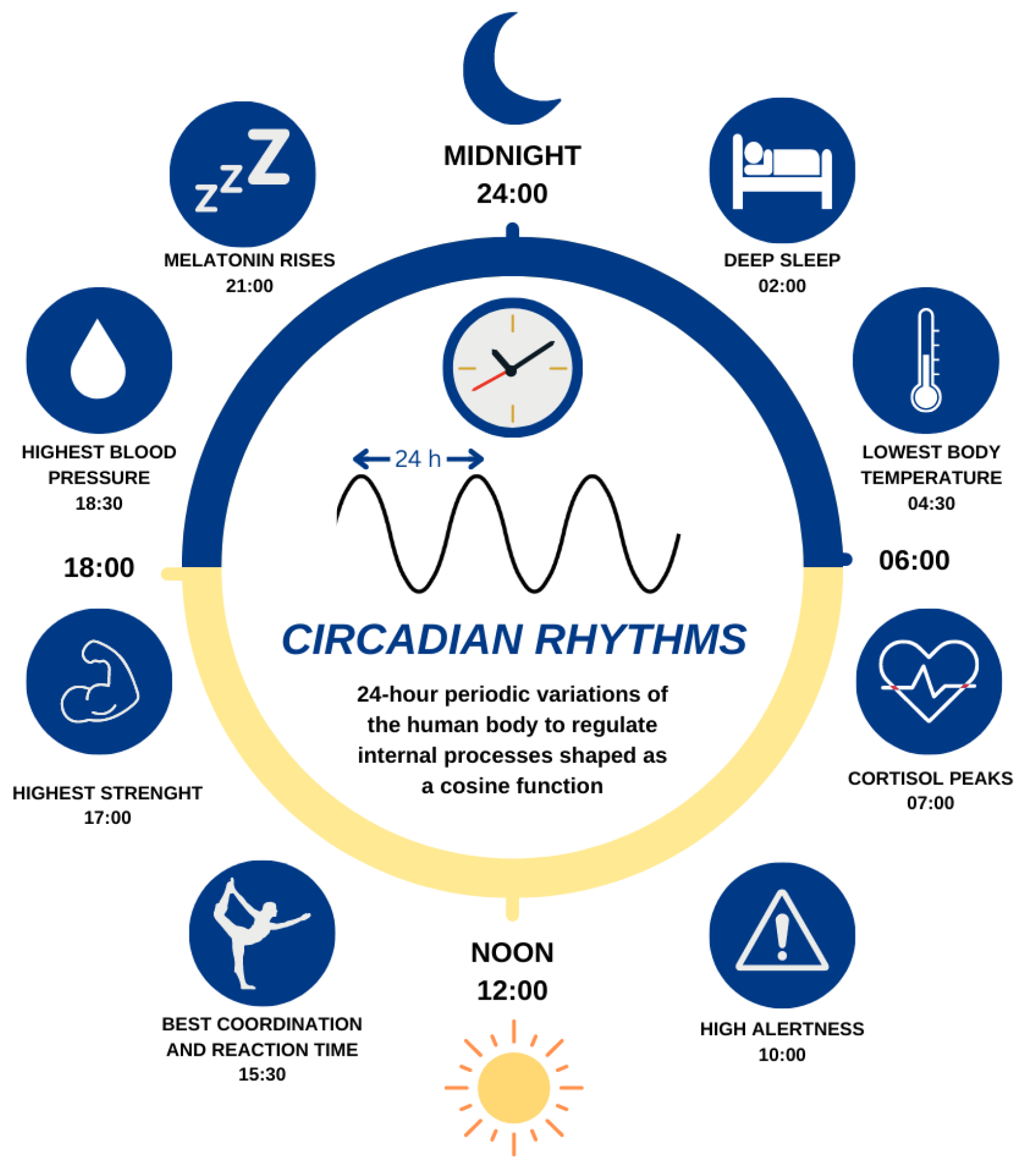
Conclusion
You have now moved from understanding the intricate science of biological rhythms to creating a simple yet powerful tool for daily execution. This cheat sheet is the practical synthesis of Module 5.
Your key takeaways from this lesson are:
- Simple Rules, Deep Science: Each line on the cheat sheet is a simple instruction backed by a specific neurobiological or physiological mechanism.
- Consistency over Perfection: The power of this protocol comes from consistent application, which strengthens the signaling to your internal clocks. Missing a step occasionally is insignificant; the pattern is what matters.
- A Template for Experimentation: This cheat sheet is your baseline. You can now systematically test variations—shifting your second work block, changing your exercise time—and observe the effects on your focus and energy, staying true to your analytical nature.
In our next module, we will shift our focus from when you do things to what you consume. Having established a robust framework for energy management, we will now explore the science of Nutrition for Cognitive Performance, examining how the fuel you provide your body directly impacts the quality of your mental output.