In our last lesson, we established the fundamental architecture of behavior change, exploring the mechanics of the habit loop and the profound role of identity in making new behaviors stick. We saw that lasting change is less about the goals you set and more about the person you aim to become. Now, with that "why" firmly in place, we will turn to the practical "how."
This lesson provides you with two of the most powerful, evidence-based techniques for engineering new habits into your life: habit stacking and environmental design. You will learn how to cleverly link new routines to existing ones and how to architect your surroundings to make focus and relaxation the path of least resistance. This is where we move from theory to tangible action, building the systems that will support your desired identity.
1. Habit Stacking: The Art of Neurological Association
In the previous lesson, we identified the "cue" as the starting point of the habit loop. Habit stacking is a strategy that leverages this principle with elegant simplicity. Instead of waiting for a random cue to appear or trying to invent a new one, you use an existing, already-automated habit as the trigger for the new habit you want to build.
The formula is straightforward:
After/Before [Current Habit], I will [New Habit].
This method works because it anchors the uncertainty of a new behavior to the certainty of an old one. Your brain already has a well-trodden neural pathway for the existing habit; you are simply adding a small extension to that path.
To see this in action, let's turn to a summary of James Clear's "Atomic Habits," which popularized this technique.
How to become 37.78 times better at anything | Atomic Habits summary (by James Clear)
This segment from the YouTube channel Escaping Ordinary provides a clear, practical explanation of habit stacking and its core formula.
Please watch the section explaining Habit stacking. Notice how it chains behaviors together, making it more likely that the new habit will be executed.
The power of this technique lies in creating a cascade of behaviors. Each completed habit acts as the cue for the next, creating momentum.

Consider your own routines. You already have dozens of robust habits that you perform without fail each day, like waking up, brushing your teeth, making coffee, or shutting down your computer. These are prime opportunities for habit stacking.
Examples for your goals:
- Focus: "After I pour my morning coffee, I will sit down and write my three most important tasks for the day." (This stacks a planning habit onto a caffeine habit).
- Relaxation: "After I close my laptop at the end of the workday, I will immediately perform two minutes of cyclic sighing." (This stacks a relaxation ritual onto the cue that signals the end of work stress).
This technique is particularly effective for integrating the small, but impactful, focus and relaxation practices we've discussed throughout this course.
2. Environmental Design: Architecting Your Behavior
While habit stacking helps engineer the timing of your habits, environmental design engineers the space in which they occur. The core idea is that your environment is not a passive backdrop but an active participant in your behavior. The objects, sounds, and light around you are constantly sending cues to your brain, making certain actions easier and others harder.
Relying on willpower to resist temptation or initiate a difficult task is a neurologically expensive and often losing battle. A more robust strategy is to design an environment where the desired behavior is the most obvious and convenient option.
Let's watch two more segments from the "Atomic Habits" summary that introduce this concept and the related idea of reducing friction.
How to become 37.78 times better at anything | Atomic Habits summary (by James Clear)
These sections explain how to manipulate your environment to make good habits more likely and bad habits less likely. The first part focuses on making cues obvious or invisible, while the second discusses reducing or increasing friction.
First, watch the segment on designing your environment, from "Motivation is highly overrated". Pay attention to the "One space, One use" mantra. Then, watch the section on reducing friction from The Law of Least Effort, which introduces the powerful "Two-Minute Rule."
These principles give us a clear directive: to build good habits, increase the exposure to cues that trigger them and decrease the friction to perform them. To break bad habits, do the opposite.
Designing for Focus: An Evidence-Based Approach
Your goal to enhance focus can be directly supported by a scientifically informed approach to environmental design. A cluttered, notification-rich environment actively works against your brain's attentional systems.
The following reading from Super Productivity dives into the research behind creating a high-focus workspace. Given your background in statistics, you'll appreciate how it quantifies the impact of environmental factors.
Distraction-Free Work Environment: Setup Guide (2026)
This guide provides a detailed, research-backed breakdown of how to engineer your physical and digital environment for deep work.
Please read the sections on Visual Field and Cognitive Load, Acoustic Environment and Attention, and The Smartphone Problem. Focus on the specific research findings cited, such as the impact of clutter on neural resources, the cognitive cost of office noise, and the mere presence effect of smartphones.
These findings provide a clear blueprint for action:
- Declutter your workspace: Keep only essential tools within arm's reach.
- Manage your acoustic environment: Use noise-cancelling headphones and consider focus-enhancing soundscapes like pink noise or nature sounds.
- Implement a "phone quarantine": During deep work blocks, place your phone in another room to reclaim cognitive capacity.
Designing for Relaxation: The Biophilic Approach
Just as you can design an environment for focus, you can design one for relaxation. One of the most powerful frameworks for this is biophilic design, which involves incorporating elements of nature into indoor spaces. This approach is grounded in Attention Restoration Theory, which posits that natural environments engage our "soft fascination," allowing the brain's directed-attention resources to recover.
This infographic provides a quick overview of the principles and benefits.
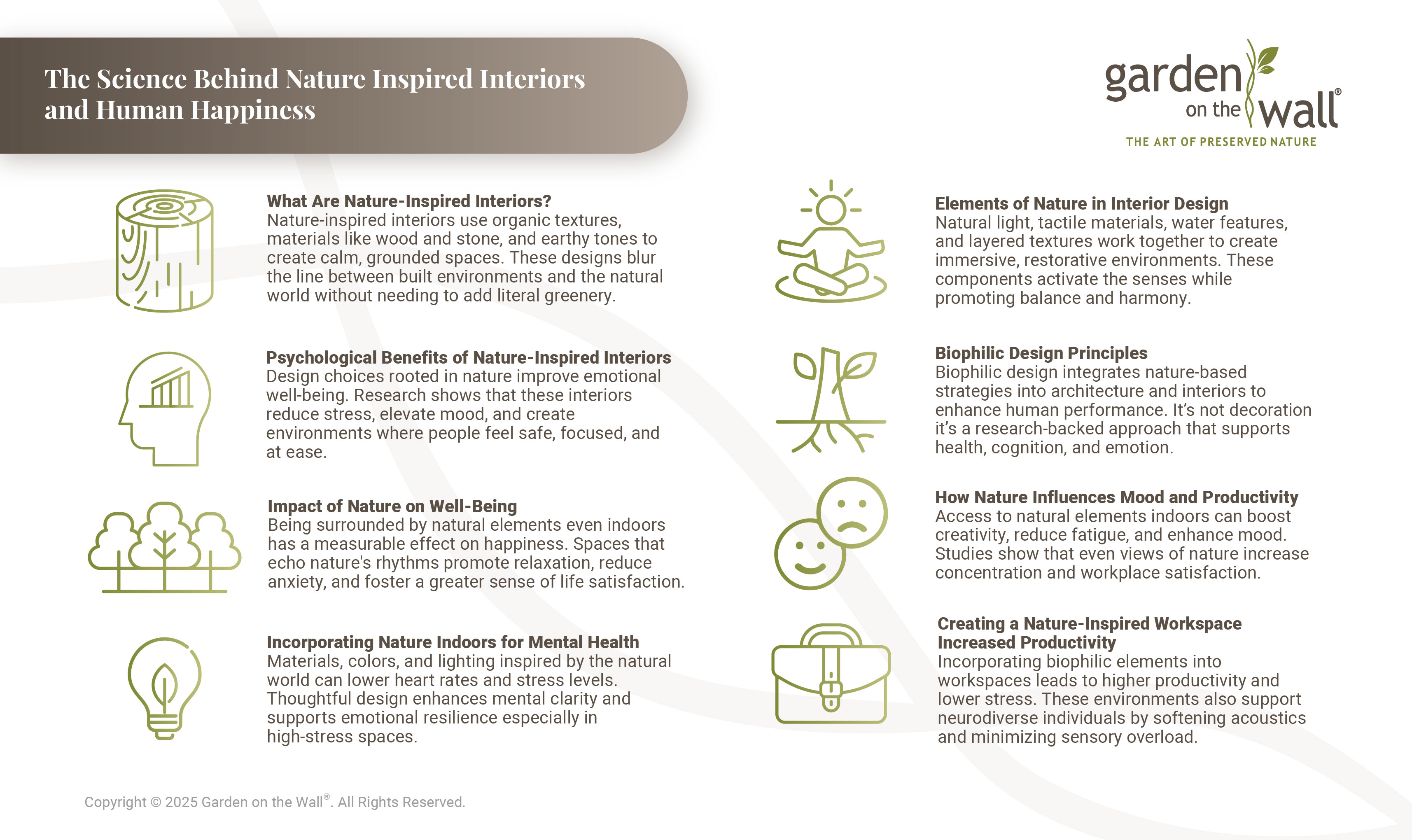
To understand how to apply this to your own space, let's explore a more detailed article.
How Biophilic Interior Design Supports Mental Health
This article from Dayhouse Studio explains the 'why' and 'how' of using nature-inspired design to create restorative home environments.
First, read the introduction to grasp the core concept. Next, read the section on physiological and psychological mechanisms to understand how it works. Finally, review the specific, actionable strategies under the heading Therapeutic Home Design Strategies, focusing on the sections for Plants, flowers, and scents, and Natural sounds and light.
These readings demonstrate that creating a restorative environment is not about luxury, but about intentional choices that engage the senses and activate the body's parasympathetic "rest and digest" system.
Actionable strategies for your home:
- Introduce greenery: Place a few well-chosen plants in your living area or workspace.
- Incorporate natural materials: Consider items with wood grain or natural stone textures.
- Curate a soundscape: Use a speaker to play nature sounds during your post-work wind-down.
- Optimize natural light: Arrange your workspace to maximize daylight and use dynamic lighting that warms in the evening to support your circadian rhythm.
3. Integrating Your Personal Performance System
The true power of these techniques is revealed when you combine them within a structured daily framework. Here, we can leverage the neurobiological model introduced by Dr. Andrew Huberman, which divides the 24-hour day into three distinct phases based on your body's natural neurochemical state.
The Science of Making & Breaking Habits
This clip from Dr. Andrew Huberman's podcast outlines a powerful framework for scheduling your habits based on your body's natural biological rhythms, optimizing for both high-effort and restorative activities.
Watch from the start of the program description to understand the three phases. The key is to align the type of habit with the neurochemical state of each phase.
Here's how you can merge this framework with habit stacking and environmental design:
Phase 1: 0-8 Hours After Waking (High Norepinephrine/Dopamine)
This is the time for habits that require overcoming high "limbic friction."
- Environmental Design: The night before, "prime" your environment. Lay out your powerlifting clothes. Place the one book or paper you need for your deep work block alone on your cleared desk.
- Habit Stack: "After my morning sunlight exposure (existing habit), I will immediately begin my 90-minute deep work session on my most critical research task."
Phase 2: 9-15 Hours After Waking (Serotonin Rising)
This phase is better suited for habits with lower limbic friction, such as creative tasks or integrating relaxation practices.
- Environmental Design: Create a dedicated "relaxation space" with a comfortable chair, a plant, and a speaker.
- Habit Stack: "After I complete my final work-related task of the day, I will move to my relaxation chair and listen to a 10-minute Yoga Nidra script."
Phase 3: 16-24 Hours After Waking (Sleep/Consolidation)
This phase is about recovery and ensuring the habits you practiced get encoded.
- Environmental Design: Use blackout curtains, keep the room cool, and ensure your phone is charging in another room.
- Habit Stack: "After I brush my teeth for the night, I will read a fiction book for 15 minutes (no screens) before turning off the lights."
By using this three-part structure, you align your behavioral goals with your biological state, significantly increasing the probability of success.
Conclusion: Your Cheat Sheet for Integrating Habits
In this lesson, we have moved from the theory of habit formation to the practical engineering of behavior. You now have a powerful, two-pronged strategy for systematically integrating new focus and relaxation practices into your life.
- Habit Stacking: This technique anchors a new behavior to an existing one, using a simple formula: After/Before [Current Habit], I will [New Habit]. It automates the "cue" for your new routine.
- Environmental Design: This principle involves architecting your physical and digital spaces to make desired habits obvious and easy, and undesired habits invisible and difficult. It is a more reliable method than willpower for guiding behavior.
- Integrated System: By combining these strategies within a daily structure based on your natural neurochemical phases, you create a robust system where your biology and your environment work in concert to support your goals.
With these tools in hand, you are now equipped not just to choose new habits, but to install them. The next logical step is to measure their effectiveness. In our upcoming lesson, we will delve into how you can apply your statistical expertise to do just that by using N-of-1 experimental designs to rigorously test which interventions work best for you.