Welcome to the final module of our course. Over the past nine weeks, we have covered an immense amount of ground, from the neurobiology of focus to an evidence-based toolkit for relaxation. In our last lesson, you learned how to synthesize those tools into a personalized "relaxation menu" and, crucially, how to use N-of-1 trials to scientifically validate what works for you.
This module, "Designing Your Personal Performance System," is where we bring everything together. We will shift from accumulating individual tools to architecting a cohesive system that integrates them into your daily life. To do this, we must first understand the fundamental principles of behavior change. This lesson will explore the very architecture of our automatic behaviors by describing the habit loop model. We will then examine the most powerful engine for lasting change: identity.
1. The Mechanics of Automaticity: The Habit Loop
A significant portion of our daily life, estimated to be around 40-45%, is governed by habits. From a neurobiological standpoint, habits are a brilliant energy-saving strategy. As we saw in our first module, focused, deliberate action requires immense cognitive resources. By encoding frequently repeated behaviors into automatic routines, the brain frees up the prefrontal cortex for more novel, complex tasks. This process involves neuroplasticity, where neural pathways in a region called the basal ganglia are strengthened, making the behavior progressively more automatic and less reliant on conscious thought.
The most widely recognized model for this process is the Habit Loop, popularized by author Charles Duhigg and grounded in research from MIT. It consists of three core components: a cue, a routine, and a reward.

- Cue: The trigger that tells your brain to go into automatic mode and which habit to use. Cues can be a location, a time of day, an emotional state, the presence of certain people, or a preceding action.
- Routine: The physical, mental, or emotional action you take. This is what we typically think of as the "habit" itself.
- Reward: The positive outcome that satisfies the craving initiated by the cue. This tells your brain that this particular loop is worth remembering and repeating.
To delve deeper into this model and its variations, let's watch a brief summary from a review of James Clear's "Atomic Habits." Clear's model introduces a fourth component, Craving, which serves as the motivational force between the Cue and the Routine.
How to become 37.78 times better at anything | Atomic Habits summary (by James Clear)
This segment from Escaping Ordinary's summary of "Atomic Habits" provides a concise explanation of the four-stage habit loop and how the components work together to form automatic behaviors.
Please watch the section from The Habit Loop. Notice how the reward becomes associated with the cue, creating a craving that drives the response.
The Science Behind the Loop: Task Bracketing and Dopamine
For a habit to become truly automatic, the brain needs to do more than just execute the routine. It needs to clearly delineate the beginning and end of the behavioral sequence. Neuroscientist Dr. Andrew Huberman explains this through the concept of task-bracketing.
Research on the basal ganglia, specifically a structure called the dorsolateral striatum (DLS), shows that certain neurons become highly active at the initiation and termination of a habitual routine, but less so during the routine itself. This "bracketing" is what allows a habit to become a discrete, reliable package of behavior that can be executed regardless of context—whether you're at home or traveling, feeling motivated or tired. It’s the neural signature of a deeply embedded habit.
The "Reward" component is also more nuanced than simple pleasure. As we discussed in Module 2, the neurotransmitter dopamine is less about the pleasure of a reward ('liking') and more about the motivation to obtain it ('wanting'). In the context of the habit loop, dopamine release is driven by reward prediction error. As your brain learns that a specific cue predicts a reward, it begins releasing dopamine in anticipation of the reward, creating the craving that powers the routine.
This is a critical insight: the neurological reward is often the anticipation, not the outcome itself. This is what makes the loop so powerful and self-reinforcing.
2. The Engine of Change: Identity-Based Habits
Understanding the mechanics of the habit loop is necessary, but not sufficient. You can design a perfect cue-routine-reward loop and still fail to make a habit stick. The missing piece is the "why"—the underlying motivation that drives the entire system. The most robust form of motivation comes from identity.
Behavior change can be visualized as occurring on three layers.
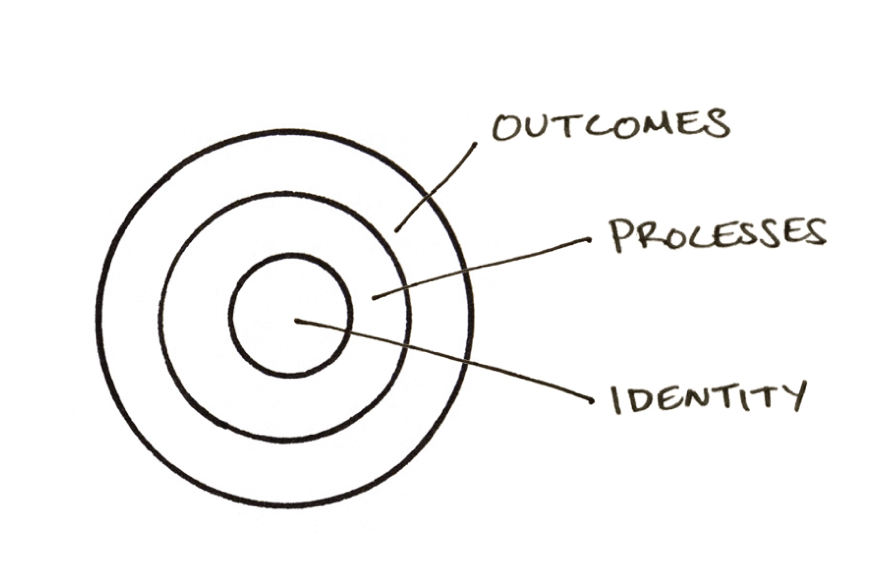
- Changing Your Outcomes: This is goal-oriented. "I want to lose 20 pounds." or "I want to finish writing my research paper."
- Changing Your Processes: This is system-oriented. "I will follow this weightlifting program." or "I will use the Pomodoro technique to write for two hours every day."
- Changing Your Identity: This is belief-oriented. "I am the type of person who is strong and athletic." or "I am a disciplined writer."
Most people attempt to build habits from the outside in, starting with a goal they want to achieve. This approach is fragile. What happens after you reach the goal? For many, motivation plummets, and they revert to old routines.
A far more powerful approach is to work from the inside out. Instead of focusing on what you want to achieve, you focus on who you wish to become.
How to become 37.78 times better at anything | Atomic Habits summary (by James Clear)
This segment of the "Atomic Habits" summary introduces the three layers of behavior change and makes the case for focusing on identity as the primary driver of lasting habits.
Please watch from the three layers. The key idea is to shift the focus from "running a marathon" (an outcome) to "becoming a runner" (an identity).
When you adopt an identity, the corresponding behaviors feel natural and congruent rather than like a chore. Every time you perform a habit, you are casting a vote for that identity.
- Every time you go to the gym, you are voting for "I am an athlete."
- Every time you choose to meditate instead of checking your phone, you are voting for "I am a calm, focused person."
- Every time you turn off your work notifications at 6 PM, you are voting for "I am someone who values recovery and work-life balance."
This is not just a psychological trick; it has a firm basis in neuroscience and behavioral research.
[PDF] Habit formation and change - USC Dornsife
This review article from Current Opinion in Behavioral Sciences provides academic weight to the link between behavior, environment, and identity.
First, read the introduction to understand the shift from goal-directed to habitual behavior. Then, in the section on changing environments, read the paragraph that introduces the concept of "rip currents" to see how a small behavioral change can cascade into an identity shift.
The article highlights a feedback loop: a small change in behavior (putting fruit on the counter) leads to a repeated action (eating fruit), which can lead to a physiological change (weight loss), and ultimately to a new identity attribution ("I am a healthy eater"). This new identity then reinforces the behavior, making it stable and long-lasting.
3. The Bridge: Identity and "Limbic Friction"
So, how do the mechanics of the habit loop and the engine of identity connect? The bridge is a concept Dr. Huberman terms limbic friction.
Think of limbic friction as the activation energy required to overcome your internal state (tiredness, anxiety, lack of motivation) and initiate a behavior.
- High limbic friction: You feel exhausted after work, and the thought of going to the gym feels like pushing a boulder uphill. The resistance is immense.
- Low limbic friction: You wake up, and without much thought, you put on your running shoes and head out the door. The behavior feels almost effortless.
A strong, aligned identity is the most effective tool for reducing limbic friction.
When your desired habit aligns with your self-concept, the internal resistance plummets. If you truly see yourself as a "powerlifter," the limbic friction to get under the bar—even on a day you feel tired—is significantly lower than for someone who is merely "trying to exercise more." Your identity provides an intrinsic, powerful "why" that overrides momentary feelings of discomfort or apathy.
Conversely, trying to force a habit that conflicts with your identity creates enormous limbic friction. If your identity is "I'm a night owl," trying to build a habit of waking up at 5 a.m. will be a constant, draining battle against your own self-concept. The more effective long-term strategy would be to first work on shifting the identity itself: "I am becoming a disciplined person who masters their mornings."
Conclusion: Your Cheat Sheet for Behavior Change Architecture
This lesson has laid the foundational architecture for the personal performance system we will build in this module. We've seen that habits are not random; they follow a predictable neurological pattern—the habit loop. More importantly, we've learned that the most resilient and sustainable habits are not those aimed at a temporary goal, but those that serve to reinforce a desired identity.
Here is a distillation of today's key principles:
- The Habit Loop Formula: Cue (Trigger) → Craving (Dopamine-driven Anticipation) → Routine (Action) → Reward (Reinforcement). This sequence, when repeated, is encoded by the brain's basal ganglia, creating an automatic behavior.
- The Identity Principle: The most powerful driver of long-term behavior change is identity. Focus on who you wish to become, not just what you want to achieve. Each action is a vote for the type of person you want to be.
- The Limic Friction Bridge: Your identity determines the amount of limbic friction (activation energy) required to perform a habit. An aligned identity lowers this friction, making the habit loop easier to initiate and sustain.
With this theoretical framework in place, we are now ready to get practical. In our next lesson, we will explore two of the most powerful techniques for consciously engineering these loops into your life: habit stacking and environmental design.