Introduction
Welcome to the second-to-last lesson in your journey through Applied Deep Learning. In our previous lesson, you learned how to apply transfer learning and fine-tuning, a powerful technique for adapting massive, pre-trained models to solve new problems with remarkable speed and accuracy. This skill is a cornerstone of modern AI development.
Today, we address the "why." With the ability to build sophisticated models, the crucial question becomes: What can you build with them? This lesson is dedicated to answering that by exploring the real-world applications of AI across a vast landscape of industries. Our learning outcome is to describe real-world AI applications in various domains (e.g., NLP, computer vision).
This is more than a simple survey; it's a map of possibilities. For someone with your ambition to build transformative technology, understanding this landscape is the first step toward choosing where you'll make your mark. We'll see how the very techniques you've been learning are revolutionizing everything from your daily mobile apps to advanced engineering and disaster response.
1. AI in Your Everyday Life
Before we explore the frontiers of AI, let's recognize how deeply it's already integrated into our daily lives. Many services you use every day are powered by machine learning models that predict, classify, and recommend.
To get a sense of this, watch the following video from IBM Technology. It provides a great overview of ten common applications of machine learning.
Ten Everyday Machine Learning Use Cases
This video provides a quick and clear overview of how machine learning is used in services you likely interact with daily.
Watch the segments on Natural Language Processing (00:45 - 01:48) and Mobile Apps (01:48 - 02:56). Pay attention to how many distinct applications fall under these broad categories.
As the video highlights, AI is the engine behind:
-
Natural Language Processing (NLP):
- Chatbots: Providing instant customer service on websites.
- Voice Assistants: (Siri, Alexa) converting your speech to text and then processing the command.
- Auto-transcription: Services like YouTube generating captions for videos.
These applications often use architectures like Transformers, which you've learned about, to understand the context and nuances of human language.
-
Recommendation Engines & Mobile Apps:
- Content & Product Recommendations: Spotify suggesting a new song, Netflix a new series, or Amazon a product you might like. These systems analyze your past behavior and the behavior of similar users to make predictions.
- On-device AI: Your smartphone uses AI for more than just apps. On-board models power features like computational photography (the "portrait mode" blur), facial recognition for unlocking your device, and searching your photo library for objects or people.
These "everyday" applications are built on the fundamental principles you've studied: training models on vast datasets to recognize patterns and make useful predictions.
2. Transforming Core Industries
While daily conveniences are significant, the most profound impact of AI is its ability to revolutionize major industries. Here, AI systems perform tasks that require superhuman speed, precision, and the ability to process enormous amounts of data. This is where the techniques you learned, like fine-tuning CNNs, are creating immense value.
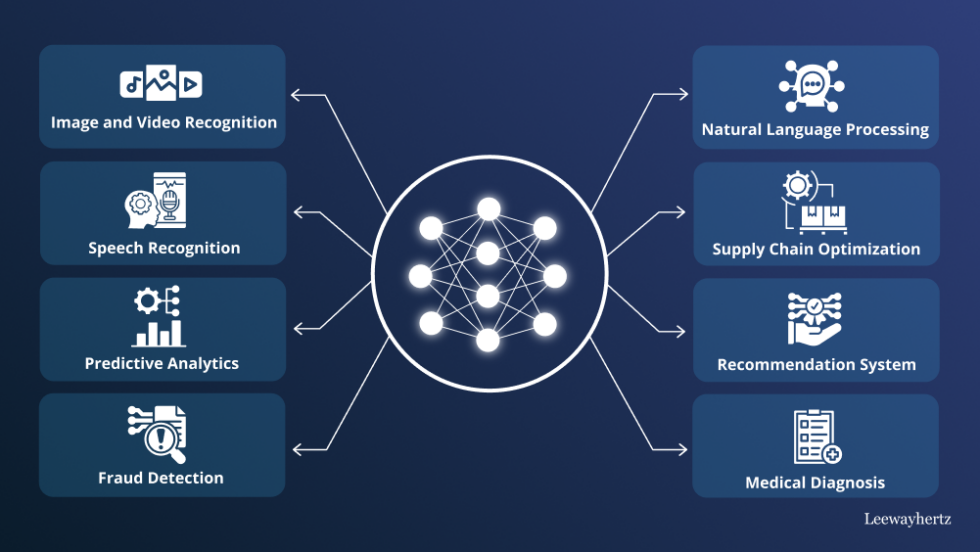
Let's explore a few of these high-impact domains.
Healthcare
AI is augmenting the capabilities of medical professionals, leading to faster diagnoses and novel treatment discovery. Computer vision, in particular, has become a powerful tool for analyzing medical imagery.
Top 50+ Real-World Computer Vision Applications Across Industries
This article from Lightly.ai provides a concise summary of how computer vision is applied in healthcare. Read the introduction and the bullet points to get a quick overview.
Read only the section '1.1 Computer Vision in Healthcare', from the title down to the 'Future Trends' part. Focus on the four main application areas described.
Key applications include:
- Medical Imaging Analysis: Models, typically fine-tuned CNNs, analyze X-rays, MRIs, and CT scans to detect signs of diseases like cancer or fractures, often with a level of accuracy rivaling human experts.
- Drug Discovery: As detailed in the "Deep Learning Applications" article from Neural Concept, deep learning models can accelerate drug discovery by predicting how molecules will interact, saving immense time and resources in the lab.
- Surgical Assistance: Vision-guided robots can enhance a surgeon's precision by differentiating tissue types or providing augmented reality overlays during an operation.
Engineering & Manufacturing
This domain is a prime example of where AI can fulfill the "Tony Stark" vision of designing and building better technology. AI is moving engineering from a reactive to a predictive and generative process.
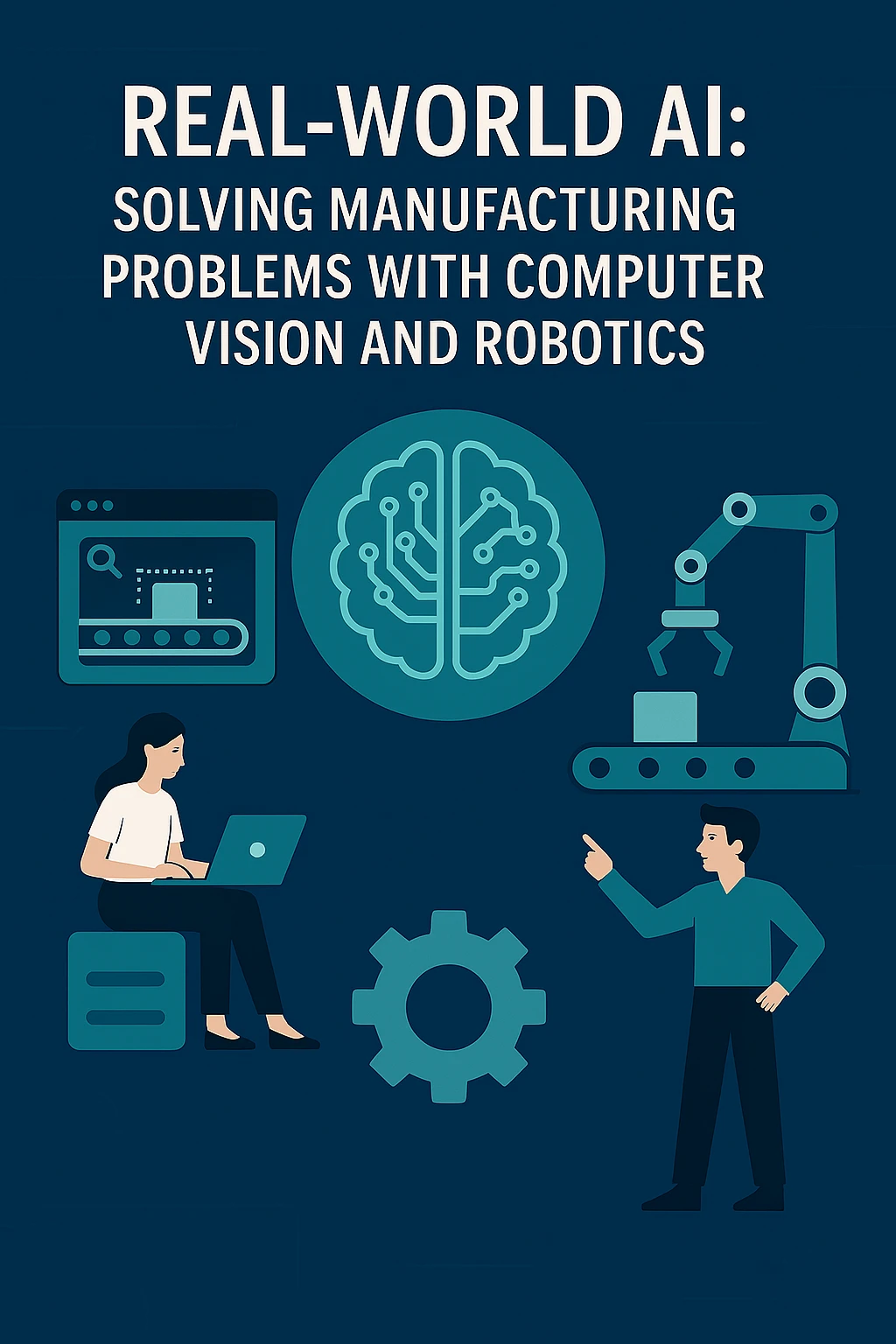
Read the following sections to see how deep learning is being applied in demanding engineering contexts.
Deep Learning Applications: Examples in Engineering & ...
The following article from Neural Concept focuses on engineering-specific applications. These examples showcase AI's role in design, safety, and efficiency.
Read the following three sections: 'Deep Learning Applications in Engineering': Focus on the applications in Robotics, Aerospace, and Automotive. 'Design Optimization with Deep Learning': Understand how AI can explore design possibilities automatically. 'Predictive Maintenance with Deep Learning': Grasp the concept of using AI to predict equipment failure before it happens.
To summarize the key industrial applications:
- Predictive Maintenance: Instead of waiting for a machine to break, AI models analyze sensor data (vibration, temperature) to predict failures in advance. This is crucial for high-value assets like jet engines and factory equipment.
- Quality Control: Computer vision systems on assembly lines can spot microscopic defects in products like circuit boards or car parts, operating 24/7 with higher accuracy than human inspectors.
- Design Optimization: AI can explore thousands of design variations for a component—like a drone wing or a car chassis—to find the optimal shape for performance, weight, and strength, a task that would be impossible to do manually.
- Autonomous Vehicles: Companies like Tesla use deep learning systems that process real-time data from cameras and sensors to navigate, recognize traffic signs, and detect pedestrians. This is one of the most complex integrations of computer vision and control systems in the world.
3. The Frontier: Autonomous AI Agents
So far, we've mostly seen AI systems that perceive and predict. The next frontier is autonomous agents—AI systems designed to reason, plan, and take actions in the real world to achieve a goal. These agents are less like a simple classifier and more like a digital collaborator that can execute complex, multi-step tasks.
The following video explores this exciting area, showcasing use cases that go far beyond simple prediction.
10 Use Cases for AI Agents: IoT, RAG, & Disaster Response Explained
This video from IBM Technology introduces the concept of AI agents and highlights several advanced use cases where they are being deployed today.
Watch the segments covering Agriculture (01:13 - 03:34), Content Creation (03:34 - 05:50), and Disaster Response (05:50 - 07:29). Notice how these systems combine planning, memory, and action to achieve complex goals.
These examples represent a significant leap in AI capability:
- Smart Agriculture: An AI agent's goal is to "maximize crop yield." It uses a planner to access data from weather APIs and soil sensors (IoT), consults its memory of past actions, and then executes an action, like turning on irrigation for a precise amount of time.
- Authentic Content Creation: An agent tasked with writing a blog post doesn't just generate text. It plans an outline, uses tools to search for the latest research, stores this new information in a vector database (a form of memory using Retrieval Augmented Generation or RAG), writes a draft, and then iteratively critiques and refines its own work.
- Disaster Response: In a crisis like an earthquake, a central "coordinator agent" can deploy specialized sub-agents. One agent analyzes satellite imagery for damage, another scans social media for distress calls, and a third runs simulations. They share information on a common "situational map" to help orchestrate an effective emergency response at a scale no human team could manage.
These agent-based systems, which can reason and act, are the closest we've come to the versatile, problem-solving AI you might imagine from science fiction. They represent the direction the field is heading and offer a glimpse into the truly transformative systems you could one day build.
Conclusion
Today, we've toured the vast and expanding world of real-world AI applications. You've seen how the neural networks and learning strategies you've studied are not just theoretical concepts but are actively reshaping our world.
Key Takeaways:
- Pervasive Impact: AI is already a fundamental part of everyday digital life through recommendation engines, voice assistants, and on-device features.
- Industrial Transformation: In critical sectors like healthcare, engineering, and manufacturing, AI is driving unprecedented gains in efficiency, safety, and innovation, often by fine-tuning large pre-trained models for specialized tasks.
- Breadth of Application: The same core technologies (like CNNs for vision or Transformers for language) can be applied to solve vastly different problems, from diagnosing diseases to designing more efficient aircraft.
- The Future is Autonomous: The frontier of AI lies in creating autonomous agents that can reason, plan, and act to achieve complex goals, moving beyond simple perception and prediction.
You have now reached the end of the theoretical content in this course. You have journeyed from the basics of Python to the architecture of advanced neural networks and seen where they are deployed.
Preview of the Final Lesson:
With all this knowledge and context, one final piece remains. Our next and final lesson, "Outline the key steps for planning and executing a simple AI project from problem definition to deployment," will serve as your launchpad. We will synthesize everything you've learned into a practical framework for taking an idea from a concept to a real, working AI project. It's time to start thinking about what you will build.