Introduction
Welcome to the next lesson in your journey into Applied Deep Learning. In our previous session, we delved into the Transformer architecture, the powerhouse behind modern marvels like ChatGPT. We concluded by highlighting a major challenge: training these massive models from scratch requires immense data and computational power, far beyond the reach of most individuals and organizations.
This lesson directly addresses that challenge. We will focus on the learning outcome: Explain the concept of transfer learning and its benefits.
Transfer learning is an elegant and powerful technique that allows us to stand on the shoulders of giants. Instead of building a model from zero, we can take a powerful, pre-trained model (like one based on the Transformer architecture) and adapt it to our own specific needs. This is the key to unlocking the power of state-of-the-art AI without needing the resources of a major tech company. For your goal of building transformative technology, mastering transfer learning is not just useful—it's essential.
1. What is Transfer Learning?
At its core, transfer learning is the process of taking knowledge learned from one task and applying it to a different but related task.
Think about how humans learn. You don't learn to identify a bicycle from scratch. You already have a deep understanding of concepts like wheels, frames, and motion from seeing cars, motorcycles, and carts. When you see a bicycle for the first time, you transfer that existing knowledge to quickly understand this new object.
In deep learning, a neural network trained on a vast dataset (like millions of internet images) learns to recognize fundamental features—edges, textures, shapes, and then more complex concepts like eyes or wheels. Transfer learning allows us to take this pre-existing "visual knowledge" and apply it to a new, more specific task, such as identifying different types of birds or diagnosing diseases from medical scans, even if we only have a small dataset for our new task.
Let's watch a video from DeepLearning.AI that introduces this core idea.
Andrew Ng provides a clear, intuitive introduction to transfer learning. He explains the fundamental concept using an excellent example of adapting an image recognition model for radiology diagnosis.
Watch the video from the beginning to 00:34 and then from 03:20 to 04:23. Pay close attention to the intuition behind why this works: the network's knowledge of low-level features (edges, curves) learned from a general task is useful for a new, specific task.
2. The Mechanics of Transfer Learning
Now that you have the high-level concept, let's look at how it works in practice. The process generally involves three main steps:
-
Select a Pre-trained Model: You start with a sophisticated model that has already been trained on a large, general-purpose dataset. For image tasks, this might be a model like ResNet or MobileNet trained on the ImageNet dataset. For language tasks, it could be a Transformer model like BERT or GPT trained on a massive corpus of text from the internet.
-
Adapt the Architecture: A neural network can be thought of as having a "body" and a "head".
- The body consists of the early and middle layers, which learn to extract general features (like edges and shapes in an image, or grammar and syntax in text).
- The head is the final set of layers that takes these features and makes a prediction for the original task (e.g., classifying an image into one of 1000 categories).
In transfer learning, we typically chop off the original head and replace it with a new, randomly initialized head designed for our new task (e.g., a classifier with only two outputs: "cancerous" or "non-cancerous").
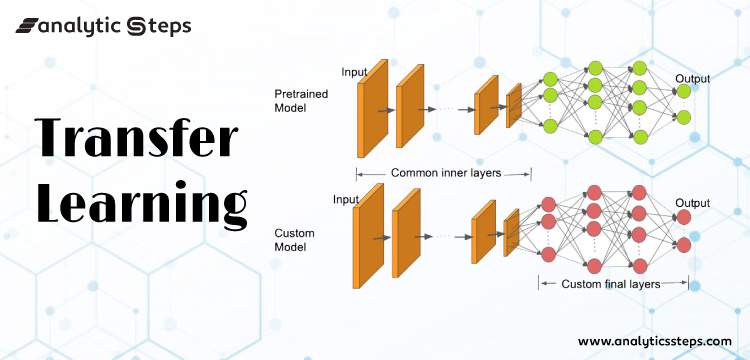
- Train the New Model (Fine-Tuning): With the new head attached, you then train the model on your smaller, task-specific dataset. Here, you have a crucial choice regarding the pre-trained "body" layers:
- Frozen Layers: You can "freeze" the weights of the body, meaning they are not updated during training. Only the new head is trained. This is a fast approach, often called "feature extraction," and works well when your new dataset is small.
- Trainable Layers (Fine-Tuning): You can "unfreeze" some or all of the body layers and allow them to be updated during training, typically with a very low learning rate. This fine-tunes the pre-trained features to be more relevant to your specific task. This approach is more powerful but requires more data to avoid overfitting.
The article from GeeksforGeeks provides an excellent summary of this distinction.
This article, 'What is Transfer Learning?', clearly outlines the practical workflow. We'll focus on the section that explains the difference between freezing and training layers.
Read the sections titled "Working of Transfer Learning" and "Frozen Vs Trainable Layers in Transfer Learning". Pay close attention to the table comparing the two types of layers and the guidelines on how to decide which layers to freeze based on your dataset size and similarity.
3. The Benefits of Transfer Learning
So, why go through this process? The advantages are significant and are the reason transfer learning is so prevalent in applied AI.
- Higher Starting Performance: A model initialized with pre-trained weights starts off much "smarter" than one with random weights. It already has a good understanding of the world, giving it a significant head start.
- Faster Convergence: Because the model starts from a better place, it takes less time (fewer training epochs) to reach optimal performance on the new task. This saves significant time and computational resources.
- Better Final Performance: Often, a fine-tuned model can achieve a higher level of accuracy than a model trained from scratch, especially when the target dataset is small. The general features from the large source dataset help the model generalize better and avoid overfitting to the small target dataset.
- Reduced Data Requirement: This is perhaps the most important benefit. It enables the creation of high-performance models for problems where collecting large labeled datasets is difficult, expensive, or impossible (e.g., in specialized medical or scientific domains).
The following video from Hugging Face, a key company in the AI space, provides a striking visual demonstration of these benefits and introduces how transfer learning is used in Natural Language Processing (NLP).
This video, 'What is Transfer Learning?', shows a direct comparison of training a model from scratch versus using transfer learning. It also connects the concept to the Transformer models we studied previously.
Watch the video from the beginning to 03:07. Focus on: The graph comparing 'training from scratch' vs. 'fine-tuning' (0:47). Notice the differences in starting accuracy, learning speed, and final accuracy. The examples of pre-trained models in both computer vision (ImageNet) and NLP (BERT, GPT-2). The practical step of replacing the model's 'head' (2:32).
4. Important Considerations
While incredibly powerful, transfer learning is not a magic bullet. To use it effectively, you need to consider two key points: when it's appropriate and what its potential pitfalls are.
When to Use Transfer Learning
Transfer learning is most likely to be successful under these conditions:
- The source and target tasks have the same input type. For example, transferring from one image task to another, or from one text task to another.
- You have significantly more data for the source task than the target task. The value of transfer learning comes from leveraging a model trained on a massive dataset (e.g., millions of images) for a task with a much smaller dataset (e.g., hundreds of medical scans).
- The low-level features learned in the source task are relevant to the target task. Learning to detect edges and textures from photos of cats and dogs is useful for detecting tumors in X-rays. This is almost always true for inputs like images and natural language.
Andrew Ng summarizes these conditions perfectly in the final part of his video.
Let's return to the DeepLearning.AI video to hear the concise rules of thumb for when transfer learning is most effective.
Watch from 05:45 to 10:43. Listen carefully to the summary of the three conditions that make transfer learning a good choice for your problem.
A Word of Caution: The Transfer of Bias
Pre-trained models don't just transfer knowledge; they also transfer any biases present in their original training data. This is a critical ethical consideration for anyone building AI systems.
For example, a model pre-trained on images primarily from Western countries may perform poorly on images from other parts of the world. A language model trained on biased text from the internet may generate stereotypical or prejudiced responses.
As someone aspiring to build transformative technology, it is your responsibility to be aware of these potential harms and to actively work to mitigate them.
The Hugging Face video provides a stark example of this issue.
Finally, let's watch the last segment of the Hugging Face video, which highlights the crucial issue of bias in pre-trained models.
Watch from 03:07 to the end. Pay attention to the examples of geographic bias in ImageNet and gender bias in GPT-3. This is a vital concept in responsible AI development.
Conclusion
In this lesson, you have learned about transfer learning, a cornerstone technique of modern applied AI. It provides a practical and efficient path to leveraging the power of massive, state-of-the-art models for your own custom tasks.
Key Takeaways:
- Concept: Transfer learning re-purposes a model trained on a large, general dataset (source task) for a new, specific dataset (target task).
- Mechanics: It involves replacing the task-specific "head" of a pre-trained model and then fine-tuning the weights on the new data, either by training just the new head or unfreezing parts of the model's "body."
- Benefits: It leads to faster training, requires less data, and often results in higher final performance compared to training from scratch.
- Considerations: It is most effective when the source and target tasks share similar inputs and low-level features. Crucially, you must be aware that pre-trained models can inherit and amplify biases from their original training data.
Preview of the Next Lesson:
Now that you understand the what and why of transfer learning, it's time for the how. In the next lesson, "Apply a pre-trained model to a new task (fine-tuning) for faster development," we will move from theory to practice. You will learn how to take a pre-trained model using a deep learning framework and fine-tune it on a new dataset to solve a real problem.