Introduction
In our last lesson, we explored Recurrent Neural Networks (RNNs), which process information sequentially, step-by-step. You learned that this structure is powerful for understanding context in sequences like text but faces a critical limitation: the vanishing gradient problem. This makes it difficult for RNNs to connect words that are far apart, as the "memory" of early words fades over long distances.
This lesson introduces a revolutionary architecture that solves this problem and has since become the engine behind almost all modern AI breakthroughs, including ChatGPT. We'll address the learning outcome: Describe the high-level concept of the transformer architecture and its impact.
Instead of processing word by word, the Transformer looks at the entire sentence at once, using a mechanism called self-attention to weigh the relationships between all words simultaneously. This allows it to capture long-range dependencies with ease and efficiency. Understanding this architecture is a key step toward your goal of mastering the technologies that are shaping our world.
1. The Big Idea: Parallel Processing with Attention
RNNs process data like a person reading a sentence one word at a time, trying to keep everything in their short-term memory. The Transformer, by contrast, looks at the entire sentence laid out on a page and can draw lines connecting any word to any other word. This fundamental shift from sequential to parallel processing is what makes the Transformer so powerful.
The core task of many modern Transformers, like the one inside ChatGPT, is surprisingly simple: predicting the next word. By training on a massive amount of text to get very good at this one task, these models learn an incredible amount about language, reasoning, and the world itself.
To get a high-level overview of what a Transformer is and how it operates, let's start with a video from 3Blue1Brown.
Transformers, the tech behind LLMs | Deep Learning Chapter 5
This video introduces the Transformer as the key technology behind Large Language Models (LLMs). It gives a fantastic birds-eye view of the entire process, from breaking text into tokens to generating a prediction.
Watch the video from the beginning to 05:28. Focus on understanding: The core task of the model (predicting what comes next). The high-level data flow: text is broken into tokens, each token is turned into a vector, and these vectors are processed through repeating layers called attention blocks and MLPs.
As the video explained, the process involves turning text into numerical vectors and then repeatedly refining those vectors through a series of blocks. Now, let's break down the key components of that process.
2. Core Components of the Transformer
To understand the Transformer, we need to look at three key ideas:
- How it represents words and their order.
- How the "self-attention" mechanism works.
- How these pieces are assembled into the full architecture.
This iconic diagram from the original paper, "Attention Is All You Need," shows how these components fit together. We will refer back to it as we unpack each piece.
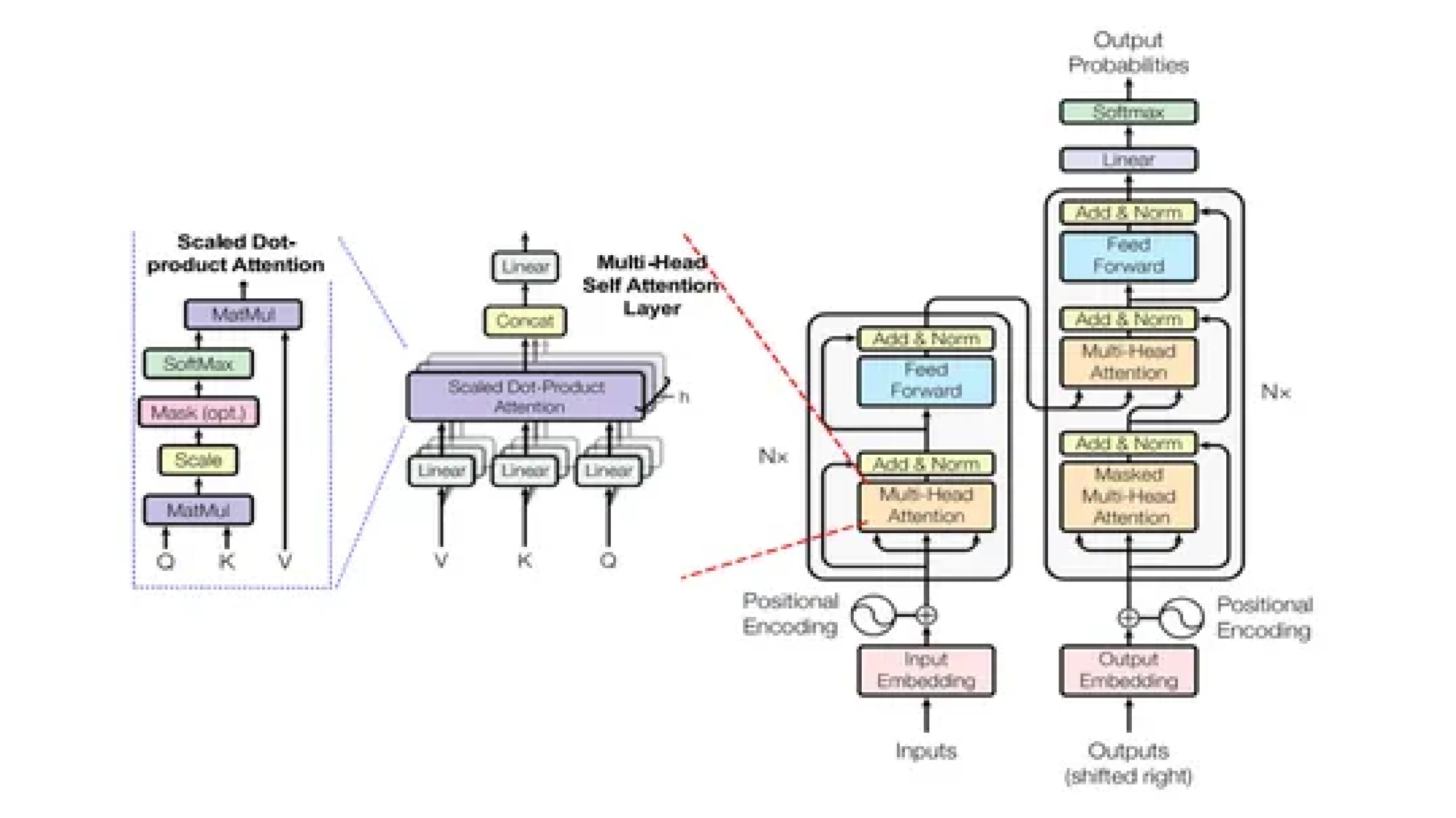
A. Input Representation: Embeddings & Positional Encoding
Like RNNs, the first step is to convert text into numbers the model can understand. This involves two steps:
-
Token Embedding: The input text is broken into "tokens" (words or sub-words). Each token is then mapped to a high-dimensional vector using an embedding matrix. As you saw in the 3Blue1Brown video, this vector space is structured so that words with similar meanings are located close to each other. This is a concept you first encountered with RNNs.
-
Positional Encoding: Since the Transformer processes all tokens at once, it has no inherent sense of word order. Is "The cat chased the dog" the same as "The dog chased the cat"? Of course not. To solve this, we inject information about each token's position. This is done by adding a "positional encoding" vector to each token's embedding. This vector follows a specific pattern that allows the model to learn the relative positions of words.
To get a clearer intuition for positional encoding, let's watch a segment from StatQuest.
Transformer Neural Networks, ChatGPT's foundation, Clearly Explained!!!
This StatQuest video gives a very clear explanation of why word order is crucial and how positional encoding, using a clever combination of sine and cosine functions, provides the model with this information.
Watch from 07:29 to 11:30. Focus on the visual intuition of the 'squiggles' (sine and cosine waves) and how they create a unique positional signature for each word in the sequence.
Now that our input tokens are represented by vectors that contain both semantic meaning and positional information, they are ready to be processed by the heart of the Transformer: the self-attention layer.
B. The Heart of the Transformer: Self-Attention
Self-attention is the mechanism that allows the model to weigh the importance of different words when processing a specific word. For example, in the sentence "The animal didn't cross the street because it was too tired", self-attention helps the model figure out that "it" refers to "animal," not "street."
It does this by creating three vectors for each input token:
- Query (Q): A representation of the current word, used to "ask" for relevant information.
- Key (K): A representation of each word in the sentence that can be "matched" against the query.
- Value (V): The actual content or meaning of each word.
The process, at a high level, is:
- For the word we are currently processing, its Query vector is compared with the Key vector of every other word in the sentence. This comparison (a dot product) produces an attention score.
- These scores are scaled and run through a softmax function to get weights that sum to 1. These weights determine how much "attention" the current word should pay to every other word.
- The Value vector of each word is multiplied by its corresponding attention weight.
- Finally, all the weighted Value vectors are summed up. This produces a new vector for the current word that is enriched with context from all the other words it paid attention to.
This entire process is done for every word in the sentence, in parallel. The article "The Illustrated Transformer" by Jay Alammar provides one of the best visual explanations of this process.
This article is a classic resource for understanding Transformers. We'll focus on the sections that detail the self-attention mechanism step-by-step.
Read the sections titled "Self-Attention at a High Level" and "Self-Attention in Detail". Don't worry about the matrix calculations at the end for now. Focus on the six conceptual steps of calculating the output for a single word. The visualizations of what the word 'it' is attending to are particularly insightful.
C. Enhancements: Multi-Head Attention and Transformer Blocks
The actual Transformer architecture includes a few more sophistications:
-
Multi-Head Attention: Instead of just one set of Q, K, and V matrices, the Transformer uses multiple sets in parallel (e.g., 8 or 12 "attention heads"). Each head can learn to focus on different types of relationships (e.g., one might track syntactic relationships, another semantic ones). The outputs from all heads are then combined.
-
Transformer Block: The core architecture consists of a stack of identical blocks. Each block contains:
- A Multi-Head Attention layer.
- A simple Feed-Forward Neural Network (an MLP).
Both of these sub-layers have residual connections around them and are followed by layer normalization, which helps stabilize the training of these very deep networks. The output of one block becomes the input to the next.
To see how these components fit together in a modern, decoder-only Transformer like GPT-2, explore the following interactive resource.
LLM Transformer Model Visually Explained
This interactive webpage provides a visual walkthrough of the GPT-2 architecture, which is a decoder-only Transformer. It's a great way to consolidate your understanding of the different layers.
Read the sections titled "Transformer Block," "Multi-Head Self-Attention," "MLP," and "Auxiliary Architectural Features." This will show you how the attention mechanism is packaged into a repeating block and explain the role of the MLP, residual connections, and layer normalization.
3. The Impact of Transformers
The invention of the Transformer architecture in 2017 was a watershed moment for AI. Its ability to effectively model long-range dependencies and its parallelizable nature allowed researchers to train unprecedentedly large models on massive datasets.
The Rise of LLMs:
This led directly to the development of Large Language Models (LLMs) like BERT and the GPT series. These models have revolutionized Natural Language Processing (NLP), powering everything from Google's search engine to advanced chatbots like ChatGPT and code-completion tools like GitHub Copilot. Their ability to generate coherent, contextually-aware text, translate languages, and answer complex questions has unlocked capabilities that feel like a step-change in AI.
Beyond Language:
The impact of the Transformer is not limited to text. The architecture is so general and powerful that it has been successfully adapted to other domains:
- Computer Vision: Vision Transformers (ViTs) treat images as a sequence of patches, applying the attention mechanism to achieve state-of-the-art results in image classification, often outperforming the CNNs we studied earlier.
- Biology: Models like AlphaFold2, which uses a Transformer-like architecture, have made incredible breakthroughs in predicting the 3D structure of proteins from their amino acid sequence—a problem that has vexed scientists for decades.
- Audio, Music, and More: The same principles are being applied to speech recognition, music generation, and time-series forecasting.
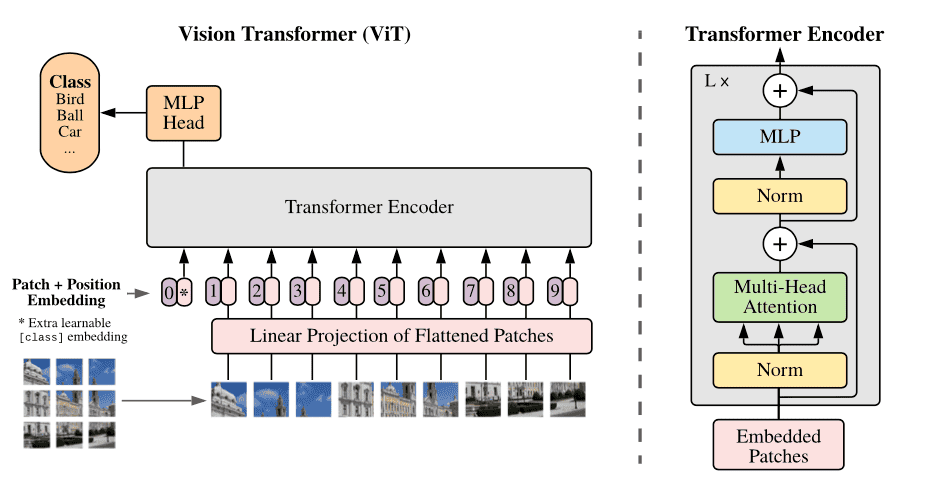
This cross-domain success is what makes the Transformer a truly foundational concept in modern AI, and a critical piece of knowledge for anyone aspiring to build advanced intelligent systems.
Conclusion
In this lesson, you've taken a high-level look at the Transformer architecture, the engine behind the current AI revolution. You've moved beyond the sequential world of RNNs to the parallel, attention-based processing that defines modern AI.
Key Takeaways:
- Transformers overcome the limitations of RNNs by processing entire sequences in parallel, using self-attention to model dependencies between any two tokens, regardless of distance.
- The core components are token embeddings, positional encodings to retain word order, and a stack of Transformer blocks.
- Each block contains a Multi-Head Self-Attention layer to weigh word relationships and a Feed-Forward Network to process each word's representation.
- The impact of this architecture has been immense, enabling the creation of Large Language Models (LLMs) and finding applications in computer vision, biology, and many other fields.
Preview of the Next Lesson:
The models we've discussed, like GPT-3, have hundreds of billions of parameters and are trained for months on supercomputers at a cost of millions of dollars. This is beyond the reach of almost everyone. So how can we leverage their power? The answer is transfer learning. In the next lesson, you will learn how we can take a powerful, pre-trained model and adapt, or "fine-tune," it for a new, specific task with much less data and computational cost.