Introduction
In our previous lesson, we established the first principle of system optimization: a system's output is dictated not by its total resources, but by its single scarcest resource—the constraint. We drew a direct line from the limiting reactant in chemistry to the binding constraint in production models like the Leontief function.
Today, we move from the what to the how. Knowing a constraint exists is the first step; systematically managing it is the path to maximizing potential. This lesson introduces the Theory of Constraints (TOC), a powerful management philosophy for achieving goals. Your learning outcome is to describe the five focusing steps of the TOC and, critically, to distinguish between exploiting a constraint and elevating a constraint. This framework will serve as your primary algorithm for bottleneck identification and resolution throughout the course.
The Theory of Constraints: A Process of Ongoing Improvement
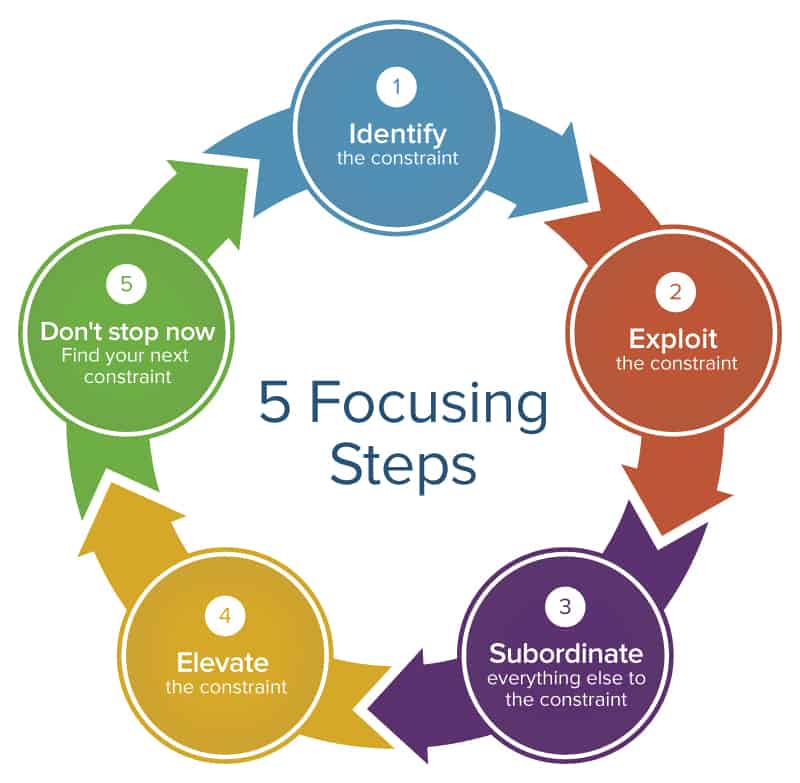
Developed by Dr. Eliyahu Goldratt, the Theory of Constraints (TOC) is a methodology for identifying and systematically improving the primary limiting factor that prevents a system from achieving its goal. At its core is a cyclical, five-step process designed to foster continuous improvement.
To begin, let's get a quick, high-level overview of this process.
Theory of Constraints: A Proven Methodology
This short video from ActiveCollab TV provides a concise summary of the five focusing steps. It will give you a clear mental map of the entire process before we dissect each component.
Watch the section from 02:24 to 03:17. Focus on memorizing the names of the five steps in order: Identify, Exploit, Subordinate, Elevate, and Repeat.
This iterative process is the engine of TOC. It provides a highly focused approach, ensuring that your improvement efforts are always directed at the one point in the system where they will have the greatest impact.
Dissecting the Five Focusing Steps
Now, let's analyze each step in detail. The following reading provides a clear, actionable breakdown of the entire process.
Theory of Constraints (TOC) - Lean Production
The article 'Theory of Constraints (TOC)' from Lean Production offers a comprehensive guide to the five steps, with practical examples for each. We will use this as our primary reference for understanding the standard application of TOC.
Read the section titled 'The Five Focusing Steps', starting from the diagram and continuing through the detailed table that describes each step. This will give you the formal definition and objective of each stage.
Based on that reading, let's formalize the five steps:
-
IDENTIFY the System's Constraint:
This is the starting point. You must locate the single part of the process that limits the rate at which the goal is achieved. In a manufacturing context, this could be a machine. In your context of scientific research, it could be your ability to write grant proposals, access to a specific piece of lab equipment, or the time required for peer review. The key is that this is the system's overall weakest link. -
EXPLOIT the System's Constraint:
The objective here is to get the absolute maximum output from the constraint using existing resources. This is about efficiency and optimization, not investment. You squeeze every drop of potential out of what you already have. For example, if a specific microscope is your constraint, exploitation means ensuring it's never idle during working hours, that it's only used for tasks that only it can perform, and that the samples it analyzes are pre-screened for quality so its time isn't wasted. -
SUBORDINATE Everything Else to the Above Decision:
This is often the most counter-intuitive step. All other non-constraint parts of the system must adjust their operations to support the constraint. Their own individual efficiency is irrelevant; their only purpose is to ensure the constraint can work at its maximum exploited capacity. If the microscope is the constraint, other lab processes (non-constraints) must work to prepare samples just in time for the microscope, ensuring it never has to wait (is never starved) and that there is space to receive its output (it is never blocked). This means non-constraint resources may be idle at times, which is not only acceptable but desirable for optimizing the whole system. -
ELEVATE the System's Constraint:
This step is taken only when the first three steps are insufficient to meet the system's goal. Elevation involves making a significant change to increase the constraint's capacity. This is where investment—of time, capital, or other resources—comes in. To elevate the microscope constraint, you might buy a second microscope, upgrade its components for faster imaging, or hire a dedicated technician to run it 24/7. -
REPEAT the Process (and Avoid Inertia):
After elevating, the original constraint may no longer be the weakest link. A new constraint will have emerged elsewhere in the system. The process begins again from Step 1. TOC is not a one-time fix; it's a continuous improvement loop. Inertia—organizational or personal complacency—becomes the new primary constraint if you fail to repeat the cycle.
The Critical Distinction: Exploit vs. Elevate
The core of your learning outcome is to distinguish between "exploiting" and "elevating". Misunderstanding this difference leads to wasted resources, typically by jumping to expensive "elevation" solutions before fully "exploiting" what's already available.
Let's use the detailed examples from the Lean Production article to solidify this distinction.
Theory of Constraints (TOC) - Lean Production
Now, let's do a focused reading on the practical actions associated with exploiting and elevating a constraint.
First, read the section 'Step Two – Exploit the Constraint' and review the table of actions (Buffer, Quality, Continuous Operation, etc.). Next, read 'Step Four – Elevate Performance of the Constraint' and review its corresponding table (Performance Data, Setup Reduction, Equipment, etc.). As you read, mentally categorize each action: does it use existing resources (Exploit) or does it require new investment (Elevate)?
After that reading, the distinction should be clear. Here is a summary table that formalizes the differences:
| Dimension | Step 2: Exploit | Step 4: Elevate |
|---|---|---|
| Objective | Maximize the throughput of the constraint with existing resources. | Increase the fundamental capacity of the constraint. |
| Method | Process optimization, efficiency gains, eliminating waste/idle time at the constraint. | Substantive changes, capital investment, adding resources, technology upgrades. |
| Cost | Low to zero. Focus is on "quick wins". | Significant investment of capital, time, or both. |
| Example (Research Grant Writing) | A writer's time is the constraint. Exploitation is ensuring they only write, while others handle research, formatting, and submission. | The writer is still the constraint after exploitation. Elevation is hiring a second grant writer or purchasing AI-powered writing software. |
| Analogy (Physics) | Optimizing the performance of an existing particle accelerator. | Building a new, more powerful particle accelerator. |
A Deeper, Strategic View on Elevation
The standard model of TOC implies you elevate a constraint until it "breaks" and moves elsewhere. However, a more sophisticated application of TOC, which should appeal to your analytical background, suggests a more strategic approach.
Theory of Constraints: Five Focusing Steps - Future State Engineering
This whitepaper from Future State Engineering offers a more nuanced perspective on the 'Elevate' step, which is highly relevant for strategic planning.
Please read two sections from this paper: Chapter 2, Exploiting the Constraint: Focus on the idea that the location of the constraint can be a strategic choice. The goal is to determine where the constraint provides the most leverage. Chapter 4, Elevating the Constraint: Pay close attention to the argument that 'the concept of elevation in not to increase the capacity of the constraint to the point that the constraint is broken'. The goal is to increase capacity while maintaining stability and a deliberate amount of protective capacity in non-constraints.
This reading introduces two advanced concepts:
- The Strategic Constraint: You may choose to have the constraint in a specific place. For example, a research lab might want the market (i.e., the availability of significant scientific problems) to be its constraint, rather than an internal resource like equipment. This implies you would elevate internal resources until they have more capacity than the market demands.
- Elevating for Stability, Not Just to Break: Breaking a constraint and having it move unpredictably can create system-wide instability. A more controlled approach is to elevate the constraint's capacity to a desired level while ensuring other parts of the system maintain a "protective capacity" buffer (e.g., 20% more capacity than the constraint). This creates a balanced, stable, and predictable flow, which is invaluable for long-term planning. This transforms TOC from a reactive "whack-a-mole" game into a deliberate system design methodology.
From your perspective of maximizing scientific output, this means you might strategically decide your primary constraint should be the rate at which you can generate novel, high-quality ideas, not the rate at which you can run experiments or write papers. You would then elevate your experimental and writing capacities until they exceed your idea-generation capacity, creating a stable system designed around its most valuable process.
Conclusion
This lesson provided you with the core operational framework of the Theory of Constraints. You now have a systematic algorithm for improving system performance.
Key Takeaways:
- The Five Focusing Steps (Identify, Exploit, Subordinate, Elevate, Repeat) form a continuous improvement cycle for managing system constraints.
- Exploitation vs. Elevation: Exploitation is about maximizing the efficiency of the constraint with existing resources (a low-cost, immediate action). Elevation is about increasing the capacity of the constraint through significant investment (a higher-cost, longer-term action). You must always exploit fully before you elevate.
- Strategic Elevation: A sophisticated application of TOC involves not just breaking constraints, but strategically placing and elevating them to create a stable, predictable, and high-performance system designed around a desired goal.
You have moved from a static understanding of a limiting agent to a dynamic process for managing it.
Preview of the Next Lesson:
Theory is necessary, but application is where mastery is built. In the next lesson, you will apply the first three TOC steps (Identify, Exploit, Subordinate) to a practical case study. This will challenge you to translate these concepts into a concrete action plan for a realistic productivity workflow.