Introduction
Welcome to the first lesson of your course on Strategic Back-Calculation and Bottleneck Identification. Your goal is to develop a robust framework for maximizing your potential in scientific and professional endeavors. The first principle of any optimization problem is to understand what limits the system. Therefore, this initial lesson focuses on a foundational concept: the limiting agent.
Today, we will map the limiting reactant principle from chemistry to the concept of binding constraints in multi-resource productivity systems. This isn't just an analogy; it's a fundamental law that governs the output of any system, from chemical reactions to your own research output. By the end of this lesson, you will be able to identify and describe the primary limiting factor that dictates a system's maximum performance, setting the stage for the more advanced analytical techniques we'll cover later.
We will begin by framing our inquiry using first-principles thinking, a method you'll find aligns well with a background in physics and mathematics.
Thinking from First Principles
To start, let's consider a powerful mental model for problem-solving. First-principles thinking involves breaking down a complex problem into its most basic, foundational truths—the axioms—and reasoning up from there.
How Elon Musk solves problems: First principles thinking explained | Lex Fridman Podcast Clips
To frame our approach, watch this short clip where Elon Musk explains first-principles thinking. Pay close attention to how he differentiates it from reasoning by analogy and how he applies it to determine the absolute physical limits of a problem, such as manufacturing costs.
Watch from the beginning of the clip to 05:14. Focus on two key ideas: Boiling a problem down to its fundamental, axiomatic truths (00:38 - 01:47). Using 'thinking in the limit' to determine the theoretical floor for cost, based on raw material inputs (01:58 - 05:14). This is a direct application of identifying a limiting factor.
Musk's method of calculating the cost of a rocket's raw materials is a perfect example of identifying a system's ultimate constraint. The cost of the constituent atoms sets the absolute, unbreakable lower limit on the cost of the final product. The difference between this theoretical minimum and the actual price represents process inefficiencies. Our goal is to apply this same thinking to productivity: what is the "raw material" that sets the hard limit on your output?
The Limiting Reactant: From Chemistry to Systems
In chemistry, the limiting reactant (or limiting reagent) is the substance that is completely consumed when a chemical reaction is completed. The amount of product formed is limited by this reactant, since the reaction cannot continue without it.
Consider the synthesis of water from hydrogen and oxygen:
This equation tells us that two moles of hydrogen gas react with one mole of oxygen gas to produce two moles of water. If you have 10 moles of but only 1 mole of , you can only produce 2 moles of . The oxygen is the limiting reactant. You will have 8 moles of left over, but the system's output (water) is capped entirely by the initial amount of oxygen.
This isn't just a chemical curiosity. It's a specific manifestation of a general principle known as Liebig's Law of the Minimum. Formulated in the 19th century, it states that growth is dictated not by total resources available, but by the scarcest resource. A plant's growth is limited by the nutrient in shortest supply, even if all other nutrients are abundant.
In economics and production theory, this same concept is captured by the Leontief Production Function, named after Wassily Leontief. This function models a system where inputs are used in fixed proportions (perfect complements) and are not substitutable.
The mathematical form is:
Where:
- is the total output.
- is the quantity of input .
- is the constant amount of input required to produce one unit of output .
The min() operator makes it explicit: the total output is determined entirely by the input that is most scarce relative to its requirement.

Formalizing the Analogy: A Mathematical Derivation
The link between chemistry and production is not merely metaphorical. We can derive the Leontief function from the dynamics of a production process modeled as an enzyme-catalyzed reaction. The following paper provides a rigorous mathematical justification. Your background in applied mathematics will be valuable here.
Opening the Leontief's black box
This paper, 'Opening the Leontief's black box', reconstructs the Leontief production function by modeling a production unit as an enzyme-catalyzed chemical reaction. This provides the 'first-principles' derivation we are looking for.
This is a dense paper. Focus your attention on the core argument by reading the following parts (estimated reading time: 15-20 minutes): Introduction: Read from the beginning until the end of the discussion on the Liebig production function. This section explicitly defines and contrasts the Leontief (Eq. 2) and Liebig (Eq. 3) functions, linking them directly to the 'law of the minimum'. Section 3.1, The model of a single resource, single product workstation: Skim the setup and focus on the result, Equation (11). This equation is the Leontief-Liebig production function derived for a single production unit, showing that output is determined by the minimum of either the resource supply rate or the installed capacity (the 'fund'). Section 3.2, Linear supply chain: Focus on the conclusion of this section, Equation (22). This demonstrates that for a chain of production units, the overall output is still governed by a Leontief-Liebig function, controlled by the single most deficient factor across the entire chain.
The key insight from the paper is that for systems where output saturates in response to the amount of work-in-progress (like an enzyme becoming saturated with a substrate), the overall throughput is inevitably governed by a single limiting factor. This holds true whether the system is a single workstation or a complex, multi-stage supply chain. The output of the entire system is dictated by its weakest link.
Constraints vs. Bottlenecks
In the context of productivity and management, we use specific terms for these limiting factors. It's crucial to distinguish between a bottleneck and a constraint.
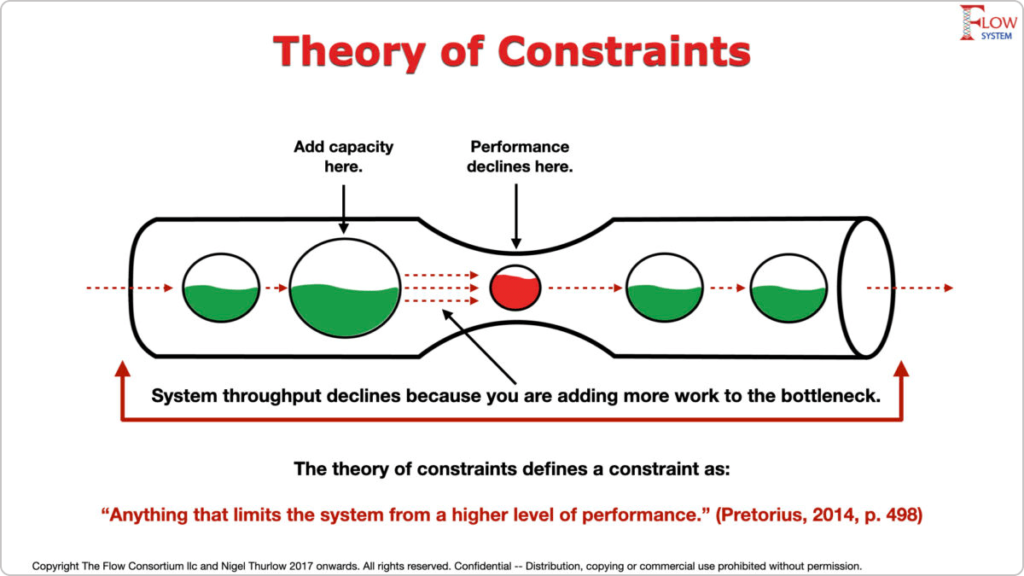
Let's clarify these terms.
The subtle difference between a constraint and a bottleneck (Theory of Constraints)
This video provides a concise and clear distinction between a bottleneck and a true system constraint.
Watch the entire video (it's short, under 3 minutes). Focus on how it defines the two terms using the factory example: Bottleneck: Any resource with capacity less than or equal to the demand placed upon it (e.g., resources B and E). Constraint: The specific bottleneck that limits the entire system's throughput (e.g., only resource E). The crucial point is that improving a bottleneck that is not the constraint yields zero improvement for the system as a whole.
To summarize:
- A system can have multiple bottlenecks.
- A system has, by definition, at most a very small number of constraints. Often, there is only one.
- The constraint is the bottleneck that is the "weakest link in the chain." It's the factor that governs the system's overall output, just like the limiting reactant in our chemical equation.
Your goal throughout this course is to become proficient at identifying the true constraint, not just any bottleneck.
Conclusion
In this lesson, we established the foundational principle for analyzing and optimizing any productivity system.
Key Takeaways:
- The Limiting Agent Principle: Complex systems, whether chemical, biological, or economic, are often limited not by the sum of their resources but by the single factor in shortest supply. This is known as Liebig's Law of the Minimum, with the limiting reactant in chemistry being a specific example.
- Mathematical Formalism: The Leontief-Liebig production function, , provides a mathematical model for this principle, showing that output is capped by the most deficient resource or capacity.
- Constraints vs. Bottlenecks: A bottleneck is any resource working at or near its capacity limit. The constraint is the specific bottleneck that dictates the throughput of the entire system. Effort spent improving non-constraints is wasted.
You now have the fundamental concept—the "first principle"—of system limitations. You understand that a single constraint must exist and why it dictates the performance of the entire system.
Preview of the Next Lesson:
Now that we have established the theoretical foundation, we need a practical methodology for acting on it. In the next lesson, we will introduce the Theory of Constraints (TOC), developed by Eliyahu Goldratt. We will explore the Five Focusing Steps, a systematic process for identifying, exploiting, and elevating a system's primary constraint to achieve continuous improvement.