Introduction
In our last lesson, we deconstructed the Theory of Constraints into its five focusing steps: Identify, Exploit, Subordinate, Elevate, and Repeat. You learned the critical distinction between exploiting a constraint with existing resources and elevating its capacity through investment.
Today, we transition from theory to practice. Your learning outcome is to apply the first three TOC steps (Identify, Exploit, Subordinate) to a case study workflow. We will dissect a complex, real-world problem from a public hospital's pharmacy, analyzing how they used these principles to resolve long-standing bottlenecks. This case demonstrates that constraints are often subtle policy or process issues, not just physical limitations, a crucial insight for optimizing complex systems like scientific research.
The Case Study: A Bottleneck in Cancer Treatment
Our subject is a hospital's Cytotoxic Pharmacy Manufacturing Unit (CPMU), responsible for preparing chemotherapy drugs. Despite the staff's best efforts, the system was plagued by undesirable effects (UDEs):
- Extremely long and variable patient wait times for treatment.
- High levels of staff overtime, stress, and burnout.
- A chaotic workflow with periods of idleness followed by frantic rushes.
These are classic symptoms of a poorly managed bottleneck. The entire system's performance, from patient well-being to operational cost, is being dictated by its weakest link.
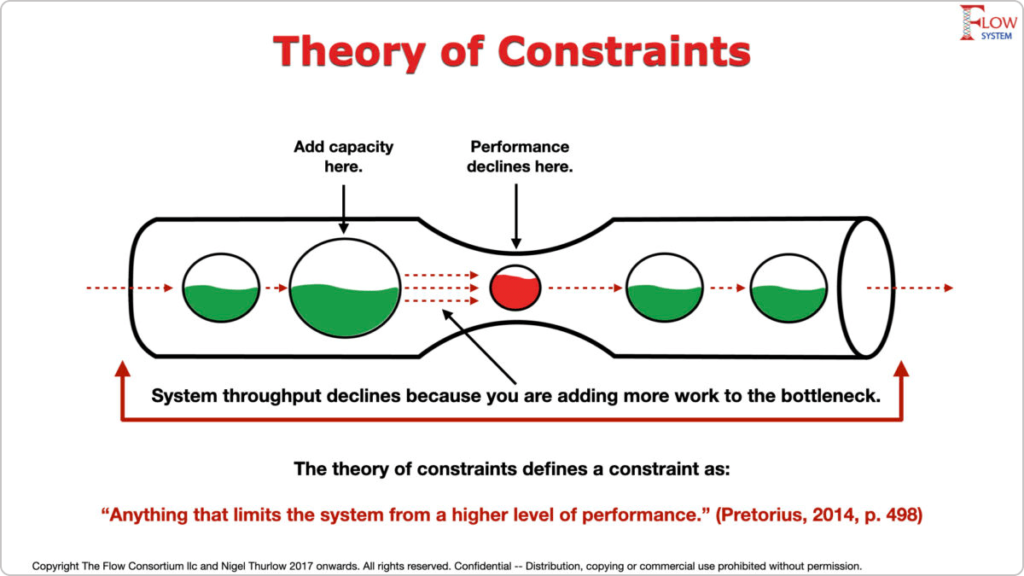
To begin, let's get a detailed understanding of the initial workflow and the problems it created.
Using the Theory of Constraints to resolve long-standing resource ...
The following reading is from a paper analyzing a TOC implementation in a hospital. It describes the specific workflow that was causing significant delays and stress.
From the paper, please read the subsection titled '3.1.1. What to change?'. Focus on understanding the 'traditional working system' and the 'active confirmation' process. Identify the sequence of events and where the delays occurred.
Step 1: Identify the Constraint
After reading that section, the structure of the problem becomes clearer. The process involves multiple steps: doctor's prescription, patient assessment, specialist verification, drug manufacturing in the CPMU, and finally, administration by a nurse.
The UDEs—long patient waits and staff overtime—point to a significant bottleneck. Where is it? While the CPMU's physical capacity (the isolator where drugs are made) is a factor, the root cause is a policy constraint: the "active confirmation" rule. As the paper states, "chemotherapy drugs are not manufactured until the production unit receives definite confirmation from the Cancer Centre clinician that the patient is to receive treatment."
This policy forces the CPMU to operate in a reactive, start-stop manner. It creates a bottleneck at the CPMU because manufacturing can only begin after a long chain of preceding events is complete, with the patient already on-site. The constraint isn't just the machine; it's the rule that governs when the machine is allowed to start working.
Therefore, the identified constraint is the CPMU, whose capacity is severely limited by the "active confirmation" policy.
Step 2: Exploit the Constraint
Recalling from our last lesson, the second step is to exploit the constraint—to get the maximum possible output from it without significant new investment. You do not buy a new, faster isolator. You change the process to make the existing one more productive.
The project team proposed a radical change to the policy constraint.
Using the Theory of Constraints to resolve long-standing resource ...
Now, let's examine the solution proposed by the project team. This is a classic example of exploitation.
Please read the subsection '3.1.2. What to change to?'. Note the proposed 'new system' and how it fundamentally alters the workflow by challenging the core assumption of the 'active confirmation' process.
The proposed solution—to prepare drugs in advance of confirmation—is a powerful act of exploitation. By decoupling manufacturing from the immediate patient visit, the CPMU can batch its work, smooth its schedule, and eliminate idle time waiting for confirmations. It allows the unit to produce at a steady, planned pace, thereby maximizing the throughput of the constrained resource (the isolator and pharmacy staff). This is a pure process optimization that unlocks hidden capacity.
Step 3: Subordinate Everything Else
This is often the most difficult step from an organizational perspective. It demands that all other parts of the system change their behavior to support the exploitation of the constraint. Local efficiencies must be sacrificed for global system performance.
In our case study, subordination meant that the Cancer Centre (doctors and nurses) had to adapt to the pharmacy's new production rhythm. The old process of sending a confirmation and expecting an immediate manufacturing response was eliminated. Instead, they had to trust that drugs would be ready when needed, based on a schedule determined the day before.
The planning and execution of the four-week trial demonstrates this subordination in action.
Using the Theory of Constraints to resolve long-standing resource ...
The implementation of the pilot project required careful coordination and a change in behavior from all departments. This is subordination.
Read the subsection '3.1.3. How to make the change?'. Pay attention to how the baseline data was collected and how all teams (pharmacy, clinical directors, nurses) were brought into the new process for the four-week trial. This illustrates subordinating old habits to the new system.
By agreeing to the trial, the non-constraint resources (doctors, nurses, administrative staff) subordinated their previous workflow to the needs of the constraint (the CPMU). They stopped optimizing for their own local process (e.g., the convenience of confirming on the spot) and started supporting the new global process designed to maximize system throughput and reduce patient wait times.
Analysis of the Outcome: The Continuous Improvement Loop
The initial application of Identify, Exploit, and Subordinate is rarely the final step. A core principle of TOC is the process of ongoing improvement. The results of the pilot project were dramatic, but they also revealed a new problem.
Using the Theory of Constraints to resolve long-standing resource ...
Let's analyze the quantitative outcomes of this intervention. The results highlight both the success of the changes and an unintended negative consequence, which is a critical part of the learning cycle.
First, read section '3.2. Results of the pilot'. Note the massive improvements in wait times and overtime, but also the significant increase in drug wastage costs. Then, read section '3.3. Refinement and acceptance of the pilot project – two-tier confirmations process'. This shows how the team iterated on their solution to address the wastage problem, demonstrating the cyclical nature of TOC.
The results are striking:
- Identify: The "active confirmation" policy was identified as the constraint.
- Exploit: Manufacturing drugs in advance was implemented.
- Subordinate: The rest of the hospital subordinated to this new process.
Initial Outcome:
- Patient wait times plummeted from an average of 129 minutes to just 20 minutes for a few, with most waiting 0 minutes.
- Nursing staff overtime was reduced by 67%.
- However, drug wastage costs increased tenfold, from 0.4% to 4%.
This is where many improvement initiatives fail. They solve one problem but create another. The TOC process, however, demands iteration. The team did not abandon the new system; they refined it.
The "two-tier confirmations process" is a more sophisticated application of the same principles. They analyzed the new problem (wastage) and realized it was primarily driven by a small number of high-cost drugs. By creating a hybrid system—continuing pre-emptive manufacturing for the 90% of low-cost drugs and re-instating confirmation for the 10% of high-cost drugs—they achieved a win-win-win solution:
- Patient wait times remained exceptionally low.
- Staff overtime remained low.
- Wastage costs returned to near-baseline levels.
This refinement is a perfect illustration of Step 5: "Repeat the process and avoid inertia." The team found a new imbalance and adjusted the system again, leading to a stable and vastly superior state.
Conclusion
In this lesson, you have moved beyond the theory of TOC and applied its core principles to a complex, real-world system.
Key Takeaways:
- Application of the First Three Steps: You have walked through a concrete example of how to Identify a policy constraint, Exploit it by changing the process to maximize its throughput, and Subordinate all other activities to support the new system.
- Policy as a Constraint: Constraints are not always physical machines or resource quantities. Often, the most powerful constraints are rules, policies, or paradigms—like the "active confirmation" process.
- Global vs. Local Optima: The case study is a powerful demonstration that subordinating local efficiencies (e.g., the Cancer Centre's original confirmation process) is essential for achieving a global optimum (drastically reduced patient wait times).
- Iteration is Key: The initial solution was not the final one. True mastery of this process involves analyzing the new system state created by your changes and making further refinements, as seen with the development of the two-tier system.
Preview of the Next Lesson:
We have now established how to analyze and optimize an existing system using the forward-looking process of TOC. However, your goal also involves determining maximum potential from the outset. In our next module, we will introduce a complementary framework: Backward Induction. You will learn how to solve a sequential decision problem by starting from a future goal and working backward to the present, a core technique in game theory and strategic planning.