Hello! Let's dive into the final part of the Knuth-Morris-Pratt (KMP) algorithm.
In our last lesson, you learned the critical preprocessing step: constructing the Longest Proper Prefix which is also a Suffix (LPS) array. You saw how this lps array, built in O(M) time, encodes the internal overlapping structure of the pattern.
Today, we'll put that array to work. Your learning outcome is to implement the KMP pattern matching algorithm using a precomputed LPS array. We will focus on the search phase, where we use the lps array to achieve the famous O(N+M) time complexity, a significant improvement over naive approaches, especially in worst-case scenarios.
1. The KMP Search Logic: Intelligent Shifts in Action
The KMP search algorithm uses two pointers:
i: A pointer for thetextstring (let's call ittxt). It always moves forward, never backward.j: A pointer for thepatternstring (pat). This pointer tracks how much of the pattern we have matched so far.
We iterate through the text with i while trying to match the pattern with j. The magic of KMP happens when a mismatch occurs. Instead of resetting our progress, we use the lps array to perform an intelligent shift.
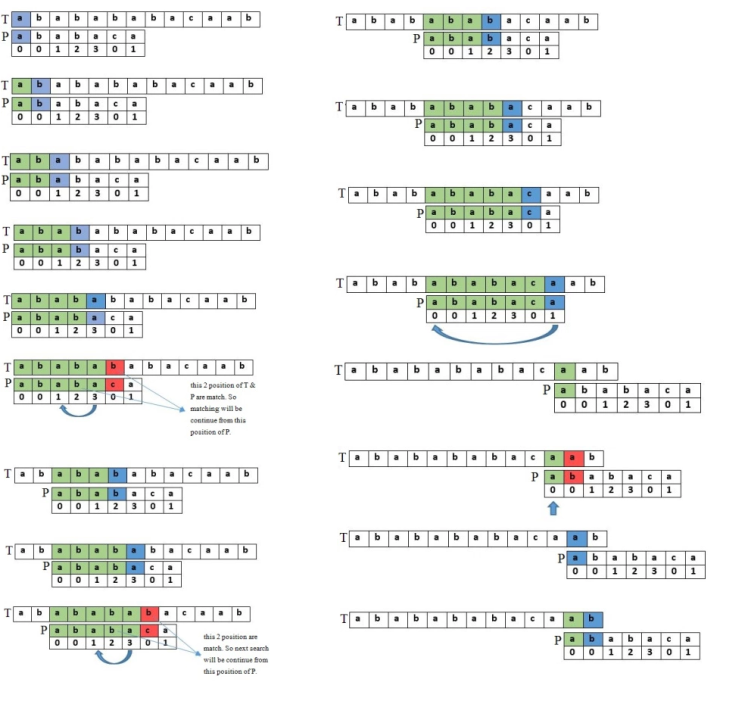
Let's watch a video that explains the main algorithm. It demonstrates how the pointers i and j interact and how the precomputed array guides the search after a mismatch.
Knuth Morris Pratt (KMP) String Search Algorithm - tutorial with failure function in Java
The video 'Knuth Morris Pratt (KMP) String Search Algorithm' from the Stable Sort channel provides a clear, concise explanation of the main search algorithm.
Please watch the segments from 4:24 to 6:01 and 6:56 to 7:58. The first part explains how the lps array (called the 'prefix length array' here) is used to calculate the shift. The second part shows the main Java implementation and explains its linear time complexity.
2. The Search Algorithm in Detail
As you saw in the video, the search loop revolves around comparing txt.charAt(i) and pat.charAt(j). This leads to three main cases:
Case 1: Characters Match
If txt.charAt(i) == pat.charAt(j), it means we've extended our match. We simply increment both pointers: i++ and j++.
Case 2: A Full Pattern Match is Found
After incrementing, if j becomes equal to the pattern's length (M), we have found a complete match!
- Record the starting index of the match, which is
i - j. - Important: We don't stop here. To find subsequent overlapping matches, we must shift the pattern. We do this by setting
j = lps[j - 1]. This repositions the pattern to the longest proper prefix that is a suffix of the entire pattern, allowing the search to continue seamlessly.
Case 3: Characters Mismatch
If txt.charAt(i) != pat.charAt(j), we consult the lps array.
- If
j > 0: We can't extend the current partial match. However, thelpsarray tells us that a shorter prefix of the pattern might still align with the text. The length of this shorter prefix islps[j-1]. So, we updatej = lps[j - 1]. We do not incrementi. We are effectively sliding the pattern forward and retrying the comparison with the current charactertxt.charAt(i)against a new character in the pattern. - If
j == 0: The mismatch occurred at the very first character of the pattern. There's no shorter prefix to fall back to. We have no choice but to move to the next character in the text. We simply incrementi.
3. Java Implementation
Now, let's look at how this logic is implemented in Java. The following resource provides a clean and well-commented implementation of the KMP search function, which takes the text, the pattern, and the pre-computed lps array.
KMP Algorithm for Pattern Searching
The GeeksforGeeks article 'KMP Algorithm for Pattern Searching' provides a complete Java implementation. We will focus on the search function, which implements the logic we just discussed.
Scroll down to the 'Matching Step – Search the Pattern in the Text' section and find the Java code block. Study the search function. Pay close attention to the while (i < n) loop and how the three cases (match, full match, and mismatch) are handled within the if-else structure.
Here's the core search logic from the article, with added comments to connect it back to our three cases. In a real-world scenario, you would have a method computeLPSArray that you wrote in the last lesson and call it before starting the search.
class KMP_Search {

    // The LPS array construction method from the previous lesson
    void computeLPSArray(String pat, int M, int lps[]) {
        int length = 0;
        int i = 1;
        lps[0] = 0; // lps[0] is always 0

        while (i < M) {
            if (pat.charAt(i) == pat.charAt(length)) {
                length++;
                lps[i] = length;
                i++;
            } else { // (pat[i] != pat[length])
                if (length != 0) {
                    length = lps[length - 1];
                } else { // if (length == 0)
                    lps[i] = 0;
                    i++;
                }
            }
        }
    }

    // The KMP search algorithm
    void KMPSearch(String pat, String txt) {
        int M = pat.length();
        int N = txt.length();

        // Create lps[] that will hold the longest prefix suffix values for pattern
        int lps[] = new int[M];
        int j = 0; // index for pat[]

        // Preprocess the pattern to calculate lps[] array
        computeLPSArray(pat, M, lps);

        int i = 0; // index for txt[]
        while (i < N) {
            // ---- Case 1: Characters Match ----
            if (pat.charAt(j) == txt.charAt(i)) {
                j++;
                i++;
            }

            // ---- Case 2: A Full Pattern Match is Found ----
            if (j == M) {
                System.out.println("Found pattern at index " + (i - j));
                // To find other occurrences, we continue searching.
                // We shift the pattern using the lps value of the last element.
                j = lps[j - 1];
            }

            // ---- Case 3: Mismatch after some matches ----
            else if (i < N && pat.charAt(j) != txt.charAt(i)) {
                // Don't match lps[0..lps[j-1]] characters,
                // they will match anyway.
                if (j != 0) {
                    j = lps[j - 1];
                } else {
                    // Mismatch at the very first character of the pattern
                    i = i + 1;
                }
            }
        }
    }
}
Test your understanding!
Given txt = "ABABDABACDABABCABAB" and pat = "ABABC". The lps array for pat is [0, 0, 1, 2, 0].
Trace the values of i and j until the first match is found. What is the value of i and j right after the mismatch at txt[4] (which is 'D')?
Show answer
Let's trace:
i=0, j=0:txt[0]=='A',pat[0]=='A'. Match.i=1, j=1.i=1, j=1:txt[1]=='B',pat[1]=='B'. Match.i=2, j=2.i=2, j=2:txt[2]=='A',pat[2]=='A'. Match.i=3, j=3.i=3, j=3:txt[3]=='B',pat[3]=='B'. Match.i=4, j=4.i=4, j=4:txt[4]=='D',pat[4]=='C'. Mismatch!- Since
jis not 0 (it's 4), we updatejusing thelpsarray:j = lps[j-1] = lps[3] = 2. The pointeriremains at 4.
So, after the mismatch, i = 4 and j = 2. The algorithm will now compare txt[4] ('D') with the new pat[2] ('A'). This demonstrates the intelligent shift: we know the 'AB' at the end of the matched text portion (txt[2..3]) matches the prefix of our pattern, so we don't need to re-check it.
4. Complexity Analysis
-
Time Complexity: O(N + M)
- The
computeLPSArrayfunction takesO(M)time, as we saw in the last lesson. - The
KMPSearchloop processes the text. The pointeriis always incremented and never goes back. The pointerjcan go back, but the number of times it can be decremented is bounded by the number of times it has been incremented. Amortized analysis shows that the search phase takesO(N)time. - Therefore, the total time complexity is
O(M) + O(N) = O(N + M).
- The
-
Space Complexity: O(M)
- We need an auxiliary array
lpsof sizeMto store the preprocessing results. The search itself uses a constant amount of extra space for the pointers.
- We need an auxiliary array
Conclusion
You have now fully implemented the Knuth-Morris-Pratt algorithm! By combining the LPS array construction with the intelligent search logic, you can now solve the pattern matching problem with a guaranteed linear time complexity, which is a major achievement and a staple of technical interviews.
Key Takeaways:
- The KMP search uses two pointers,
ifor the text andjfor the pattern. The text pointerinever backtracks. - When characters match, both pointers advance.
- When a mismatch occurs, the
lpsarray is used to find the optimal shift for the pattern pointerj(j = lps[j-1]), avoiding redundant comparisons. - The algorithm's total time complexity is
O(N+M), making it highly efficient for all cases.
Preview of the next lesson:
This lesson concludes our deep dive into advanced string algorithms. We will now shift gears and move on to a fundamental, pointer-based data structure that is crucial for interview preparation: Linked Lists. In the next lesson, you will learn to implement a singly linked list with insertion, deletion, and traversal operations.