Hello! Welcome to your next lesson on advanced string algorithms.
In our last session, we implemented the Rabin-Karp algorithm. We saw how its use of rolling hashes gives it an excellent average-case time complexity of O(N+M), making it very fast in practice. However, we also noted its Achilles' heel: a worst-case time complexity of O(N*M) when frequent hash collisions (spurious hits) occur.
Today, we begin our study of the Knuth-Morris-Pratt (KMP) algorithm, a celebrated method in computer science that solves the pattern matching problem with a guaranteed O(N+M) time complexity in all cases. The key to this efficiency lies in a clever preprocessing step on the pattern string. Your learning outcome for this lesson is to construct the Longest Proper Prefix which is also a Suffix (LPS) array for the KMP algorithm. This array is the brain behind KMP's intelligent shifts.
1. The KMP Idea: Smarter Shifts
First, let's understand the problem KMP solves. A naive, brute-force search algorithm is inefficient because when a mismatch occurs, it shifts the pattern by only one position and starts comparing from the beginning. This leads to many redundant comparisons, especially in patterns with repeating characters.
The core insight of KMP is: when a mismatch happens after matching k characters of the pattern, we already know what those k characters of the text look like. Instead of dumbly shifting by one, we can use pre-computed information about the pattern to make a much larger, "smarter" shift, bypassing positions that could not possibly result in a match. This eliminates the need to ever move the text pointer backward.
To see this inefficiency in action, let's watch a video that explains the drawbacks of the naive approach.
9.1 Knuth-Morris-Pratt KMP String Matching Algorithm
The video 'Knuth-Morris-Pratt KMP String Matching Algorithm' by Abdul Bari clearly illustrates the problem with naive string matching.
Please watch from the beginning to 7:37. Focus on how the pointer in the main text (i) has to backtrack after a mismatch. This backtracking is the primary source of inefficiency that KMP eliminates.
2. The LPS Array: Encoding the Pattern's Structure
The "pre-computed information" that enables these smart shifts is stored in an array, typically called the LPS array.
LPS stands for "Longest Proper Prefix which is also a Suffix".
Let's break that down:
- Prefix: A substring starting from the beginning. For "abcd", the prefixes are "a", "ab", "abc", "abcd".
- Suffix: A substring ending at the end. For "abcd", the suffixes are "d", "cd", "bcd", "abcd".
- Proper Prefix: A prefix that is not the entire string itself. For "abcd", the proper prefixes are "a", "ab", "abc".
The LPS array for a pattern P of length M is an array of size M where lps[i] stores the length of the longest proper prefix of the substring P[0...i] that is also a suffix of P[0...i].
This might sound complex, so let's see it in action. The following video provides a clear, example-driven introduction to what this array represents.
Knuth Morris Pratt (KMP) String Search Algorithm - tutorial with failure function in Java
The video 'Knuth Morris Pratt (KMP) String Search Algorithm' by Stable Sort gives a great visual introduction to this array, which it calls the 'prefix length array'.
Watch the segment from 2:23 to 4:24. Observe how the array is built for the pattern ABCxxxABCY and what the numbers in the array signify.
Let's do one more example by hand for the pattern P = "ababa":
i = 0:P[0...0]is"a". No proper prefixes.lps[0] = 0.i = 1:P[0...1]is"ab". Proper prefix is "a". Suffix is "b". No match.lps[1] = 0.i = 2:P[0...2]is"aba". Proper prefixes: "a", "ab". Suffixes: "a", "ba". The longest match is"a". Length is 1.lps[2] = 1.i = 3:P[0...3]is"abab". Proper prefixes: "a", "ab", "aba". Suffixes: "b", "ab", "bab". The longest match is"ab". Length is 2.lps[3] = 2.i = 4:P[0...4]is"ababa". Proper prefixes: "a", "ab", "aba", "abab". Suffixes: "a", "ba", "aba", "baba". The longest match is"aba". Length is 3.lps[4] = 3.
So, the final LPS array for "ababa" is [0, 0, 1, 2, 3]. This array tells the KMP search algorithm that after matching "ababa", if the next character fails, the text has a suffix "aba" which matches the prefix of our pattern, so we don't need to recheck everything.
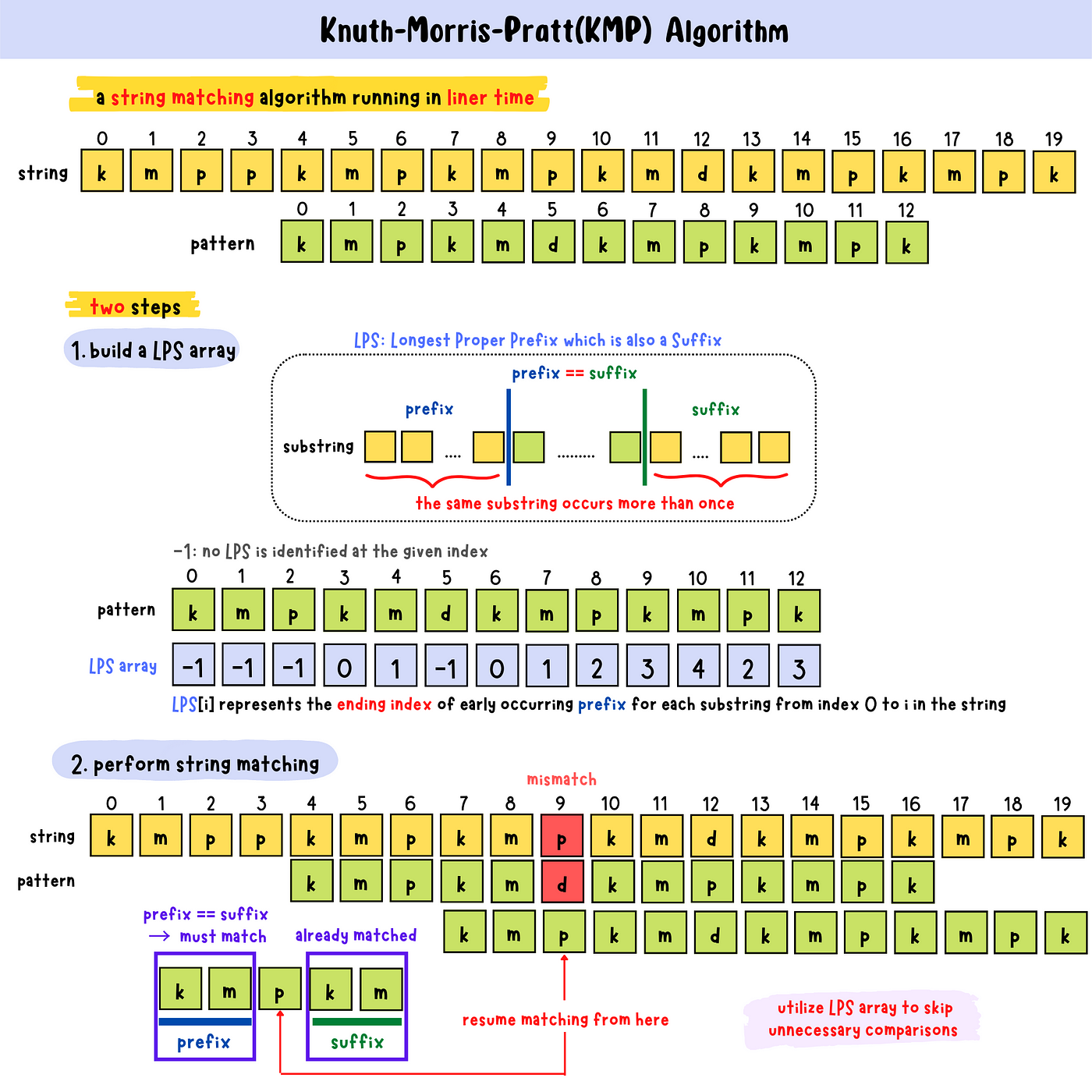
3. The Algorithm to Construct the LPS Array
We can build the LPS array efficiently in O(M) time using a clever two-pointer approach. Let M be the pattern length.
We use two integer variables:
i: Iterates through the pattern from index 1 toM-1. We are trying to computelps[i].len: Stores the length of the longest proper prefix-suffix for the previous index,i-1. It also serves as a pointer to the character in the prefix we're trying to match.
The logic revolves around comparing pattern[i] and pattern[len]. The following article explains the algorithm beautifully.
KMP Algorithm for Pattern Searching
The GeeksforGeeks article 'KMP Algorithm for Pattern Searching' provides an excellent step-by-step explanation of the logic for building the LPS array. We'll focus on the section that breaks the algorithm down into three clear cases.
Please read the section titled 'Algorithm for Construction of LPS Array'. Pay close attention to the three cases described for the pat[i] vs pat[len] comparison. Understand how the len variable is updated in each scenario, especially the 'fallback' mechanism in Case 3. This is the heart of the algorithm.
To summarize the logic you just read:
- Match (
pattern[i] == pattern[len]): We've extended the prefix-suffix match. We incrementlen, setlps[i] = len, and move to the next character by incrementingi. - Mismatch (
pattern[i] != pattern[len]):- If
len > 0: We can't extend the current prefix. We need to try a shorter prefix. The length of the next-best prefix is already computed and stored inlps[len - 1]. So we "fall back" by settinglen = lps[len - 1]and repeat the comparison for the sameiwith the new, shorterlen. - If
len == 0: We've fallen back as far as possible. No prefix matches. We setlps[i] = 0and move to the next character by incrementingi.
- If
4. Java Implementation
Now let's translate this logic into Java code. As you'll see, the if-else structure maps directly to the three cases we just discussed.
KMP Algorithm or LPS Array - Tutorial
The article 'KMP Algorithm or LPS Array - Tutorial' from takeuforward.org offers a very clean and readable Java implementation of this logic. Let's study it to see how the algorithm translates into code.
In the 'Code' section, select the 'Java' tab and focus on the computeLPS function. Compare this code to the three cases we just learned about from the GeeksforGeeks article. Notice how the while (i < pattern.length()) loop and its internal if-else structure directly implement that logic.
The code you just reviewed is a concise and efficient implementation of the LPS construction algorithm. The fallback step, len = lps[len - 1], is the most crucial part. It allows the algorithm to reuse its own past results to avoid re-computing from scratch, which is what gives it its linear time complexity.
Test your understanding!
Manually construct the LPS array for the pattern P = "AAABAAA". What is the resulting array?
Show answer
The LPS array for "AAABAAA" is [0, 1, 2, 0, 1, 2, 3].
Let's trace it:
i=0: "A" ->lps[0]=0i=1: "AA" ->lps[1]=1i=2: "AAA" ->lps[2]=2i=3: "AAAB". Mismatch (BvsA). Fallback:lenbecomeslps[2-1]=lps[1]=1. Mismatch (BvsA). Fallback:lenbecomeslps[1-1]=lps[0]=0. Mismatch (BvsA).lenis 0. So,lps[3]=0.i=4: "AAABA". Match (AvsA).lenbecomes 1.lps[4]=1.i=5: "AAABAA". Match (AvsA).lenbecomes 2.lps[5]=2.i=6: "AAABAAA". Match (AvsA).lenbecomes 3.lps[6]=3.
5. Complexity Analysis
-
Time Complexity: O(M), where M is the length of the pattern.
While thewhileloop contains a mechanism (len = lps[len - 1]) where the inner pointerlencan go backward, the outer pointerialways moves forward. Thelenpointer can only be decremented as many times as it has been incremented. This is a classic case for amortized analysis, which shows that the total number of operations is proportional toM. -
Space Complexity: O(M). We need an auxiliary array of size
Mto store the LPS values.
Conclusion
Congratulations! You've successfully learned how to construct the LPS array, the fundamental building block of the KMP algorithm. This preprocessing step captures the internal overlapping structure of a pattern, which is the key to avoiding redundant comparisons during the search phase.
Key Takeaways:
- The KMP algorithm guarantees
O(N+M)time complexity by using pre-computation to make intelligent shifts. - The LPS array is the result of this pre-computation.
lps[i]stores the length of the longest proper prefix ofpattern[0...i]that is also a suffix. - The LPS array can be constructed in
O(M)time andO(M)space using an efficient two-pointer algorithm. - The fallback step (
len = lps[len-1]) is the core of the construction algorithm, allowing it to reuse previous results.
Preview of the next lesson:
Now that we have this powerful tool, the next logical step is to use it. In our next lesson, you will implement the KMP pattern matching algorithm using the precomputed LPS array to perform the actual search in a text, completing your mastery of this cornerstone algorithm.