Hello! Welcome back to our module on Linear Algebra Foundations.
In the last lesson, we established how to represent vectors and matrices using NumPy arrays and perform fundamental operations like addition and the dot product. We saw that these are not just abstract mathematical objects but the primary way we handle data in machine learning.
Today, we'll build on that by learning how to measure the "size" or "magnitude" of these vectors and matrices. This concept is called a norm. The learning outcome for this lesson is to compute vector and matrix norms (e.g., L1, L2, Frobenius) using NumPy. Understanding norms is critical, as they form the basis for many machine learning concepts, including measuring model error, evaluating model performance, and a powerful technique for preventing overfitting called regularization.
1. What is a Norm and Why is it Important?
At its core, a norm is a function that assigns a strictly positive length or size to each vector in a vector space (except for the zero vector, which has a length of zero). You can think of it as a generalized concept of distance.
In machine learning, we use norms constantly. For instance:
- When a model makes a prediction, we can represent the errors for all data points as a vector. The norm of this error vector gives us a single number that quantifies the total error of the model.
- In regularization, we add a term to our model's loss function that is based on the norm of the model's weight vector. This encourages the model to learn smaller, less complex weights, which can help it generalize better to new data.
To get a quick overview of the role of norms in machine learning, please watch the following short video clip.
Machine Learning Maths | Vectors And Matrix Norms | Part 2 | Eduonix
The video 'Machine Learning Maths | Vectors And Matrix Norms' by Eduonix provides a great introduction to why we need to measure vector magnitudes in machine learning.
Watch the segment from 00:28 to 01:28. Pay attention to the examples mentioned, like defining a loss function or using regularization.
2. Vector Norms
Most common vector norms are part of a family called Lp norms. The general formula for the Lp norm of a vector is:
By choosing different values for , we get different types of norms with unique properties. Let's explore the most important ones for machine learning.
The L2 Norm (Euclidean Norm)
This is the most common norm you'll encounter. It corresponds to setting in the general formula and represents the familiar concept of Euclidean distance—a straight line from the origin to the point defined by the vector.
Formula:
In NumPy, we can compute this using the numpy.linalg.norm function. If you don't specify the type of norm, NumPy calculates the L2 norm by default for vectors.
import numpy as np

# A vector representing a point in 3D space
x = np.array([3, 0, 4])

# Calculate the L2 norm (Euclidean distance from origin)
l2_norm = np.linalg.norm(x)

# The result is sqrt(3^2 + 0^2 + 4^2) = sqrt(9 + 16) = sqrt(25) = 5.0
print(f"Vector x: {x}")
print(f"L2 Norm of x: {l2_norm}")

# You can also be explicit by setting the 'ord' parameter to 2
l2_norm_explicit = np.linalg.norm(x, ord=2)
print(f"L2 Norm of x (explicit): {l2_norm_explicit}")
The L1 Norm (Manhattan Norm)
The L1 norm is calculated by setting . It's the sum of the absolute values of the vector's components. It's often called the "Manhattan norm" because it represents the distance you would travel between two points in a city grid, where you can only move along horizontal or vertical streets.
Formula:
In machine learning, the L1 norm is particularly interesting because it tends to produce sparse results (many values being exactly zero). This makes it very useful for feature selection, as it can effectively "turn off" the influence of less important features by setting their weights to zero.
To compute the L1 norm in NumPy, we set ord=1.
# The same vector x
x = np.array([3, 0, -4])

# Calculate the L1 norm
l1_norm = np.linalg.norm(x, ord=1)

# The result is |3| + |0| + |-4| = 3 + 0 + 4 = 7.0
print(f"Vector x: {x}")
print(f"L1 Norm of x: {l1_norm}")
Geometric Intuition: L2 vs. L1
The different properties of L1 and L2 norms lead to different geometric shapes when you plot all the vectors that have a norm equal to 1.

The L-infinity Norm (Max Norm)
As approaches infinity, the Lp norm simplifies to become the absolute value of the largest element in the vector.
Formula:
To compute the max norm in NumPy, we use np.inf for the ord parameter.
x = np.array([3, 0, -4])

# Calculate the L-infinity norm
inf_norm = np.linalg.norm(x, ord=np.inf)

# The result is max(|3|, |0|, |-4|) = 4.0
print(f"Vector x: {x}")
print(f"L-infinity Norm of x: {inf_norm}")
Test your understanding!
You are given a vector that represents the errors of a model's predictions: errors = np.array([-2.5, 1.0, 0.5, -3.0]).
- Which norm (L1, L2, or L-infinity) would give you the value of the single worst error? What would that value be?
- Calculate the L1 norm. What does this value represent in practical terms?
Show answer
- The L-infinity norm gives the maximum absolute value, which corresponds to the single worst error. The value would be
max(|-2.5|, |1.0|, |0.5|, |-3.0|) = 3.0. - The L1 norm is the sum of the absolute errors:
|-2.5| + |1.0| + |0.5| + |-3.0| = 2.5 + 1.0 + 0.5 + 3.0 = 7.0. This value represents the total absolute error across all predictions, often called the Mean Absolute Error (MAE) when averaged.
3. Matrix Norms
Just as we can measure the size of vectors, we can also measure the size of matrices. While several types of matrix norms exist, the most common one in machine learning is the Frobenius norm.
The Frobenius Norm
The Frobenius norm is analogous to the vector L2 norm. To calculate it, you simply take all the elements of the matrix, square them, sum them all up, and take the square root of the total.
Formula: For an matrix A:
This is a very natural way to extend the concept of Euclidean length to a matrix. In NumPy's linalg.norm() function, the Frobenius norm is the default for 2D arrays (matrices).
A = np.array([[1, 2],
              [3, 4]])

# Calculate the Frobenius norm (default for matrices)
frob_norm = np.linalg.norm(A)

# Result: sqrt(1^2 + 2^2 + 3^2 + 4^2) = sqrt(1 + 4 + 9 + 16) = sqrt(30) ≈ 5.477
print(f"Matrix A:\n{A}")
print(f"Frobenius Norm of A: {frob_norm}")

# You can also be explicit by setting ord='fro'
frob_norm_explicit = np.linalg.norm(A, ord='fro')
print(f"Frobenius Norm of A (explicit): {frob_norm_explicit}")
4. A Practical Reference for Calculation
To consolidate your understanding of the formulas and see more examples of their implementation in Python, the following article is an excellent reference.
Vector and Matrix Norms with NumPy Linalg Norm
The article 'Vector and Matrix Norms with NumPy Linalg Norm' from KDnuggets provides a concise summary of the formulas and corresponding Python code for all the norms we've discussed.
Please read the following sections: 'Common Vector Norms: L1, L2, and L∞ Norms' for the mathematical formulas. 'How to Compute Vector Norms in NumPy' for the code examples with vectors. 'Understanding Matrix Norms' and 'How to Compute Matrix Norms in NumPy' for the Frobenius norm formula and its code implementation. Focus on connecting the mathematical formulas to the ord parameter in the np.linalg.norm() function.
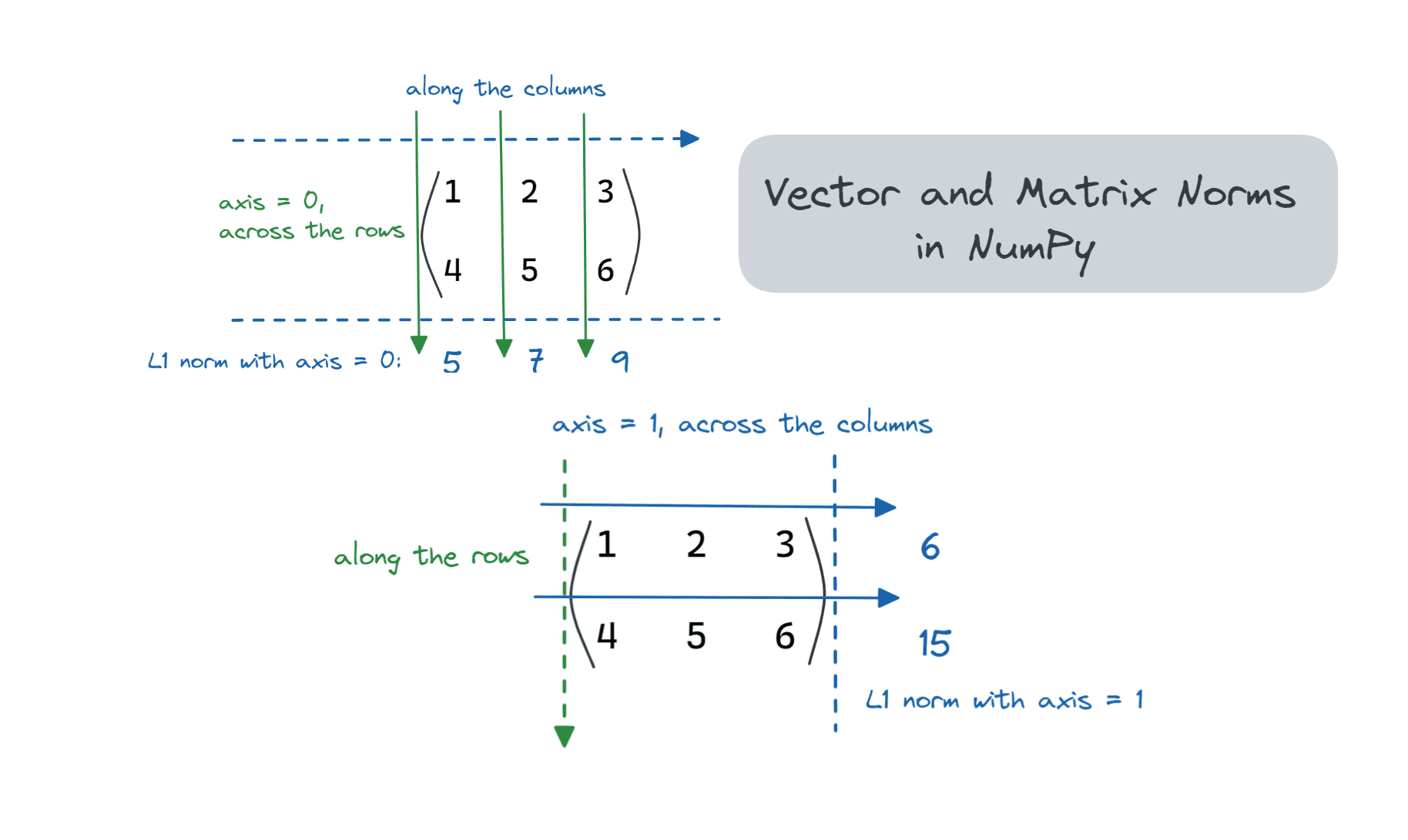
This article also briefly mentions calculating norms along a specific axis of a matrix, like summing up columns or rows. This is a powerful feature of NumPy that combines what you've learned about norms and array axes.
Conclusion
Excellent work! You've now learned how to quantify the magnitude of vectors and matrices, a fundamental skill for understanding and implementing machine learning algorithms.
Key Takeaways:
- A norm measures the "size" or "length" of a vector or matrix.
- The L2 norm (Euclidean) is the standard measure of distance and is the default for vectors in NumPy.
- The L1 norm (Manhattan) sums absolute values and is useful for promoting sparsity (zero-valued weights) in models.
- The Frobenius norm is the L2 equivalent for matrices and is the default for 2D arrays in NumPy.
- All these norms can be computed with the
np.linalg.norm()function, using theordparameter (1,2,np.inf,'fro') to specify the type.
Preview of the Next Lesson:
Now that we can create, operate on, and measure vectors and matrices, we'll dive into two more essential matrix operations in the next lesson: matrix multiplication and transposition. We will explore their properties and see why they are at the heart of how linear models and neural networks process information.