Recommended resources
The freely available resources this lesson will direct you to.
In our last lesson, we built a robust defense against tool call failures by using Pydantic for validation and creating a self-correction loop. This ensures that when an agent acts, it does so with valid inputs. But what happens if the agent gets stuck in that correction loop, or gets lost in its own reasoning, endlessly trying and failing without making progress?
This lesson addresses that critical failure mode. You will learn how to implement turn and step limits to act as "guardrails," preventing your agents from entering infinite loops. This is not just a best practice; it's a non-negotiable requirement for building reliable, production-grade AI systems that don't burn through your budget or run indefinitely without supervision.
The Anatomy of an Agent Loop
Unlike a deterministic program where an infinite loop is usually a straightforward logical bug (while True:), an agent's loop is often more subtle. The agent might seem like it's working, but it's actually stuck in a repeating pattern of thought and action that never reaches a conclusion.
This phenomenon, sometimes called "Loop Drift," can happen for several reasons:
- Misinterpreting "Done": The agent's probabilistic nature might lead it to believe a task isn't truly complete. It might try to "improve" a summary it has already written or re-verify a fact it has already confirmed.
- Repetitive Tool Use: If a tool returns a vague or slightly erroneous response, the agent might get stuck calling it repeatedly, unable to interpret the result and move forward. This is where our self-correction loop from the last lesson, if unchecked, could become a problem.
- Contextual Amnesia: In very long conversations, the agent might lose track of the original goal and re-process earlier information, inadvertently restarting a sub-task it has already completed.
The result is a "runaway agent" that silently consumes tokens, API calls, and compute resources without making any real progress. Our job as AI engineers is to build a system that can detect and stop this behavior.
A well-designed agent workflow anticipates this problem. Notice the "Loop breaker" in the diagram below, which acts as a safety net for the core planning and execution cycle.

The Solution: Budget Guardrails
To prevent runaway loops, we implement Budget Guardrails. These are simple, deterministic rules that sit outside the agent's probabilistic reasoning and enforce a hard stop. They are your system's ultimate safety switch.
Why AI Agents Get Stuck in Loops, and How to Prevent It
This article from FixBrokenAIApps provides an excellent conceptual framework for this problem, introducing the ideas of "Loop Drift" and "Loop Guardrails."
First, read the introduction from the beginning to understand the nuances of why agents get stuck. Then, review the section on Loop Guardrails to grasp the principle of external enforcement. Finally, read the first implementation step, implementing turn limits, which shows a clear pseudocode example of wrapping an agent in a while loop with a counter.
The article you just read introduces the core principle. Now, let's look at a concrete, code-level implementation. The two most common guardrails are a cycle budget and a token budget.
5 AI Agent Error Handling Patterns That Keep Your Agent Running at 3 AM - DEV Community
This article from the DEV Community offers practical, Python-based patterns for agent reliability. We'll focus on the pattern for budget guardrails.
Please read the section titled Pattern 4: Budget Guardrails for Runaway Loops. Pay close attention to the two Python dataclass examples: CycleBudget: This is the most important guardrail. It tracks the number of turns or steps the agent takes. A "turn" typically consists of one call to the LLM plus any tool calls it decides to make. TokenBudget: This is a cost-control guardrail. It tracks the cumulative number of tokens used and stops the agent if it exceeds a predefined cost limit. Notice how the example code integrates these checks directly into the main agent while loop. This is the standard implementation pattern.
From Theory to Practice
These budget concepts are not just theoretical. They are built directly into popular AI engineering frameworks. For instance, in LangChain, a parameter like recursion_limit in an agent executor serves exactly this purpose.
Build a Python AI Agent in 10 Minutes
In this short clip from Tech With Tim, you'll see this concept in a single line of code.
Watch from this point, where the presenter passes a recursion_limit=50 parameter. This is a framework's way of implementing a cycle budget, telling the agent to stop after a maximum of 50 steps.
While a simple turn limit is the most crucial guardrail, more sophisticated systems can also detect loops by looking for repetition. For example, you could track the last few tool calls the agent made. If it calls search("what is an agent?") three times in a row, it's a strong signal that it's stuck and should be terminated.
A Counterpoint: Deliberate Loops for Autonomy
So far, we've treated loops as a failure mode to be prevented. However, in advanced agent design, you might intentionally create a loop to enable a long-running, autonomous task. The key is that even these deliberate loops must have an external termination condition.
A great example is the "Ralph Mode" concept, humorously named after a character from The Simpsons, which is used to make agents persistent.
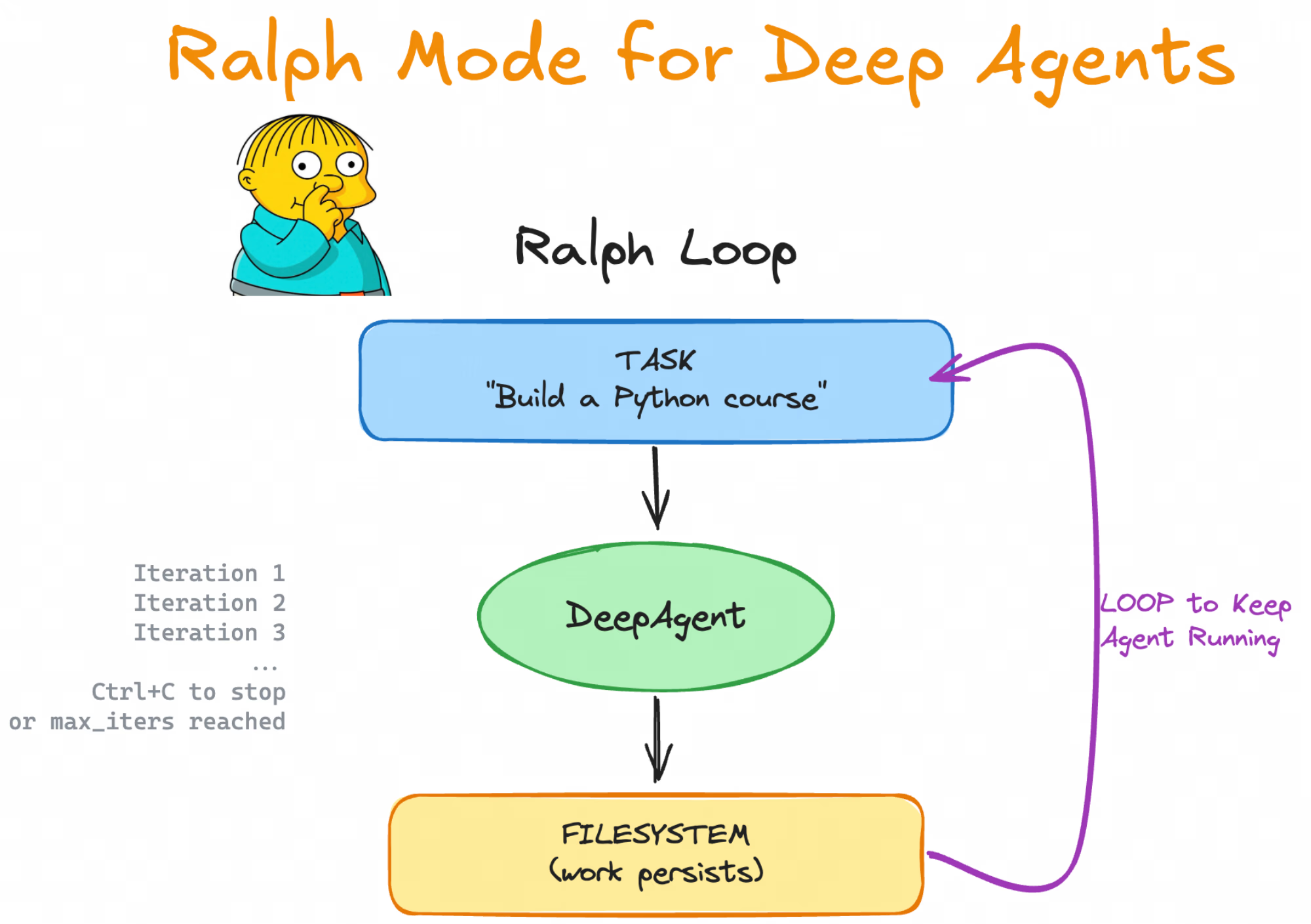
This pattern often uses a stop_hook—a piece of code that runs when the agent thinks it's finished. Instead of letting the agent stop, the hook can check the work (e.g., by running unit tests) and then feed the results back into the agent to have it continue working.
How to Run Claude Code For Hours Autonomously
This video from Developers Digest explains how the creator of the popular claude-code agent uses this looping technique to achieve long-term autonomy.
First, watch from this segment to understand what a stop_hook is and how it can be used to create a persistent loop by intercepting the agent's natural stopping point. Next, watch the segment from the 'Ralph loop' explanation. This details the mechanism: the stop hook blocks the agent from exiting and re-feeds it input, causing it to repeat the process. Finally, and most importantly, watch the crucial warning from the conclusion. The presenter explicitly states that if you use this pattern, you must set a max_iterations limit or define a clear completion "promise." Without this, you have created a true infinite loop.
This final point perfectly underscores the lesson's main takeaway: whether a loop is accidental or intentional, an external, deterministic limit on the number of turns is an essential safety mechanism.
Conclusion
In this lesson, you've learned how to safeguard your agentic systems against one of their most common and costly failure modes: infinite loops. By acting as an external supervisor to the agent's probabilistic mind, you can ensure reliability and control costs.
Key Takeaways:
- Agents loop for subtle reasons, such as misinterpreting when a task is "done" or getting stuck on a repetitive tool call.
- Budget Guardrails are your primary defense. These are deterministic checks that run outside the agent's core logic.
- The Cycle/Turn Limit is the most critical guardrail, setting a hard stop on the number of reasoning steps an agent can take.
- The Token Budget is a complementary guardrail focused on preventing runaway API costs.
- This pattern is so fundamental that it's a standard feature in AI frameworks (e.g.,
recursion_limit). - Even advanced autonomous agents that use deliberate loops require a
max_iterationslimit to ensure they eventually terminate.
You now have a powerful set of tools for building agents that are not only capable but also stable and reliable. You can handle single-step errors (last lesson) and now multi-step loops (this lesson). But how do we measure if the agent is actually succeeding at its task? In our next lesson, we will dive into evaluation, learning how to measure agent autonomy and task completion rates using deterministic test cases.