Recommended resources
The freely available resources this lesson will direct you to.
Hello again. Last lesson, you distinguished a currency exchange from contracts that depend on exchange rates. Now consider who uses those transactions, and why. The same exchange rate matters to a company paying a supplier, a bank serving that company, a fund managing investments, and an individual taking a trading position—but their objectives are not the same.
This lesson introduces six groups: central banks, commercial banks, corporations, funds, brokers, and retail traders. Understanding their roles will help you read market news without assuming that every large currency trade is a bet on where the price will go next.
Different reasons to enter the same market
Suppose a company receives payment in US dollars but needs another currency to meet its expenses. It asks a bank for a conversion rate. The bank may provide the currency from its own holdings or manage the resulting exposure through other trades. Meanwhile, a fund might be changing its international investments, and a central bank might be managing foreign-currency reserves. All can affect demand for currencies, even though only some are trying to profit from a short-term price move.
The image below is a useful cast list. Read its categories as roles, not as a claim that each participant trades directly with the next one pictured. “Commercial and investment banks” also overlap in practice: a large financial institution may perform several currency-market functions.
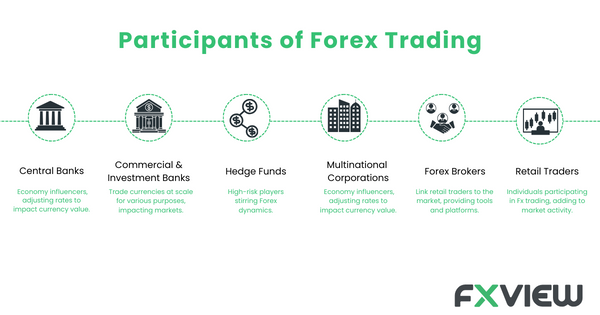
A distinction to keep in mind is purpose versus size. A very large transaction might be a routine payment rather than a speculative trade. A small retail position might be entirely speculative. The amount traded alone does not reveal the trader’s reason.
Central banks and commercial banks: similar names, different jobs
A central bank is a public monetary authority. Its currency-market role is connected to policy goals, not simply to earning a trading profit. Decisions about interest rates can change what market participants expect a currency to be worth. A central bank may also hold foreign-currency reserves and, at times, buy or sell currencies as part of an intervention. None of this means it sets every exchange rate by decree: prices also reflect transactions and expectations across many other participants.
A commercial bank, by contrast, serves customers and manages its own business risks. Its currency desk may convert money for companies or other clients and may quote prices at which it is willing to buy and sell. When a bank repeatedly offers both sides of a trade, it is acting as a market maker: it helps customers find a price without having to locate another customer with precisely the opposite need at that moment. The bank then has to manage the currency exposure it has taken on. Large banks also trade with other financial institutions and may take positions for their own accounts.
Read the two relevant parts of BabyPips’ Forex Market Players. Its lively descriptions are memorable, but focus on the functions rather than phrases such as “puppet masters” or the suggestion that banks single-handedly determine exchange rates.
BabyPips introduces central banks and large commercial banks. Read to separate policy influence from providing currency transactions and quotes to customers.
In “1. Central Banks,” start with the paragraph beginning “These big kahunas are responsible” and read the policy discussion through the paragraph about attention to central-bank actions. Then, in “2. The Super Banks,” read the client and quoting discussion. Near the end of that same bank section, read the role summary. As you read, distinguish a bank quoting prices from a central bank setting monetary policy.
The difference between the price at which a dealer buys and the price at which it sells is called the spread. You do not need to calculate it yet; a later lesson will teach you how to read those two prices. For now, notice that providing a convenient transaction can be a business service, not a prediction that the currency will rise.
Corporations and funds: currency as part of another activity
For a corporation, currency is often a means to do business. An importer may need foreign currency to pay a supplier; an exporter may receive foreign currency and convert it to meet expenses. A company with a payment due months from now may also want to reduce uncertainty about its eventual cost. That was the motivation behind the forward-contract example in the previous lesson. The company can be affected by the exchange rate even if it has no interest in day trading.
Funds are organizations that manage pools of investment capital, but they do not all use forex in the same way. An asset manager or pension fund buying investments denominated in another currency may need to convert money or manage the currency exposure of those holdings. A hedge fund might instead take a deliberate position because it expects an exchange rate to move. Even one fund can use currencies for more than one purpose. Calling all fund activity “speculation” would obscure that difference.
Watch the short opening of The Forex Market: Who Trades Currency And Why? How can I Compete with the Big Banks? from UKspreadbetting. It introduces large investors and central-bank reserves alongside other currency-market participants. Treat these as examples of possible motivations, not as a way to infer the purpose of any particular trade.
The Forex Market: Who Trades Currency And Why? How can I Compete with the Big Banks?
UKspreadbetting’s video provides a brief view of institutions whose currency transactions can arise from managing assets or reserves.
Watch the opening overview. Focus on why an institution holding international assets or foreign-currency reserves might transact even without a short-term trading forecast.
For a second view, return to Forex Market Players. Its corporation and speculator sections make the contrast between business needs and positions taken to seek profit particularly clear. The labels “smart money” and “little folks” are informal, not measures of whether a trade is sensible.
Return to BabyPips to compare a company’s need for currency with the motives described for hedge funds and retail traders.
In “4. Large Commercial Companies,” begin with the paragraph opening “Multinational corporations participate” and read the company discussion through its closing list of business needs. Then go to “5. The Speculators,” under “Hedge Funds and Prop Firms: The Smart Money,” and read the fund description. Under “Retail Traders: The Little Folks with Big Dreams,” read the retail introduction. Focus on motives and scale; do not treat the section’s promotional language or numerical claims as a trading advantage.
Retail traders are individuals taking currency positions rather than institutions managing large pools of money. A retail trader might speculate on a price movement, but being able to place an order through an app does not put that person on equal footing with a large bank or establish that the product is a currency exchange. Recall that the app could offer a currency future or a price-based contract such as a CFD; what the individual actually holds depends on the product.
Brokers: the route to a transaction is not always the other side
A broker provides a way for a customer to transact. That description needs one crucial qualification: the firm operating a trading platform may have different roles under different products and arrangements.
If a firm acts as an agent, it arranges or routes a customer’s order rather than being the customer’s trading counterparty. For example, a broker may route an order for an exchange-traded currency future to an exchange. If a firm acts as a dealer, it offers a price and becomes the customer’s counterparty—the other party to the transaction. A retail forex platform offering a bilateral contract, such as a CFD, may be the counterparty even when its displayed prices are informed by the wider currency market. The firm may subsequently manage its own exposure elsewhere; that does not change who entered the original contract with the customer.
This is why the words “broker” and “access to forex” are not enough to tell you what happens to an order. To understand the arrangement, you would need to identify the product, the execution venue, and who the counterparty is. None of these can be established just from a chart that resembles a global currency price.
The following short passage from BabyPips’ Where Are Retail Forex Traders Actually Trading? helps explain why a retail quote can relate to prices among large dealers without being the same transaction as a trade between those dealers. The article makes broad claims elsewhere about all retail brokers; do not apply those claims to every currency product or venue.
Where Are Retail Forex Traders Actually Trading?
BabyPips describes the distinction between trades among large dealers and quotes shown to retail customers.
In the discussion of the “interdealer market,” find the paragraph beginning “The interdealer segment” and read who trades there. Later in that same section, find the paragraph beginning “The rates that are traded” and read the pricing connection. Focus on the distinction between a reference price and the price offered under a particular customer arrangement.
Brokers and dealers can earn fees, charge a spread, or both, depending on the service and product. Being a customer therefore involves questions about costs, execution, and obligations, not just whether the chart moves in the direction you expected. Access offered by a platform also does not establish that a particular product or venue is legally available to you; a later module will address how to check that before considering any real trade.
Put the roles together without treating them as a trading signal
Return to the company receiving dollars. Its reason to convert them is an expense in another currency. A commercial bank might quote the company a conversion rate and manage the resulting exposure. A fund might buy or sell the same currencies because it is adjusting international investments. A central-bank announcement could change expectations that inform prices offered throughout the market. Separately, a retail trader might see a quoted pair through a platform and consider a position.
Those activities interact, but observing a participant’s category does not reveal what the exchange rate will do next. A company may transact because a bill is due, regardless of whether today’s rate seems attractive. A fund may be reducing an existing exposure rather than opening a new bet. A central-bank decision may already have been widely anticipated. Knowing who participates helps you ask better questions; it does not provide an automatic day-trading signal.
Key takeaways
Central banks act in connection with monetary policy and reserves. Commercial banks serve currency customers, quote prices, and manage their own exposure. Corporations exchange currencies and manage risks created by international business. Funds may convert currency for investments, manage exposure, or take speculative positions. Brokers provide access or quotes, but may act as agents or counterparties depending on the arrangement. Retail traders are individuals whose rights and risks depend on the product they use.
Keep participant, purpose, and product separate: who is involved, why they transact, and what contract they enter are three different questions. Next, you will examine how the decentralized over-the-counter forex market differs from a centralized exchange—a distinction that will make the relationships among these participants clearer.