Recommended resources
The freely available resources this lesson will direct you to.
Hello again. In the previous lesson, you saw why someone might need another currency now—or worry about the cost of a payment due later. That timing difference is the key to this lesson. “Forex trading” does not name one single transaction: it can mean exchanging currencies, agreeing to exchange them later, or taking a position whose value changes with an exchange rate.
You will distinguish five common ways to do that: spot forex, forwards, futures, options, and contracts for difference (CFDs). Your aim is to recognize what each arrangement actually gives you, rather than assuming that every screen showing a currency pair offers a currency exchange.
Start with the transaction, not the price screen
Imagine that you need USD 1,000 to pay a supplier. The question is not only what rate can you get? It is also when do you need the dollars, and do you need to receive dollars at all?
If payment is due soon, you might exchange currencies at a spot rate. If payment is due in three months, you might arrange a rate in advance through a forward. Other contracts can provide exposure to an exchange-rate change without matching that payment as neatly—or without delivering currencies at all.
The following infographic names the five categories. Treat it as a map of types of transaction, not as a claim that they all work through the same market or give you ownership of currency.
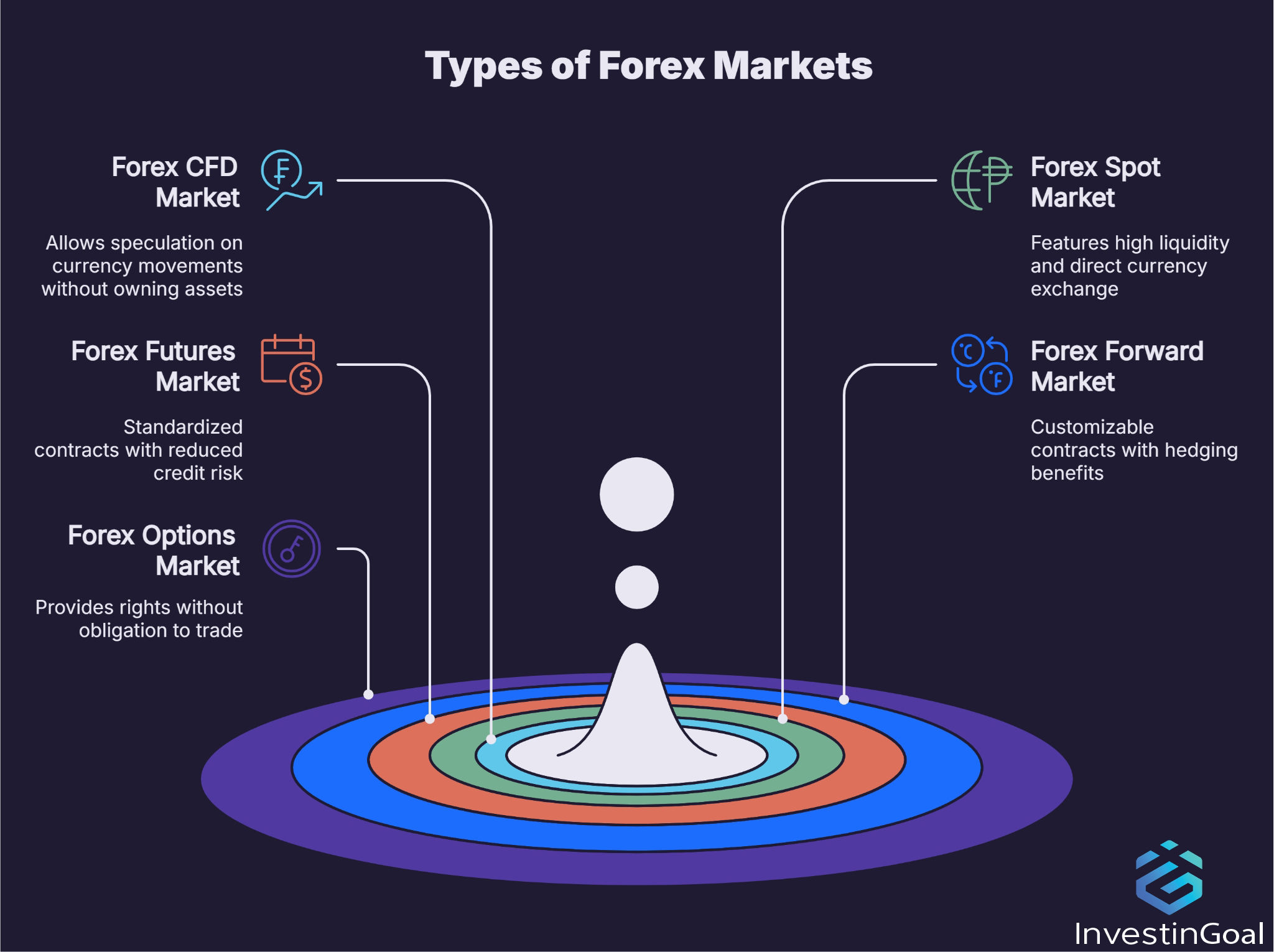
A useful question to carry through the lesson is: If I enter this arrangement, am I exchanging currency, obliged to exchange later, entitled to choose whether to exchange, or simply settling a price difference?
Spot forex: an exchange at a rate agreed now
In a spot forex transaction, two currencies are bought and sold at a rate agreed for a near-term exchange. If you exchange rupees for USD 1,000 to make a payment, you give up rupees and obtain dollars. The rate is agreed when you make the transaction; settlement—the completion of payment and delivery—may occur later.
“Spot” therefore does not necessarily mean that both currencies arrive at the same instant. Many conventional spot forex transactions settle approximately two business days after the trade, although timing varies by currency pair and arrangement. The essential contrast with a forward is that spot is for near-term settlement, not a rate agreed today for an intentionally distant payment date.
Read the opening of What is a Spot Contract? by Becca Cattlin at IG International for the distinction between agreeing a current rate and completing delivery. This source also discusses trading products based on spot prices elsewhere on the page; those are not necessarily the same as receiving currency.
What is a Spot Contract? All You Need to Know | IG International
Read the opening explanation to separate the time a spot rate is agreed from the time settlement occurs.
Under “What is a spot contract?”, read the opening paragraphs. Stop at the sentence about forex trades taking approximately two days. Focus on the difference between the current rate and later completion of the exchange.
One distinction will prevent considerable confusion later: a product may track the spot exchange rate without being a spot currency exchange. If a platform displays a live currency price, that screen alone does not tell you whether your contract delivers currencies. You must identify the product’s terms.
Forwards and futures: commitments about a future date
Suppose you must pay USD 1,000 in three months. Today’s illustrative rate is 83 rupees per dollar, but you do not know what the spot rate will be when the bill comes due. A currency forward lets two parties agree today on an exchange of currencies at a specified future date and rate. For example, they might agree that you will obtain USD 1,000 in three months for 83,000 rupees. Both parties are committed to the agreed terms.
Why do this? If the spot rate in three months is 86 rupees per dollar, buying USD 1,000 then would cost 86,000 rupees at that illustrative rate. Your agreed forward rate fixes the cost at 83,000 rupees. But if the spot rate falls to 80, you are still committed to paying 83,000 rupees rather than buying at the now-cheaper spot rate. A forward can remove uncertainty about that payment’s exchange rate; it does not guarantee the best rate in hindsight. Actual forward rates need not equal today’s spot rate—the numbers here isolate the effect of the commitment.
Forwards are usually privately negotiated. The parties can arrange an amount and date suited to a particular payment, subject to what a provider will offer. That flexibility comes with dependence on the agreed counterparty and its ability to perform. Collateral or other safeguards may be required; “privately negotiated” does not mean “risk-free” or “always free of upfront requirements.”
A currency future also commits parties to terms connected to a future date, but the contract is standardized and traded on an exchange. The exchange specifies features such as contract size and expiry dates. That makes contracts of the same type easier to trade with other market participants, though a standard size or date may not match your USD 1,000 bill exactly. Depending on the contract, final settlement may involve delivery or a cash payment; traders can often close a position before expiry instead.
Watch CME Group’s Differences Between Futures and Forward Contracts for the common commitment and the contrast between a tailored private agreement and a standardized exchange-traded one.
Differences Between Futures and Forward Contracts
CME Group’s short explanation helps you identify what forwards and futures share before comparing how they are arranged and traded.
Watch the shared commitment, then skip to the main differences. Focus on private negotiation versus exchange standardization and clearing. Treat the video’s absolute language about clearing eliminating counterparty risk as a simplification: clearing greatly reduces that risk, but does not remove every risk.
Futures introduce another practical difference: margin. A futures trader typically deposits funds as a performance bond rather than paying the entire value of the currencies represented by the contract upfront. Gains and losses are credited or debited as the position is marked to market. Consequently, an unfavorable move can require more funds before the contract expires. Posting a smaller amount of margin does not make the underlying exposure small.
The Trader’s Guide to Futures from CME Group explains that distinction. Its examples include assets other than currencies; focus on the contract mechanics, which also matter for currency futures.
[PDF] A Trader's Guide to Futures - CME
Read CME Group’s explanation of futures margin and marked-to-market gains and losses. This clarifies why margin is not a purchase price or a cap on possible losses.
In Section 3, “Why Trade Futures?”, read the margin explanation on p. 10, from “Leverage on futures contracts” through the point that a small deposit can control a large contract value. Then, on p. 11, read daily settlement, from the comparison with stock margin through the explanation of credits and debits. Notice that the performance bond is not partial payment for the underlying asset.
Neither contract type belongs exclusively to speculators. A business might use a forward to make a future bill more predictable. Someone else might trade a future to seek a gain from an exchange-rate move. The purpose of the trade and the type of contract are separate questions.
Options: a right for the buyer, not a requirement
A forward or future creates a commitment. A currency option works differently for its buyer: it grants a right, but not an obligation, under stated terms.
A call option gives its buyer the right to buy the underlying currency at a specified rate, called the strike. A put option gives its buyer the right to sell it at the strike. The buyer pays an upfront premium for that choice. If the option is exercised, the seller—also called the writer—has the corresponding obligation. Whether an option can be exercised before expiry or only at expiry depends on its terms.
Return to the hypothetical USD 1,000 payment. Suppose you buy an option giving you the right to obtain USD 1,000 at 83 rupees per dollar, and its total premium is 1,000 rupees. If the spot rate at the relevant time is 86, exercising the option would cost 83,000 rupees for the dollars, plus the 1,000-rupee premium already paid. If the spot rate is 80, you could instead let the option expire and buy dollars at that cheaper spot rate—but you do not recover the premium. This illustrates the option’s trade-off: choice instead of a fixed commitment, at a cost.
That example assumes an option settled by exchanging currencies. Some currency options instead settle in cash. In that case, an option payoff may help offset the cost of buying dollars, but the option itself does not hand you the dollars needed for a bill. A buyer of a plain, standalone option can generally lose the premium paid plus transaction costs; an option writer’s potential losses can be much larger.
Watch the options portion of Derivatives Trading Explained by The Rest Of Us. The video uses a non-currency example, so translate “underlying asset” into “currency” as you watch.
This segment explains why paying a premium for a choice differs from entering a binding forward or futures contract.
Watch option rights. Pay particular attention to who pays the premium, who gets the choice, and the difference between a put’s right to sell and a call’s right to buy. For currency products, remember that delivery versus cash settlement depends on the contract.
CFDs: a contract on a price difference
A contract for difference, or CFD, is an agreement whose gain or loss is based on the change in a referenced price between opening and closing the position, subject to the contract’s terms and costs. A forex CFD might reference the movement of a currency pair. Opening that CFD does not, by itself, exchange the two currencies or give you dollars for a supplier.
For example, if you take a CFD position that benefits when the dollar rises against the rupee, you may gain if the referenced price rises and lose if it falls. Your outcome is settled as a monetary difference under the provider’s contract, not by receiving the dollars in the pair. This is why “I traded USD against INR” would be incomplete: did you convert money, or enter a price-based contract?
Forex CFDs are commonly offered through a provider rather than as standardized exchange-traded currency futures. They often permit leveraged positions, so a deposit can support exposure larger than the amount deposited; adverse price moves can therefore produce substantial losses. Contract terms, charges, and protections vary. A CFD referencing a spot forex price remains a CFD, not a conventional spot exchange.
There is also a boundary between understanding these global product types and being permitted to trade a particular product or currency pair through a particular platform. Do not infer legal access from a product appearing in an app or an educational example. A later module will cover how to check the applicable rules and authorized venues before considering a real trade.
Compare what you actually hold
The quickest way to identify a product is to ask what happens after you enter it.
| Product | What you enter into | Defining feature |
|---|---|---|
| Spot forex | A near-term currency exchange | The currencies are exchanged at an agreed spot rate, with settlement typically shortly afterward. |
| Currency forward | A privately negotiated future exchange agreement | Both sides commit; amount and date can be tailored. |
| Currency future | A standardized, exchange-traded future contract | Both sides take on contract obligations; margin and ongoing gains or losses matter. |
| Currency option | A contract granting a right to its buyer | The buyer pays a premium for the choice to exercise under the option’s terms; the writer takes on an obligation. |
| Forex CFD | A contract based on a currency price change | The position settles a price difference; it does not itself deliver the currencies. |
Two distinctions matter especially for a beginner. First, a future is not simply a forward with a different name: standardization, exchange trading, clearing, and margin change how the position is held. Second, a quoted forex price does not identify the product. Spot currency exchange, a futures contract, an option, and a CFD can all refer to currency values while giving you different rights, obligations, costs, and risks.
Bringing the ideas together
Spot forex addresses a near-term exchange. Forwards and futures involve commitments tied to a future date, with forwards typically tailored between parties and futures standardized for exchange trading. An option buyer pays for a choice rather than a requirement to exercise. A CFD provides exposure to a price difference without itself exchanging currencies.
You do not need to choose among these products yet. The important skill is to look past the label “forex” and identify what is being exchanged or settled, when, and who is obligated. In the next lesson, you will meet the participants—such as banks, businesses, funds, brokers, and individual traders—who use and provide access to currency markets for different reasons.