Recommended resources
The freely available resources this lesson will direct you to.
- Forex Trading Sessions: Best Pairs & Strategies for Asian, London & NY!www.youtube.com
- Forex Market Sessions Explained | Know When To Trade and When To Stay Away from the market. FX202www.youtube.com
- Strategies and tips on navigating the forex spreadwww.ig.com
- Best Times of Day to Trade Forex - Babypips.comwww.babypips.com
Hello again. In the previous lesson, you placed the Sydney, Tokyo, London, and New York sessions on an IST clock. Their hours are approximate periods of regional activity, not four separate markets that switch on and off. Now we can ask what changes when two of those periods run at the same time.
This lesson connects session overlaps to three ideas you will encounter throughout trading: liquidity (how readily a currency can be traded), the spread (the gap between buying and selling prices), and volatility (how much prices move). Understanding the connection will help you interpret market conditions. It will not, by itself, tell you whether to place a trade.
Why an overlap can change market conditions
An overlap is simply a period when participants in two financial centres are active at once. For example, during part of the London afternoon, New York’s working day has begun while London’s has not yet ended. Banks, businesses, funds, and other participants across both regions may then be seeking prices.
More activity often means more liquidity: it may be easier to buy or sell without your transaction moving the price substantially. But activity and liquidity are not identical. A market can be busy while dealers are reluctant to quote large amounts at stable prices, especially around unexpected news.
Liquidity helps explain the bid–ask spread. A dealer’s bid is the price at which it will buy a currency; its ask is the price at which it will sell. The ask is normally higher. In a purely illustrative quote, a bid of 1.1000 and an ask of 1.1002 have a spread of 0.0002 in the quote’s price units. You will learn to read these quotes and measure trading costs precisely in the next module.
When more dealers and customers are active, competition and the availability of counterparties often make spreads narrower. That is why a liquid overlap can offer a lower quoted cost than a quiet period for the same currency pair. A narrower spread is not a promise of profit: the price still has to move favourably, and conditions can change before you close a position.
Read the two indicated parts of IG’s Strategies and tips on navigating the forex spread. They link spreads to liquidity, volatility, news, and time of day. Focus on those relationships rather than treating its description of an “ideal” trading time as advice to trade.
Strategies and tips on navigating the forex spread
IG explains why the spread you see is not fixed throughout the day.
In “Keeping an eye on factors that affect the size of the spread,” start with the sentence about checking the spread when opening and closing a trade. Read the three factors, ending with the bullet about providers widening spreads before news. Then go to “Trading during key times of the day.” Read the session comparison, stopping after the observation about narrower spreads during the London–New York overlap. Use the session hours from the previous lesson rather than the clock time stated after that passage.
The main overlaps on an IST clock
The previous lesson’s session windows let you find an overlap by looking for the hours that both sessions share. The examples below show why there is no single year-round IST timetable for every overlap.
| Overlap | Illustrative shared hours in IST |
|---|---|
| Sydney–Tokyo | 5:30 am–12:30 pm when Sydney is on standard time; 5:30 am–11:30 am when Sydney observes daylight saving |
| Tokyo–London | 1:30 pm–2:30 pm when London is on standard time; 12:30 pm–2:30 pm when London observes daylight saving |
| London–New York | 6:30 pm–10:30 pm when both cities are on standard time; 5:30 pm–9:30 pm when both observe daylight saving |
London and New York change clocks on different dates, so their shared hours can differ during the intervening weeks. These are approximate activity windows, not guaranteed hours for a particular broker or exchange-traded product.
The overlaps also differ in who is active. Sydney–Tokyo can bring together participants dealing in currencies such as the Australian dollar and Japanese yen. Tokyo–London is comparatively brief, though its length changes with London’s clock; it can mark a transition from Asian to European activity. London–New York is generally the busiest overlap for heavily traded pairs such as EUR/USD, because two major financial centres are active together. “Busiest” is a useful general description, not a guarantee about every pair on every day.
Babypips’ Best Times of Day to Trade Forex compares the Tokyo–London and London–New York overlaps. Read its descriptions of participation, liquidity, spreads, and possible price movement. Treat its stated clock times and durations as examples: as you have seen, the overlap you observe in IST depends on the date.
Best Times of Day to Trade Forex - Babypips.com
Babypips contrasts a relatively brief overlap with the usually busier London–New York period.
Under “Tokyo – London Overlap,” begin at the sentence defining when both sessions are active. Read the comparison through the bullet on economic data. Then, under “London – New York Overlap,” read its market characteristics through the economic-releases bullet. Notice that high liquidity, narrow spreads, and substantial price movement are discussed together, but are not the same thing.
Why a liquid period can also be volatile
At first, two claims may seem contradictory: an overlap can bring better liquidity and narrower spreads, yet also more volatility. The distinction is between the ease of trading at a given moment and how far prices change over time.
Volatility describes the size or frequency of price changes; it does not mean that prices must rise. When London and New York are both active, many participants may adjust positions or react to information. Prices can therefore move quickly even while numerous dealers are quoting them. Conversely, if buyers and sellers are closely balanced, heavy activity need not produce a large price move.
The supplied chart offers a visual illustration. Its coloured areas show an activity profile for the six currency pairs named in its legend, alongside bars indicating sessions. Look for the pronounced expansion around the London–New York overlap. Do not read the percentages as a measurement of all global forex trading: the decentralized market has no single comprehensive trading-volume counter. The chart also does not identify its clock’s time zone, so use the IST timetable above—not its numbered hours—to schedule your observations.
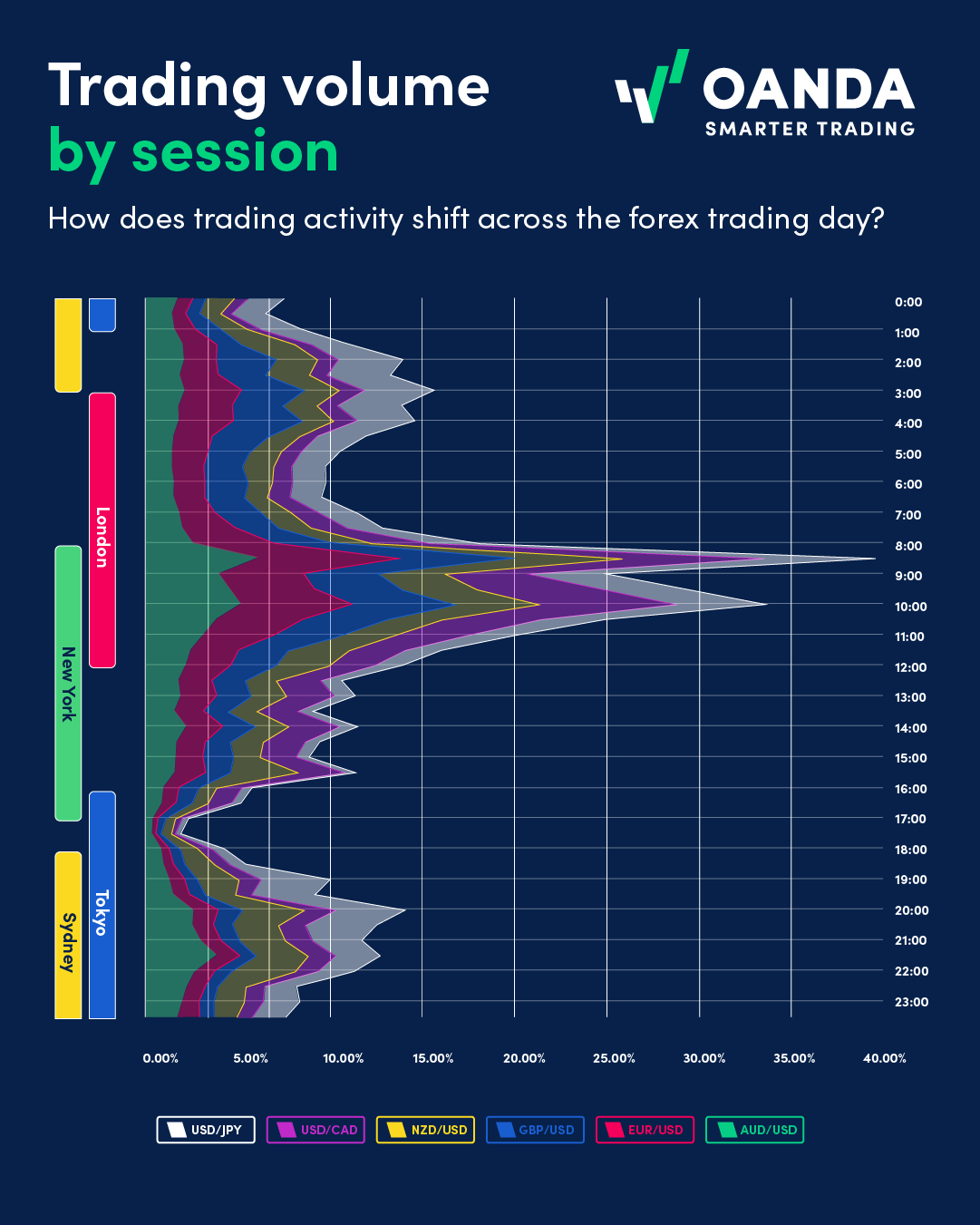
An overlap’s usual pattern can also break down. Before or just after important news, prices may move rapidly while liquidity providers widen their spreads to manage risk. A holiday can leave a normally active session quieter than expected. And an actively traded major pair may have very different conditions from a less frequently traded pair at the same hour. Always distinguish the usual session pattern from the conditions actually available for a particular pair and quote.
There is one further reason to be cautious with “best time to trade” claims. A narrow spread reduces one potential cost; it does not predict the direction of the next price move. Greater volatility creates the possibility of larger moves in either direction and can make a short-term decision harder, not easier. Later modules will cover how to assess trading costs, execution, and risk before considering a day-trading plan.
Key takeaways
When sessions overlap, participation often increases. For heavily traded currency pairs, that can mean greater liquidity and narrower bid–ask spreads. The London–New York overlap is generally an especially active example. Volatility may rise too, because more participants are trading and responding to information—but high activity does not guarantee a large move or a particular direction.
Session hours are approximate and shift in IST when some cities change clocks. News, holidays, the currency pair, and the quote available at that moment can matter more than the session label alone. Next, you will examine why someone exchanges or trades currencies in the first place: currency conversion, hedging, speculation, and arbitrage.