Recommended resources
The freely available resources this lesson will direct you to.
- Forex Hedging for Absolute Beginners: Start With Zero Experiencewww.youtube.com
- Hedging, Speculation, Arbitrage and Currency Swapwww.youtube.com
- [PDF] CHAPTER I FOREIGN EXCHANGE MARKETS The international ...www.bauer.uh.edu
- Cross Currency Transaction - Overview, Uses, Role in Arbitragecorporatefinanceinstitute.com
Hello again. In the previous lesson, you saw how session overlaps can change liquidity, spreads, and volatility. Those conditions matter because people come to the currency market for different reasons. A business paying an overseas supplier is not trying to accomplish the same thing as a day trader—even if both buy the same currency at the same time.
This final lesson of the module distinguishes currency conversion, hedging, speculation, and arbitrage by the purpose of the transaction and the risk it creates or reduces. It gives you a way to ask a useful first question whenever you encounter a forex trade: What is this participant trying to do?
Currency conversion: obtaining money you need
Currency conversion is exchanging one currency for another to make a payment or hold funds in that currency. Suppose a business must pay a supplier US dollars. If the available exchange rate is rupees per dollar, obtaining the dollars would cost rupees, before any fees. The business needs dollars to settle a bill; it does not need a prediction about where the exchange rate will go next.
Individuals may convert currency for travel or overseas purchases. Businesses may convert it to pay suppliers or receive revenue from customers abroad. Conversion can also be one step within an investment or trading strategy, but a payment-driven conversion is not, by itself, a speculative trade.
Read the beginning of Corporate Finance Institute’s Cross Currency Transaction for a short account of conversion. It also introduces cross-currency pairs: pairs that do not contain the US dollar. You do not need to memorize pair names yet; the next module will teach you to read them.
Cross Currency Transaction - Overview, Uses, Role in Arbitrage
Corporate Finance Institute explains how exchanging currencies supports transactions involving more than one currency.
In “What is a Cross Currency Transaction?”, begin with the sentence “A cross currency transaction involves the use of more than one currency.” Read the opening explanation through the sentence about the rise of cross-currency pairs, then read the following sentence defining such a pair. Stop before “When Are Cross Currency Transactions Used.” Focus on the payment or exchange need, not on a trading opportunity.
Conversion answers “What currency do I need?” It does not necessarily answer “What if the rate changes before I need it?” That second question leads to hedging.
Hedging and speculation: opposite aims toward currency risk
Imagine the business owes dollars three months from now. It does not yet know how many rupees those dollars will cost on the payment date. At rupees per dollar, the bill would cost rupees; at , it would cost . This uncertainty is currency exposure.
A hedge is a transaction intended to reduce the effect of an exchange-rate change on an exposure the participant already has or expects. For illustration, suppose the business agrees today to buy its dollars in three months at a forward rate of rupees per dollar. Its exchange cost under that agreement is rupees, regardless of whether the future spot rate turns out to be or . The hedge protects against a rise to , but it also gives up the benefit of buying at . It manages uncertainty; it does not guarantee the cheapest possible outcome.
A speculator deliberately accepts exposure to an uncertain exchange rate in the hope of profit. Someone who buys dollars solely because they expect the dollar to rise against the rupee is speculating. If it falls instead, the position can lose money. Buying dollars is therefore not automatically “conversion” or “speculation”: the reason for buying them, and any other exposure the buyer holds, determine the distinction.
Watch Dr Shabeer K P’s explanation of hedging and speculation. Its importer example is especially helpful for separating a currency need from a forecast. The video uses a forward contract to illustrate both activities; neither activity is limited to forward contracts.
Hedging, Speculation, Arbitrage and Currency Swap
In Hedging, Speculation, Arbitrage and Currency Swap, Dr Shabeer K P contrasts reducing an existing exchange-rate risk with taking one on for potential profit.
Watch the importer hedge for the future payment example. Then watch the speculation contrast, stopping as the explanation moves on to other categories of speculation. Focus on why each participant enters the contract. Treat the example rates as hypothetical, not as current prices.
The same forward purchase of dollars could serve either purpose. For the business with a dollar bill, it offsets a payment risk. For a person with no dollar obligation who enters it to profit from a forecast, it creates a position exposed to that forecast being wrong. Hedging may also be partial: protecting only some of a future payment leaves some currency risk in place.
Arbitrage: looking for an existing price discrepancy
Speculation generally depends on a favourable future price move. Arbitrage instead seeks to benefit from a price discrepancy available at the same time.
For a simple illustration, suppose one provider will sell you a euro for dollars while another will buy a euro from you for dollars. If both executable quotes really are available simultaneously for the amount you want, buying from the first and selling to the second produces a gross difference of dollars per euro. That is the idea of arbitrage across two providers.
The word executable matters. A displayed price may change before the second transaction is completed; the quoted size may be too small; fees may exceed the apparent gain; or you may not be able to trade at both venues. An apparent arbitrage is not a guaranteed profit. As participants act on discrepancies, their buying and selling also tend to make the discrepancies disappear.
Triangular arbitrage uses three currencies rather than two providers’ prices for one pair. It begins and ends in the same currency. If the amount received at the end exceeds the amount committed at the start, after all costs, the three exchange rates have presented an opportunity.
Read Corporate Finance Institute’s triangular-arbitrage explanation for the three-transaction structure. It also notes why such discrepancies tend to be rare.
Cross Currency Transaction - Overview, Uses, Role in Arbitrage
Return to Corporate Finance Institute’s Cross Currency Transaction to see how three currency exchanges can form a complete arbitrage route.
In “How Do Cross Currency Transactions Play a Role in Arbitrage?”, start with “Cross currency transactions can be used as part of one’s arbitrage strategy” and read the explanation through the sentence returning to the first currency. Stop before the example beginning “For example, suppose an investor”. Focus on why the final transaction must bring you back to the currency you started with.
Here is a deliberately simplified numerical route. Suppose the executable rates available at one moment allow dollars to buy euros, those euros to buy pounds, and those pounds to buy dollars. Ending with dollars gives a gross difference of dollars. To determine whether it is a real opportunity, you would still need to check all transaction costs, available trade sizes, and whether every exchange can be completed at those rates.
The supplied image shows the shape of a triangular route, but it is not a reliable worked calculation:
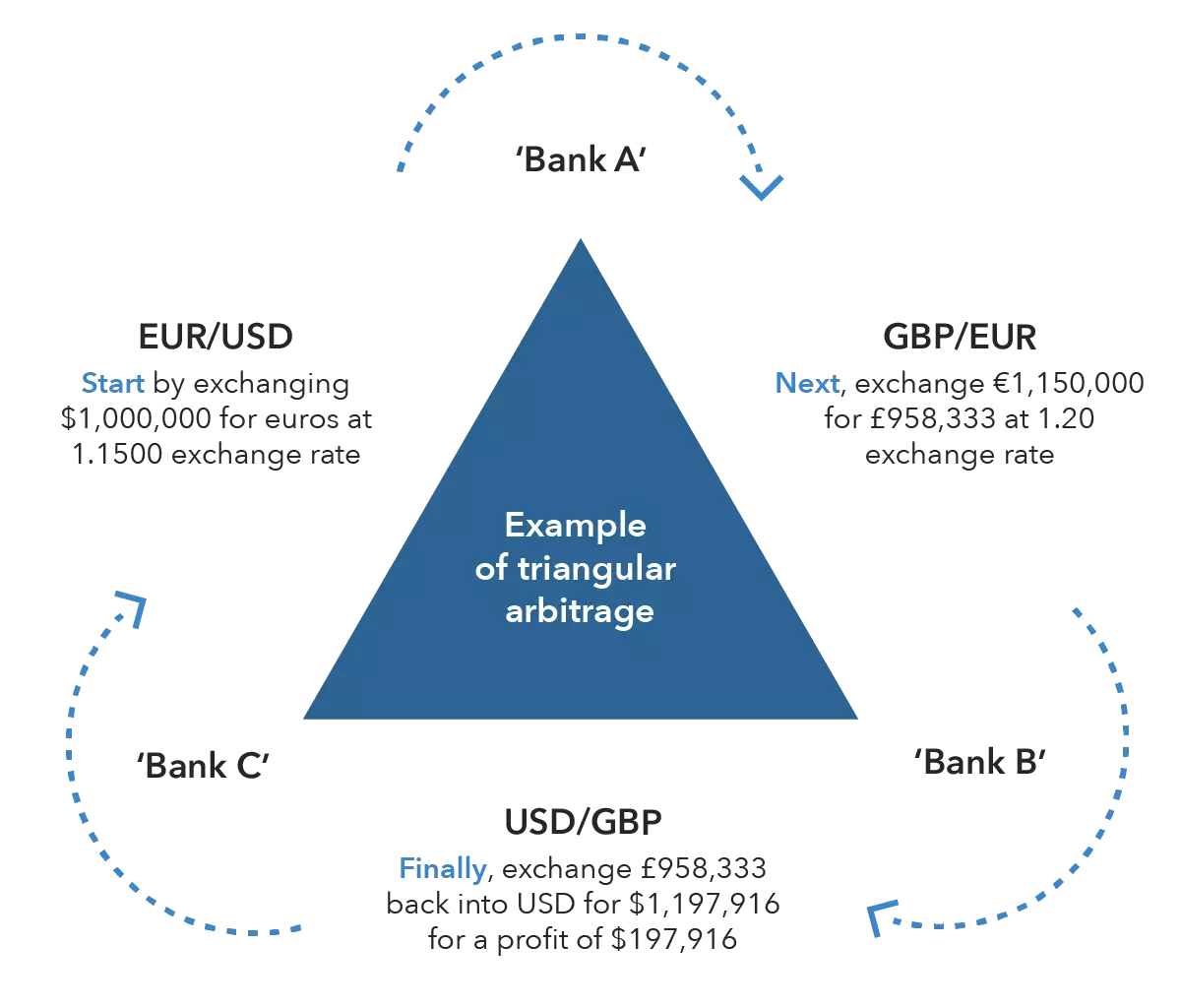
The image labels its first rate EUR/USD 1.1500. Under that pair convention, one euro costs dollars. Thus dollars would buy about euros, not the euros used in the image’s next step. You cannot establish its claimed profit by following those figures. This is a valuable check to carry forward: an arbitrage diagram must use consistent currency units as well as plausible prices.
One transaction can have different meanings
The labels describe purposes and exposures, not four mutually exclusive types of currency instrument.
| Activity | Main question | Relationship to exchange-rate risk |
|---|---|---|
| Currency conversion | “How do I obtain the currency I need?” | May complete a payment; a future payment can still be exposed until its rate is fixed. |
| Hedging | “How can I reduce the risk of an existing or expected exposure?” | Offsets some or all of that exposure, often giving up a favourable outcome too. |
| Speculation | “Will a price change in my favour?” | Takes on currency exposure in pursuit of profit and can incur losses. |
| Arbitrage | “Are prices inconsistent right now?” | Attempts to exploit a simultaneous discrepancy, subject to costs and execution risk. |
A business might convert currency to pay an invoice and hedge the invoice beforehand. A trader attempting triangular arbitrage also converts currencies, but the purpose is to capture a pricing discrepancy, not to make an overseas payment. This is why looking only at a buy or sell instruction cannot tell you the whole story.
For your eventual interest in day trading, the distinction is particularly important: a day trade placed to profit from an expected price move is generally speculation, even when the trader calls a risk-control measure a “hedge.” Neither an active session nor a narrow spread changes that basic purpose.
Key takeaways
Conversion obtains currency for a need. Hedging reduces an exposure that already exists or is expected. Speculation accepts exposure in pursuit of a favourable price move. Arbitrage seeks a discrepancy among prices available at the same time. The same currency transaction can play different roles depending on what else the participant is doing.
That completes the module’s view of who participates in forex, when market conditions can change, and why participants transact. Next, you will learn to read a currency pair precisely—including why the order of currencies matters when checking a quote or a calculation.