Recommended resources
The freely available resources this lesson will direct you to.
Hello! Last time, you tracked tensors by shape, dtype, and device. Now those checks become a way to read model code: integer token IDs enter an embedding layer, and floating-point vectors leave a linear layer as scores for every token in the vocabulary.
This lesson builds a small, runnable version of that path. It is not yet a useful language model—the missing ingredient is a way to combine information from earlier tokens—but it establishes the input and output layers you will encounter in Llama-style models. Allow about 40 minutes, including the short video, two focused readings, and time to run the code.
From an ID to a vector
A token ID is an index, not a numerical description of a token. If cast has ID 2 and heal has ID 3, the difference between those numbers says nothing about their meanings. An embedding layer instead maintains a table with one learnable vector per vocabulary entry. Given ID 2, it retrieves row 2.
Watch this brief demonstration before writing any code:
torch.nn.Embedding explained (+ Character-level language model)
Watch torch.nn.Embedding explained (+ Character-level language model) by mildlyoverfitted for a concrete view of an embedding as a row-lookup table.
Watch the table explanation for the two constructor arguments and what each row represents. Then watch the lookup demonstration, stopping before the discussion of optional embedding settings. Notice that the stored table is a trainable parameter, while the input consists of indices selecting its rows.
If the vocabulary contains tokens and each vector has values, nn.Embedding(V, D) stores a weight table of shape . For an input of shape —batch size , sequence length —the output has shape . PyTorch replaces each ID with its corresponding row while preserving the batch and sequence axes.
Read the embedding implementation and shape example in the Hugging Face guide. Its example assumes a tokenizer defined earlier in the article; for this lesson, focus on the layer and shapes rather than trying to run that excerpt independently.
A Walk With Embeddings: A Visual Guide to a Decoder-only Transformer
In A Walk With Embeddings, published on Hugging Face by velmen, the token-embedding section connects the lookup-table idea to a decoder-only model.
Under “embeddings,” find the torch.nn.Embedding() subsection. Read the layer explanation, from the opening discussion of token IDs through the description of selecting rows in TokenEmbedding.forward. Then, under “Let's take intermediate stock,” read the shape example through the question following its output. Focus on why one batch of eight IDs produces a tensor with shape (1, 8, 256).
“Learnable” does not mean that a newly created embedding already encodes useful semantics. Its entries begin with initialized values and acquire useful structure through training. In the example below, we will set values by hand so that every lookup is easy to verify.
From a vector to vocabulary scores
An embedding gives us numbers at each position, but a next-token predictor needs one score per possible next token. A linear layer performs that projection:
where has values, has shape , and the output has values. PyTorch expresses this as nn.Linear(D, V). It applies the same projection to the last axis of its input, so a tensor becomes without your having to flatten the batch or sequence axes.
Each output value is a logit: an unnormalized score associated with one vocabulary ID. Logits are not probabilities and need not lie between zero and one. If we use the scores at position to predict the token after position , there is one candidate score for each of the tokens.
In the same Hugging Face guide, look only at the output projection; the intervening transformer blocks are for a later module.
A Walk With Embeddings: A Visual Guide to a Decoder-only Transformer
Return to A Walk With Embeddings to see where the vocabulary projection sits in a fuller model.
In “5. Putting everything together: The birth of MiniGPT,” read the head description. In the MiniGPT code immediately below, find the line defining self.lm_head = nn.Linear(model_dim, vocab_size, bias=False); near the end of forward, inspect the final projection. For now, treat the blocks between embeddings and this head as the part that prepares a context-aware vector.
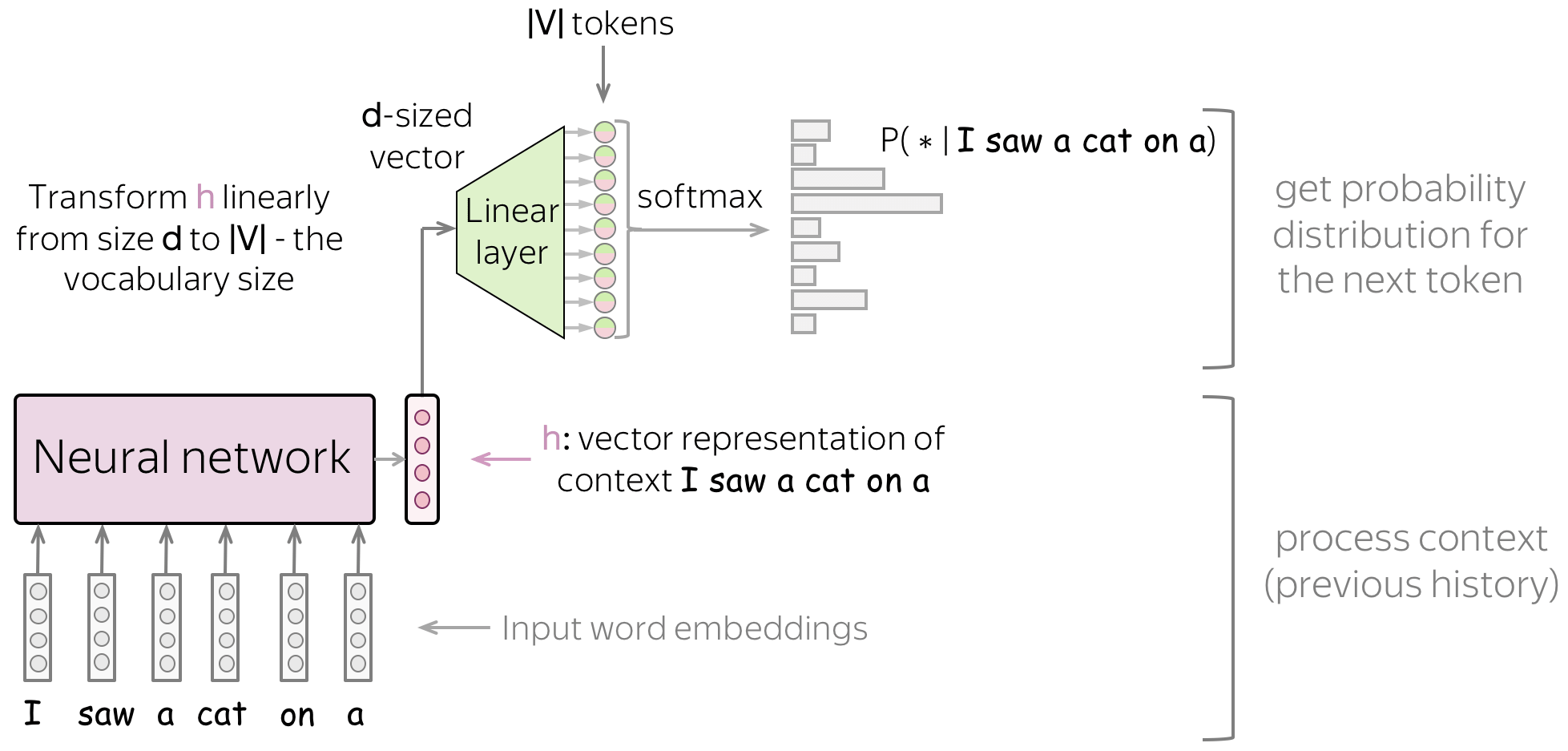
That distinction matters: the output head has the same basic job in our small example and in a full model, but the vector it receives is much more informative after a model has processed the preceding tokens.
Build and trace the two layers
Run this on the CPU; it needs only PyTorch. The vocabulary is deliberately tiny and the weights are set by hand. Here I, cast, and heal are readable stand-ins for tokens—real tokenizers can also produce pieces of words and special tokens.
import torch
from torch import nn

vocab = ["<eos>", "I", "cast", "heal", "fireball"]
vocab_size = len(vocab)   # V = 5
model_dim = 2             # D = 2

# Two sequences, each containing three token IDs.
ids = torch.tensor([
    [1, 2, 3],            # I cast heal
    [1, 2, 4],            # I cast fireball
], dtype=torch.int64)

embedding = nn.Embedding(vocab_size, model_dim)
head = nn.Linear(model_dim, vocab_size, bias=True)

# Fixed values make the lookup and projection inspectable.
with torch.no_grad():
    embedding.weight.copy_(torch.tensor([
        [ 0.0, 0.0],       # <eos>
        [ 1.0, 0.0],       # I
        [ 0.0, 1.0],       # cast
        [ 1.0, 1.0],       # heal
        [-1.0, 1.0],       # fireball
    ]))
    head.weight.copy_(torch.tensor([
        [ 0.0, 0.0],       # score for <eos>
        [ 0.0, 0.5],       # score for I
        [ 1.0, 0.0],       # score for cast
        [ 0.0, 1.0],       # score for heal
        [-1.0, 2.0],       # score for fireball
    ]))
    head.bias.zero_()

vectors = embedding(ids)
logits = head(vectors)

print("IDs:      ", ids.shape, ids.dtype, ids.device)
print("vectors:  ", vectors.shape, vectors.dtype, vectors.device)
print("logits:   ", logits.shape, logits.dtype, logits.device)
print("at 'cast':", logits[0, 1].tolist())

assert torch.allclose(vectors[0, 1], embedding.weight[2])
assert torch.allclose(
    logits[0, 1],
    vectors[0, 1] @ head.weight.T + head.bias
)
The shape trace is the core of the lesson:
| Stage | Shape | Meaning |
|---|---|---|
ids |
(2, 3) |
Two sequences of three integer IDs |
embedding.weight |
(5, 2) |
Five stored vectors, each of length two |
vectors |
(2, 3, 2) |
One retrieved vector per input ID |
head.weight |
(5, 2) |
One row of projection weights per output token |
logits |
(2, 3, 5) |
Five candidate scores at every position |
The ID tensor is torch.int64, while the embeddings, weights, and logits are floating-point tensors. The modules and IDs all remain on the CPU in this script. If you later move these layers to an accelerator, move the input IDs to that same device before calling the embedding layer.
You can verify one projection without trusting the printed tensor. At position 1 of the first sequence, the input ID is 2 (cast), so its retrieved vector is . The fireball row of head.weight is , and its bias is zero. Thus its logit is
The printed scores at that position, ordered like vocab, are [0.0, 0.5, 0.0, 1.0, 2.0]. The largest belongs to fireball. This is a consequence of the hand-set weights, not evidence that the model has learned to finish a sentence. Also notice the layout of head.weight: although nn.Linear is constructed with input size 2 and output size 5, PyTorch stores its weight as (5, 2)—one row for each output score.
What this small model can—and cannot—predict
The two sequences share I cast but end differently. At the cast position, both receive exactly the same vector and exactly the same logits:
print(torch.equal(logits[0, 1], logits[1, 1])) # True
More importantly, any occurrence of ID 2 would receive those same logits in this two-layer setup, regardless of what came before it. The linear layer acts on each position’s vector separately; neither layer has combined information from earlier positions. You could label its output as next-token scores for a training task, but it cannot yet make those scores depend on the preceding sequence. Llama-style models place context-processing blocks between the embedding and the final vocabulary projection to address that limitation.
At each position, logits[..., j] denotes the score for vocabulary ID j. Choosing the largest score is one possible way to select a token, but there is no need to select one during this forward pass. Keep the raw logits: they are the input needed for the loss calculation in the next lesson.
Takeaways
nn.Embedding(V, D) looks up a length- vector for each integer ID, changing shape to . nn.Linear(D, V) projects each such vector to floating-point logits, changing to . Neither layer, by itself, mixes information across sequence positions.
Next, you will compare next-token logits with the tokens that actually followed and calculate cross-entropy loss and perplexity. That will give us a way to measure predictions before learning how training changes the weights.